LD22 December 16–19, 2011

Lonely God Dude – Post mortem

I haven’t written this yet because ChronoLapse hasn’t been cooperating and I wanted to post my timelapse at the same time. After several days of wrestling with various video programs, I finally got my timelapse video uploaded. If not for the video, enjoy it for the music:

Since I’m sure another wall of text on the front page would be annoying, I’m going to let you hit the break if you want to read on. I’m going to babble on about my life as well, so you are hereby officially warned. 😛


Ludum Dare 22 came at a very interesting time in my life. Midway through fall semester,  I was left with a very now-or-never personal realization: if I don’t get my shit together, I am not going to make it through this computer science program. I got out of high school with a 3.5 GPA, but college is different. For the last two years that I’ve been attending, I’ve been just BARELY getting by in the program. Sure, I would pass some classes with A’s or B’s, but in the spring, for the third time, I will be retaking a class I couldn’t get through the first time around.

Thus, in November, I left my student computer technician job to focus on school. I still didn’t make it through the class I’ll be retaking, but I’m pretty sure I got through my other computer science class. Anyway, the point is I’m at a point where I feel like I need to start moving my life in the right direction, hence my decision to take part in this Ludum Dare. What better way to start moving towards owning your own game studio than getting off your ass and actually making something?

As all of you that have played it are no doubt aware, the game isn’t the best:

  • Very little “gameplay”
  • Difficult to determine the health of the dudes
  • Game becomes literally impossible to progress any further beyond the second evolution in generation 3 due to an unknown bug

Even with all of the bugs in the game and the fact that it is 100% guaranteed not to win, I’m still glad I finished! I tackled this as a solo project, so I did everything myself from scratch:

  • All of the code from scratch (C# with XNA but nothing more)
  • All of the sounds from scratch via sfxr (it works for LD)
  • All of the graphics from scratch in Paint.NET (not the best but this still means I’m working on my graphic capabilities)

Granted, I’m sure none of the stuff I’ve made for this particular Ludum Dare compares to most of the other entries. I’m also fairly certain that next to no one is going to read this. I am perfectly alright with all of that because the completion of this game marks the first “complete” game I’ve made outside of school. However small of a gap it is, I have finally busted a hole in the personal wall preventing me from moving on with some of the major goals in life. There is a very long way to go, but I finally feel like I’ve taken the first legitimate step.

And no, I did not include a damn kitten. 😛

Comments

SonnyBone
24. Dec 2011 · 10:26 UTC
CONGRATS! Keep making games. ALWAYS AND FOREVAHHHHH. Real work is for chumps.

Alone in the unknown Timelapse!

So I finally loaded up Vegas Pro 9 last night and inserted the some 2,537 images that Chronolapse took of my screen during the 72 hour Jam for LD#22. I whacked on some good music, was surprised by how well the tempo of the music and the image changes matched up in places, and published.
My only regret is not capturing Nathan’s screen, as that’s where most of the game’s art happened and a bit of coding, too.

Let’s not regret though, enjoy the timelapse!

http://www.youtube.com/watch?v=N5zSoB9fVCI&feature=youtu.be

Gemclusion Postmortem

Here is the postmortem for our LD22 jam entry : Gemclusion.  This was our second Ludum Dare (this first being LD21), and learning from our experiences from the last one we decided from the beginning to make sure to keep the game simple (K.I.S.S.).

Warmup

This time around we benefited greatly from an accidental warmup contest: Game Prototype Challenge.  It’s another for fun game dev contest, but it’s on a smaller scale than LD (29 entries in the last one).  During the GPC contest, we made a point to keep it simple and have fun with the contest.  This is an important thing to remember when doing these contests.  Too often we get caught up in the malaise of trying to make the ultimate game and forget about having fun.  It was after the GPC contest that we happened to remember that the next LD was starting soon.  Once we realized that LD was coming, we started getting ourselves ready.  The next week or so was spent relaxing and waiting for the Theme.

Theme

During the voting rounds there were main themes that we were hoping for.  In particular, I was hoping that we would get more of an unconventional theme (like midgets) … sadly we will never know that greatness that would have been mighty midget magnets … but I digress.  In the end Alone was chosen as the theme.  Once it was announced, we immediately sprang into action and started talking out some game ideas that would fit an interpretation of Alone.  Since we wanted something unconventional, we decided to stay away from any ideas involving a person being or becoming alone.  It was at this time that we came up with a rough puzzle game idea where the goal was to get a single puzzle piece alone.

A small doodle of our LD22 Prototype

A small doodle of our LD22 Prototype

Prototype

Since we liked the idea we decided to do a quick and dirty prototype.  It would have no effort placed in sounds, art or guis; instead it would focus just on the Gameplay.  So I went to work with the quickness that is afforded to me by my bearded-ness. [PIC] Within moments I had re-made my doodle in Unity [PIC].  Once the level was in place, I was able to quickly get all everything working for the prototype.  It included moving the pieces with the goal of destroying all the pieces but one.  To destroy a piece, you had to move it through an opening and into an invisible wall.  It took about 2 hours to get the prototype completed.

A screenshot of our game in Alpha state.

LD22 Entry - Alpha 0.5

[PLAY THE PROTOTYPE]

Gameplay

Over the span of the weekend, the gameplay was expanded upon a bit.  Most of Saturday morning was spent adding new gameplay elements (warp points, breakable walls, pass-through walls, merging pieces and gate walls).

  • The warp points would teleport a piece from one spot on a level to another.
  • The breakable walls were special wall blocks that would ‘break’ when a piece ran into them.  The walls could be set to take 1 or more impacts before breaking.
  • The pass-through walls looked just like the other wall blocks, but a piece could slide right through them.
  • The merging pieces would allow for pieces to be combined and form a new piece.
  • Then we added gate walls that would only allow certain pieces to pass-through them.
A small doodle of the invisible walls that would destroy pieces

A small doodle of the invisible walls that would destroy pieces


A list of the various gameplay elements

A list of the various gameplay elements

The  rest of Saturday was spent testing the gameplay and trying to come up with level designs.

Sunday morning we realized that we were shooting for too much.  Here we had several different gameplay elements that we were trying to fit into 20 levels.  It was a much bigger task then we were anticipating.  So we changed directions and decided to cut out gameplay elements that a) were not much fun or b) would take too much effort to get the 20 levels done in time.  During this process we also changed the game pretty significantly.  Originally the idea was to get the other pieces to disappear by having them leave the game-board.  After cutting through the game elements, we ended up where you had to merge all the pieces together.  We removed the warp points, breakable walls, pass-through walls and decided to make the levels closed in.  This turned into a really good direction and helped spark a 8+ hr session where were able to create all 20 levels.

Graphics

Almost all of the graphical work was texture based.  The game only used primitives for the in game items. We didn’t start any work on the GUI / HUD images or the in game textures until Sunday.  We wanted to wait to make sure we had all the gameplay done … after all it’s a game.  While the art makes up 90% of it, that other 10% is very important and often can take more time then the art.

Audio

We originally had planned to make a few different tracks for the game using FL Studio.  Sadly, we haven’t really used it much and we were not familiar enough to get that done.  In then end we used sounds that we already had from a friend and then added him to the credits.

Sleep

We have done several game jams of various lengths (24+ hrs) and several times we made the awesome decision to stay up the whole time.  One time I was awake for 44 1/2 hrs straight … and that includes the 5 – 6 hr drive to and from Pittsburgh (so 10 – 11 hrs driving total) and the time for the competition (it was a 24hr game jam + the time for setting up / packing up + the time for the awards etc).  Nothing I can say will ever describe how bad it sucks to be up for 44 1/2 hrs with all that activity.

So this time around we made sure to go to sleep at a reasonable hour and not try to stay up for the whole weekend.  I can say that it was one of the best decisions that we made this time around.  Some of the better ideas we had with the gameplay came after getting a good nights sleep.  We set clear goals for the day and made sure to get as close as we could before going to bed.

Final Thoughts

So there was our Postmortem for Gemclusion.  Hopefully it was a good read and provided some useful advice to someone for something for some reason … yeah that would be nice :).  Please be sure to play and rate our game.  We are looking for any feedback that we can get that will help improve the game.

We are currently planning on expanding the game and releasing it on PC and/or Android for $1 – $2.  We are not sure how many levels it will have (20 – 50 is probably a good bet) and we are still deciding the gameplay elements (probably some of the originals with a twist + some new ones).  We might also  change the movement a bit to coincide with a phone for the Android version.  Additionally we plan to update the art (both in-game and GUI / HUD items).  It should be a lot of fun.

I will post again with and update when we get things going after the holidays.  Until then have a safe and happy holidays!!

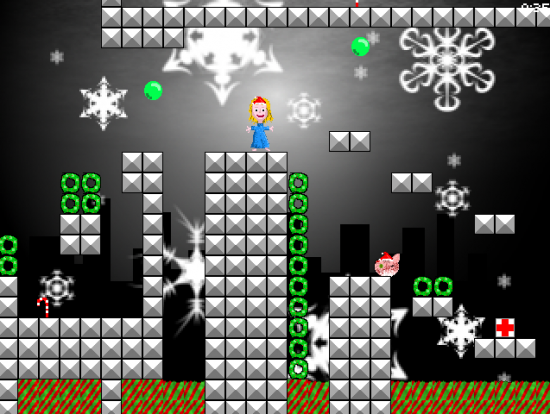
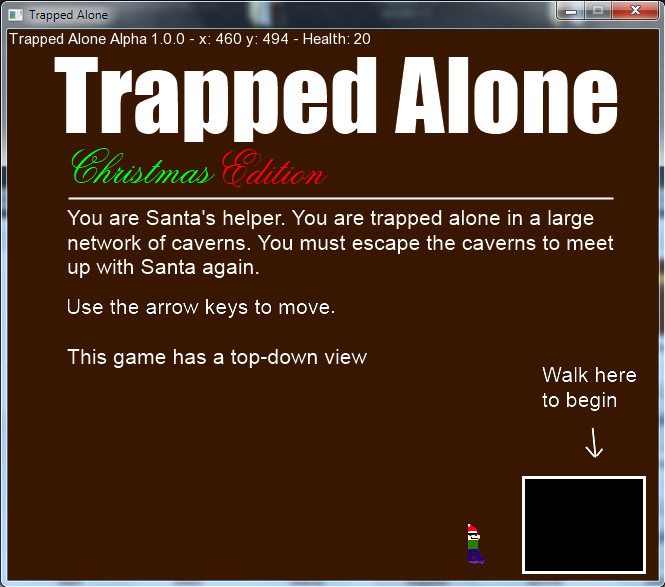
Trapped Alone – Christmas Edition

I have decided to accept bach’s Christmas challenge, so I have edited the sprites/backgrounds of my game to look more like Christmas. I also changed the game’s story.

Play it here: http://www.ludumdare.com/compo/ludum-dare-22/?action=preview&uid=6571

3

This entry was posted on Saturday, December 24th, 2011 at 12:35 pm and is filed under LD #22. You can follow any responses to this entry through the RSS 2.0 feed. You can leave a response, or trackback from your own site.

Loyds Tale Post Mortem.

As posted on my blog at: http://bombpersons.wordpress.com/2011/12/24/loyds-tale-ludum-dare-was-fun/

So I entered the Ludum Jam last weekend with my housemates. We went in completely unprepared with no libraries at all. We made everything from scratch in those 3 days, including a tile engine, all the art, the level loader T_T. We didn’t get too much sleep  haha. You can play our game here. We named our games character Loyd Hasketh as its the first thing a random name generator pumped out. So our game is called Loyds Tale.

This bits actually quite tricky.

Our game idea was that you played a pirate, rabbit .. thing you finds himself ship wrecked on desert island with a mysterious bed in the middle of it. When you wake up from your slumber, the whole island had lifted out of the ocean and turned into a huge tower. You then have to make your way down the tower in a typical platforming fashion.

We made sure to have no other humanoid enemies, in order to reinforce the “Alone” theme. We did add some birds in there to give it some difficulty however.

We used Tiled as our map editor. It’s free, has a nice and easy to load XML map format, and is pretty flexible to use. We did have to resort to some pretty strange ways of inserting entities into the map, but it still worked.

Post Mortem

Day 1

On the first day we focused on getting the tile engine finished. I worked on the map loading whilst the others sorted out the actual drawing of the tiles. At this point our motivation was pretty high, as the code was still reasonable clean. We also wrote a simple entity system to go alongside the map, and created some sprite for the tiles and character.

Day 2

We fleshed out the entity system and the collision for the player (understanding that this is always a big problem in creating platformers we worked on this a lot). I worked on creating some hazards for the player, like spikes and breakable blocks. As the day went on we got less and less motivated. The code was getting messy as we had to hack things in to make them work, it was dawning on us how terrible our game was T_T.

Day 3

Sill demoralized from day 2, we worked on adding more hazards and designing the level. One of our team members had to leave about half way through the day to go home, so it ended up with just two of us adding the finishing touches. I spent most of the day creating the level. As we finally finished the game and submitted it, we could relax. It wasn’t long after that we realized that the game we created wasn’t *that* bad. You know it was passable considering that we created it from scratch in 3 days.

The Good

  1. We got on with it, and finished it within a reasonable amount of time. We didn’t spend to long thinking of the idea and concept.
  2. Using Tiled was a brilliant idea, it saved us a lot of time. We wouldn’t have even considered writing a platformer without it.
  3. XNA was great. We all knew XNA very well as we all have a lot of experience using it. I would have preferred to use something more portable however =(
  4. This is amazing. Bfxr is an improved version of Sfxr which is simply amazing for creating simple sound effects. My friend at university swears by it.

The Bad

  1. We weren’t prepared. We really should have written a library to help us create a game in the weeks before the competition. It would have saved us a lot of time and kept our code more tidy. It wasn’t really feasible to do this time because we had a lot of assignments in the weeks leading up to the ludum dare.
  2. Next time we do the ludum dare, we will definitely try to steer clear of platformers. They are a lot of work to program the back end to (collision mostly), and it is difficult to create unique gameplay using them (our game is pretty generic haha). We would definitely want to do something different in April.
  3. We shouldn’t have resorted to messy code so early. We should have set most of the framework and ideas from the start rather than making them up as we went along. This resulted in horrible code that was painful to debug and lot’s of code repetition.

Other thoughts

Next time we might want to be more active in the community as the we are making the game. Like participating in the IRC channels or creating a timelapse video. Perhaps we will do one of those nextime =)


Alone In A Crowd Postmortem

Re-posted from my blog: http://www.kennygoff.com/post/postmortem-alone-in-a-crowd-ludum-dare-22

Last weekend’s Ludum Dare was, in my mind, the best thus far. For over a year now, I have been trying to get the game development club at my college (SGDC, Stevens Game Development Club) to get together and participate in a Ludum Dare. Well, last weekend it happened! Thanks to a new dedicated room on campus for the club, and me bringing it up at every meeting for a month and spamming our email list with reminders, we had 3 people come by to work on games, and a few other’s come by to hang out and brainstorm. Unfortunately, I was the only one to finish, although one guy made a game on his TI calculator that was pretty cool (he didn’t submit though). Not only that, but I believe this is the best game I’ve made so far in a Ludum Dare, and my time was best spent during the weekend.

The Weekend

When the night first started and the theme, Alone, was announced, I couldn’t think of anything good. I thought of a lonely kitten platformer, but I hated that idea, and wanted to avoid doing a platformer (my fallback game type). I wanted to do something different this time. However, after talking with the guys who were at the SGDC room with me, a few ideas flew around. One being a game where you repulse people, and you have to corner them and make them your friend. Another, where you are trying to be alone, and you have to escape the people following you (basically the opposite of the previous idea). And a few other small ideas came to mind but I liked none of them. It was only about an hour and a half into the competition, and not late at night, so I figured I’ll start programming a simple platformer and make a kitten sprite so I have something to branch off of the next morning. After that it was about 12:00pm EST, and 45 hours remaining. I decided to take the night to sleep it over, as I typically have a better idea in the morning.

I woke up the next morning with a spark that I did not have the night before. It seemed like a more generalized version of the repulsion/attraction ideas. Basically, the game would be top down, with the screen being one room, and the player had to travel through to other rooms, and in each room was a different situation. Each situation would deal with emotions, and specifically for the theme; loneliness, love, togetherness, loss, and some others. I had been playing a lot of Edmund McMillen’s The Binding of Isaac, so I thought of the rooms in the same style as they were in Isaac. One basic rectangular room taking up the screen, with the possibility of one door on any given wall. The difference was, you could not go back through a room you came through.

Once I though of this I immediately got hit with all the different types of rooms I could do. Death, crowds, repulsive to others, getting a girlfriend, and losing a girlfriend were some of the first to cross my mind. I went to go scrap my old platformer and start fresh with this game. I decided to keep everything as different colored squares. This was not placeholder graphics though. I wanted everything to be representational and simple, in order to allow the player to image it all, and put him or herself in the game. Also I’m not that good at drawing top down characters, but I’ll stick with the simplicity angle as the main factor in the decision. The most complex thing in the game was the kitten, who was a small square with big pointy ears and a tail. As I started to put this together I also thought of naming each room something unique and displaying the name of the room on the bottom of the screen (which ended up being the most fun part of coming up with new room … and was totally taken from Terry Cavanagh’s VVVVVV).

I had to take a break during the day because I had a final exam and my roommate and I took a trip to New York City for a couple hours. Once I got back there was just over 24 hours remaining. That was enough time to put together a few rooms, clean up bugs, and submit on time. I ended up with 10 different types of rooms, which are randomly generated when you enter a new room.

What Went Right

  1. This was the first Ludum Dare where I prioritized gameplay over art, and made sure to get everything that was needed for the game to be fun before even thinking about art.
  2. Chose an idea that was easy to implement and rooms took a very short amount of time to create.
  3. Talking to people and going out was an important part in my design process, and the game wouldn’t be where it is without that. I got some good ideas for rooms from my friends in SGDC and my roommate came up with a few good ones, including one of my favorites “Size Does Matter”, where a bigger blue square steals your girlfriend from you.

What Went Wrong

  1. Gameplay relied on a lot of content. Although the rooms were easy to implement, I still needed a lot of rooms to make the game fun, and at 10 room types, I think I was short a few.
  2. No Sounds… again. I didn’t have time to work on sounds or music, and a simple ominous tune would have sufficed for background music.
  3. “The Answer” was kind of controversial, and people seemed to take it to an extreme. That room was a room you could not leave, and had a noose in the center, and when you touched it the game ended with a screen that said “Death: Forever Alone.” This was one of my earlier ideas, and I obviously didn’t think how people would take it. I was not at all trying to imply that I support suicide. It was merely a realistic look at the path some people take when faced with deep depression. I actually planned to add an exit if you didn’t touch the noose after a few seconds and other ways to end the game, including two tombstones if you have a partner, in a room called “Old Age” or something. I simply ran out of time and didn’t have time to implement the different death cases for each setup possible (alone, with girlfriend, with cat).

Looking To The Future

Overall, I think that this was a great Ludum Dare and my best and most unique LD game yet. I want to make a fully realized version of Alone In A Crowd, with a lot of rooms, marriage, divorce, more loss, friends, kids, afterlife, and basically anything in life that could effect a person. I already have 20 or more ideas for rooms, and any time I think about or talk about the game I come up with a new one. The full version of Alone In A Crowd won’t be something I’ll be done with soon. Rather, I’ll be adding to the current version over time, until I feel like I have enough content to release it. I’ll be sticking with doing it in AS3 with flixel, because I think it will be a good online game, and am also considering doing a mobile version, since it is very easy to implement on any platform (and my next few games in mind are going to be mobile and I’ll be in the groove).

I look forward to the future of Alone In A Crowd and the next Ludum Dare, which is the 23rd LD and the 10th Anniversary for Ludum Dare.

Tags: postmortem

Trapped Alone – Postmortem

What went right

  • Images, graphic design.
  • Focus on game (no distractions)
  • Layout of game
  • Knew how to use tools (C++ SDL)
  • Game Story/Planning
  • Timelapse/Livestream

What went wrong

  • Not fully compatible with all platforms (Mac, Linux)
  • Character movement could of been better
  • Lava should have done more damage
  • Could have had more levels
  • Lots of DLLs and other included files
  • Walls should have acted differently (instead of spawning at start of room)

What I will do better next time

  • Try a different programming language that is more universal, easier to use
  • Have less DLLS
  • Graphics could be slightly better
  • Player movement could be better

Overall, it was a great experience to be part of Ludum Dare 22.

Timelapse here: http://youtu.be/qUCHPi0LrXw

Get it here: http://www.ludumdare.com/compo/ludum-dare-22/?action=preview&uid=6571


North Pole Outpost Alone

I accepted the christmas-ify your game challenge.
Changes:

  • Holiday Graphics
  • Christmas Particle Explosions
  • Snow in lieu of stars

Enjoy!
download
 

Greeble – HOLIDAY EDITION

Merry Christmas – Happy Holidays! Just for fun, here is the snowy SANTA version of my LD22 game, Greeble. Can you revive all your Santa Claus clones? Can you find the Christmas Kitty? It was made in HTML5 and runs at 60fps in all recently updated browsers. Enjoy! Hope your holidays are filled with friends, family and fun!

http://www.mcfunkypants.com/LD22/xmas/

Tags: christmas, holiday, html5, post-compo, xmas

XMas fall

I made a xmas theme too for my LD48 entry game.
Check it out: floriaen.fr/thefall

Forgotten Memories: Now with Red!

Everyone seems to be giving their Ludum Dare games a more Christmasy feel, and while it might be hard for me to say this unusually warm weather has me convinced the holiday truly is right around the corner, there’s a bandwagon, and I’m sure as hell going to jump on it.

Thus, I present to you Forgotten Memories: Limited Xmas Edition!


Do fractals more festive than these even exist? If they do, I haven’t seen them. There’s so much red and green up in this that it will melt your face off with Christmas spirit.

I seem to recall some sort of agreement to only spend five minutes on this upgrade, and adding “snow” would go over that. Sorry, but not every Christmas is a winter wonderland. Sometimes you look up at the sky, and it’s all cloudy, and you’re all “oh boy oh boy oh boy”, but then it doesn’t stay just quite cold enough, so you end up with some sort of slush that looks all sorts of ugly and threatens to kill you if you dare try to get on the roads before having dinner with the family, which I imagine is what having in-laws is like.

I wouldn’t know though. I’m all alone.

MERRY CHRISTMAS!


EDIT: Oh right. You know what helps? Actually linking the thing.

http://www.ludexor.net/xmas.php

Tags: christmas

Comments

24. Dec 2011 · 20:22 UTC
I live in Australia so I totally get the no-snow Christmas :) Merry Christmas!

(-o^_^)-o HUG MONSTER <3 YOUR GAMES 5

I’m back with another round of really interesting entries from you!

A Weekend Alone – by NoLan Labs

Did you enjoy your experience making a game for LudumDare?  Do you want to do it again?  Now you can!  Play this LudumDare simulator to balance your need to eat, sleep, and use the toilet and hope you can crank out a finished game for the jam (easy) or the compo (hard).  Easily the most “meta” game I’ve played since Game Dev Story.


Frostbite – by saint11

This game is a really tight package with great pixel art, smooth controls, well-considered level design, and light challenge.  I very much enjoyed the fireside mechanic where you cure your hypothermia and simultaneously stop hallucinating while watching the flames.  An excellent entry and a must-play.

Christmas Eve, the perfect time for the belated post-mortem.

Ah, finally got this out of the way. Was dragging my heels on this post-mortem as I didn’t feel like I had made any significant mistakes this time around, so there wasn’t a ton to reflect on. However, I haven’t had a ton of comments on my entry. So hey, if you’re in the festive spirit, give the gift of criticism!

In between zooming around from NS to NB this past weekend, I knocked out a Ludum Dare game. Neat little randomly generated retro style platformer. Posting this both on the Ludum Dare site and my own blog. So LDer’s enjoy an expository preamble!

Click to play

Preamble

So if you’re unfamiliar with Ludum Dare it’s an online, solo game development competition. They release a theme and you have to develop a game using that theme in a forty-eight hour timeframe.  A large list of themes is created and after a few rounds of voting , the list is culled to a dozen or so final themes to vote on. After the final round of voting is complete, the theme is released and a sleepless, hectic weekend begins. I was rooting for “Randomly Generated” to be selected as the theme and was already salivating at the prospect of making a roguelike.

Over the last few years the only games that really stick out to me as being actually fun and life destroyingly addictive were the new wave of roguelikes. Spelunky, Transcendence, and The Binding of Isaac have taken a mostly inaccessible genre and made it almost casual. If a player can get over how masochistic these games are, it really scratches their drive for mastery. There is nothing that can foster that “Just one more turn…” effect better than these games. But I digress, this is a subject worth a post all on its own.

Spelunky was a harsh mistress

The weekend of this Ludum Dare coincided with a friend’s Christmas party I few hours away. I didn’t want to lose six hours driving back and forth so I opted for twelve hours by train. After packing everything for the trip I settled in and waited for the theme reveal. “Alone” ended up hedging out Randomly-Generated by a few votes.  Even though I was bummed over my pet theme losing, I figured I could still work Randomly-Generated into my concept. What I roughed out, was that you were a monster created by the government, you wanted to escape their pursuit and be left alone. I pegged the gameplay as a platformer with randomly generated level sections. I wasn’t sure about combat and mechanics but I was hoping it’d grow organically throughout the competition. My main goal was to produce something playable that had some random level generation in it.

Could you, would you, on a train?

What went right?

Flixel and Flixel Power Tools

Even with the minor learning curve, Flixel and Photonstorm’s Power Tools were a huge boon. Flixel itself makes blitting ridiculously simple.  Power Tools is so feature rich it covers the majority of your bases. Projectiles, quick controllers, collision, health bars, etc. Really looking forward to having another excuse to play around with Photonstorm’s plug-in, since I’ve only scratched the surface.

Randomly Generated Levels

I feel the time was spent better generating the random levels, than building a few poorly designed levels. As there aren’t a ton of game mechanics the best I could do with level design would have been in the realm of jumping puzzles or a vertical maze. The randomly generated levels toss in a little replay value, and lay a foundation for a roguelike in further development.

In terms of the actual generation it was pretty quick and dirty. Originally I had created a system that would take sections of 5 rows, 10 rows, and 15 rows, each being 13 columns across. You’d pass the length and width (in sections) and it would stitch together the random sections into the full map.

Each section looked like this:

00,00,00,00,00,00,00,05,00,00,02,00,03
 00,00,02,00,00,01,01,01,00,01,01,00,01
 00,01,01,01,00,00,00,00,00,00,00,00,01
 00,00,00,00,00,00,02,00,00,00,00,00,03
 01,03,01,01,01,01,01,01,01,01,01,01,01

00 – Empty, 01 – Solid Tile. 02 – Enemy, 03 – Open Tile to Next Section, 05 – Possible entrance/exit door.

Due to the time constraint I wasn’t able to implement the 10 and 15 row sections. It definitely would have made the levels feel a bit more unique, but I think they come across as pretty varied just using the 5 row sections.

Pixel Art

First time playing around with pixel art, probably could have done better with the tiles, as the thick black outline doesn’t work really well. But otherwise everything turned out pretty swell. Animation was a bit of a pain, but I’m content with the results. The choice to make the main character limbless was a big timer saver.

My easily animated friend...

Organic Evolution of Mechanics

Setting out on Solitude my main goal was a Spelunky-esque platformer, but beyond the randomly generated levels I had no idea on what mechanics I’d need. Plopped in the basic melee attack and ranged attack. Bullet reflection when using a melee attack was a happy accident and a great alternative to making a shielding ability. Flight ended up being an accident as well. The terrain destruction was a response to the possibility of there being no direct path to a level exit.

Roguelike Resource Management

I didn’t have any initial plans for energy consuming attacks, but flight and and terrain destruction were easily abusable. Most roguelikes have a few finite resources that you have to manage I feel like I did a good job of integrating this with energy and life. You can only replenish energy by killing troops, and you need that energy to more easily traverse the level.

It doesn’t have a huge impact in the jam game, but I think it’ll be a much bigger deal if I continue on with development. Using a timer to push the player forward and keep the game fast paced, the health and energy trade off will be one of your main decisions.

Music

If I had hit the 48 hour deadline I definitely would not have had a chance to add music to the game, so the running over the deadline was a blessing in disguise. I had a friend put together my music. Ended up far better than what I could have ever produced, and has the perfect pacing for the game.

What Went Wrong

Time

Everything boils down to lack of time. Sparse mechanics, rough art, no sound, having to enter the 72 hour jam instead of the competition. Being tied up with real-life, and travel.

Arguably you could say my scope, goal, and choice of tech that I don’t have solid experience with is the real problem, but I set out to make a randomly generated game, make some pixel art, and learn Flixel. Those motivations went above making a fun polished game.

Difficulty

Seems to happen with every LD entry, but I think Solitude is too hard. You can only breeze through it once you start abusing mechanics. It’s likely you’ll lose interest in the game before you get that comfortable with the game.

It’s something I’m going to have to be more conscious of when pumping out an LD game. My group of friends aren’t the best for feedback in terms of a game’s difficulty. So maybe I should start harassing folks in IRC during the competition…

Conclusion

Unlike other LD’s there isn’t a ton of reflection to do here.  All in all,  really happy with the result of the LD despite my lack of time. Got to play around with Flixel and got to start off a bit of a roguelike. Woop woop.

Tags: journal, post-mortem, postmortem

A Long Walk Home : Christmas Edition!

Merry Christmas to all!


Just in time for the holiday I was able to change my game A Long Walk Home to be all Holiday Themed. I actually really really like the way the snow falls on the level. I thought about making all the blocks ice blocks, but that would be a little too much of a change from the original code base.


Christmas time!

Christmas Time!


Enjoy you holiday!

http://www.ludumdare.com/compo/ludum-dare-22/?action=preview&uid=8475

Duckling: Christmas Edition

In response to this challenge to Christmas-ify your game, I decided to add some Christmas things to my entry, Duckling.

The ground is covered in snow, the mother duck has a Santa hat and the ducklings have elf hats (including the player), the egg you respawn out of is gift wrapped, and there are other modifications as well. You can play it here.

Now you can admire the Christmas atmosphere as the poor duckling is repeatedly impaled on spikes.

Merry Christmas!


Castaway post-mortem

Ahoy all!

Last weekend I made a compo entry called Castaway.

If you speak French, you might want to read my lengthy writeup on Les Forges. Else, here are the traditional bullet point lists :

What went well

  • Using familiar tools (custom framework, FlashDevelop, HaXe, Photoshop, Reason, etc.)
  • Using project management techniques and tools. I used Asana to handle my ever growing todo list and a mini scrumboard for tracking bugs. Pictures at the end of this post.
  • Recording custom sound effects. This was my first time and I’m very happy with the result (especially since it didnt take long). Picture below.
  • Testing. Two friends came on Sunday evening and played the game again and again to spot bugs. They were the one writing the scrum post-it and it was very useful.
  • Chronolapse. Making a timelapse took no effort and I love the end result.

What went not so well

  • Theme. I did not think long enough of the theme and started working without a clear idea of what my game would be.
  • Time management. I spent too much time working on animations and art assets instead of making content. Look at this 8 frames walk cycle : walk cycle. This is wasted time, lots of it.
  • Balancing. The game is way too hard ; my testers thought it was funny because of it but I should have considered this as alarming.
  • Oops. A critical bug that crashes the game on slow computer was shipped in the compo version. Maybe the test configuration should include a slow computer too.

Pictures

Asana
Asana

Bug tracking scrumboard

Sound design tools
Sound design tools

Even though my game is way too hard, too short and unforgiving, I’m still happy with what I did. I am satisfied I made some art and music that were not 8bit/chiptune over the course of the weekend and more importantly, I had lots of fun. Next time, I will NOT make a sidescrolling platformer, that’s my objective.

Thank you all for reading/playing/rating !

Tags: post-mortem, postmortem

5

This entry was posted on Sunday, December 25th, 2011 at 11:33 am and is filed under LD #22. You can follow any responses to this entry through the RSS 2.0 feed. You can leave a response, or trackback from your own site.

Crawl the Dungeon – Christmas Edition!

Only a few hours ago did I find out about these christmas changes. So I started working on mine, and here’s the result!

It also includes some gameplay changes that I worked on the day after LD22 finished. Also, the nice thing is that editing the content was very easy, but adding separate textures isn’t possible at the moment, so I had to replace the tileset with a new one. Also, I couldn’t save the old content because there’s no way to choose which you want in a level (which you can’t choose either). So there’s still lots of room for improved mod support.

But anyway, enjoy, and merry christmas!

Direct link

Link to the rate page

Flod Embarks – devlog & micropostmortem

So, it’s christmas, I think, and I finally have some time to write a little about my experience with LD#22. My entry isn’t that great, but still, for what it’s worth:

At first I wasn’t even sure if I would participate, due to several reasons, too little sleep in the weeks and days prior to the weekend being one, and an important 30th birthday on saturday night being the second. I usually don’t have a problem with all-nighters and actually can produce results in 20-hour coding stretches with 4 hours of sleep in between, but this time I was just completely burnt out the night when the theme was announced. I tried to stay up until midnight, take a 2 hour nap to recharge my drained batteries and then start crunching once the theme was announced. I failed. I woke up to my alarm, feeling really dizzy and decided to get some more sleep and start in the morning.

Saturday 11 am: Wake up, ouch, it’s late! Check the theme, check IRC, see what people are brainstorming or making, start thinking… 9 hours until I have to go to the party… some time, just need an idea.. alone, lonely. Actually I don’t feel really creative – its so late already…. Mood is very important to me in a game, “Alone” seems to be a theme that can be supported by mood very much. Music! Ages since I composed stuff. Time to try Greasemonkey’s Autotracker. Run it a few times, awesome. But: happy! Not very alone. All I know about python is that shouldn’t mess with the indentation. Mess with autotracker until it produces a sad tune: all minor, less drums, drums pitched down, slower, fiddle with song structure a little. Great, a kind-of-sad tune!  A bit dramatic with the drums kicking in, but I’ll make that fit somehow. Still not many ideas. Let’s draw a little guy, a robot. A lonely robot in space. Walking animation, here we go. It’s really tiny, I’m running out of time. Let’s scale it up by 4: wonderful. Still no real ideas. Maybe I won’t have a submission. Oh, it’s late, time to go to the party!

Sunday noon: Wake up, ouch, it’s late. Need to start on something soon – will have to go minimalistic. If I decide on something now and follow through I can still make it. So far I have awesome sad music and a sad robot. He’s alone in space, maybe he’ll have to find friends. Really no time to make dozens of worlds to get a huge universe for him to feel lonely in… Suddenly: Star Trek The Old Series… they had one cheap studio but with lighting and different coloured ground, rocks and sky created hundreds of possible planets. An idea starts to form in my mind: An “overworld” where you navigate between hundreds of planets, and then planets that just like in star trek are simple stages, where with a combination of sky, background and ground tiles I can create many worlds with drawing only a few tiles. I draw 8 sets of skies + 9 sets of ground, code a state to combine them: works! I have 72 different possible worlds. Wonderful!

Can I make a quick space-overworld? Let’s try, draw a couple of planets, 13.. will do. Draw a spaceship with thrusters on and off. Start coding “SpaceState”. Need stars/space debris to indicate the current velocity of the ship. Easy but… can FlixelPowerTools’ StarFieldFX do the job? Yes! Place 2000 random planets on x/y coordinates between 0 and 50,000. I want the ship to orbit planets – Hmm.. Sir Isaac Newton, what was that again? acc=mass1*mass2/distance^2.. something like that. Will only use gravity from planets near to the player… Works! Nice, have orbiting ship. Need something like a map to help the player not get lost in space. Little dots pointing towards the nearest 3 planets, works, a little buggy, can’t find the bug, bad luck, no time now to fix it… Teleport animation, done. Let’s allow him to teleport down to a planet and up again. Wonderful. Pretty lonely though. A few hours left, I have a universe and 2000 planets you can visit, but nothing else. Finding friends on some of these planets will have to do, since I don’t have any other ideas. Draw some cute aliens. Put one on every third planet. Now my robot can find friends. Oh! I can use one of autotrackers happy tunes to set a happy mood when a friend is found. Great. Let’s put a little more cuteness into it – add “disappointed” animation when youre on an empty planet, head hanging low, works! Cute, wonderful! Check time: 1 hour left! What’s left to do? Menu, name for the robot/game, little bits. Add an over-ambitious title/menu screen.. Need a name for the little guy! Strain my brain to come up with something. Half an hour left, make Flod (the robot) and his friends dance, hihi cute, fix the music code a little, so the sad tune don’t start over all the time, done. T minus a couple of minutes. Perfect. Screenshots, submission, Done. what did I make? It’s not really a game at this point, but it’s interactive and cute. Not gonna win any awards with this but it’s somehow complete in itself, I’m content.

In retrospective:

What went wrong

  • Timing for the LD weekend – Even though I was really looking forward to it, I managed to have my starting conditions screwed up. Had been working full-time during the day and writing an important paper I need for starting my business at night. For the last 4 weeks, every Tuesday night was writing only and no sleep at all, followed by a day of work and an important date. I was really sleepy on friday.. Also this birthday party I just had to attend was well.. bad luck for timing. In the end, the timing issues though helped to produce something focused and minimalistic, since I tried to make something achievable within this limited timeframe.
  • No real ideas – I blame it to myself being really burnt out from the last weeks.

What went right

  • Putting it all together and making something inspite of these limiting factors – Once I somewhat knew what I was doing, I pretty much was crunching away without running into major blockades or bugs. The simple concept of course helped with that, but also my familiarity with my toolchain: Flash Builder, Flixel, TileStudio.

Where I got lucky

  • Autotracker – Without the mood set by the happy tune I got out of the unmodified autotracker and the sad one I abused the program to produce, my entry would have been far less complete and cute.

Overall: Great Fun!

Can’t mention it enough: Thanks to Gresemonkey for Autotracker!!

// empty planet
if(Flod.mood == “happy”) {
Flod.mood = “sad”;
FlxG.playMusic(Flod.SongSad);
}

Tiny planet – Christmas edition

Christmas edition for my game is done! Play it!

Things to do:

  1. Collect all candies.
  2. Sing “Jingle bells, jingle bells”.
  3. Meet the gnome.
  4. Watch a garland.
  5. (Did you know those white floating platforms are clouds?) Pierce the heaven with your drill-shaped hat!
  6. Miss the “Restart” button.
  7. Enter the Shrine Of Festivity.

No Friend Time Online

No Friend Time Online a game by a indie company monstraproductions 1 persons made 48 hours coding Mattias Sikmar is his name

and that’s me the game is a top down shooter game you can host your own server how many that can join has not been tested but online working if you host with hamachi or port forwarding there is many type of weapons graphic by me windows download http://download993.mediafire.com/611dsukh6u8g/nha47vnzct58nb7/NFTO.zip

You can has ratez!

I spent a lot of time during last week going through the entries, playing them, rating and dropping some occasional praising/scalding/(maybe)helpful or just random comments. Since I’ve hit 25 percent coolness and I no longer have time to do rating (I originally thought I’ll be already on traditional new year lan party, but I got delayed for a few days before finally declining challenge of Unity Flash to Flash compo) I’ve decided to post a list of few games that IMO deserves your attention.

It’s (in no particular order) a list of some games I’ve rated high enough (4-5) for whatever reason stroke my insane fancy at the moment. I might have missed some from those I’ve rated (and I’m pretty sure I’ve missed some interesting entries in 75% unrated remainder) – so… sorry for those of you who were left out :)

Arzea – arkeus – one of the nicest platfomers I’ve encountered, with RPG stats, nice art and music, quite playable and with a lot of content.

Final trip soccer – Benjamin – one of the biggest surprises… at first I thought what the hell, soccer sim? For the idea alone this would deserve some high rates :)

Super Smash Lander Suicide Party, Bro? – Black Ships Fill the Sky – no link to theme at all… but very funny and crazy game I enjoyed playing for a while.

There Can Only Be Static – cards – very nice “programmers” action / puzzle-ish game with minimalist art:) I probably wouldn’t put it here (even if it has nice gameplay), but using breaks and speed++ and other stuff appealed to my inside programmers mentality.

Last breath – deepnight – platformer puzzle story of lonely dog and his shadow. Interesting gameplay and great visuals.

alone I art – Make A Game very funny looking “stealth” type game. It gets boring later on, but I enjoyed it a lot.

Farrokh – Doktor Ace – gameplay of this running kitten on the moon simulator is pretty simple, but I was awed with the resulting retro – lowres – voxel visuals somehow made in Unity.

ASSAULT THE DARK FORTRESS – FrankieSmileShow – probably contender for the best LD entry in terms of sheer gameplay, this Zelda clone is one of the games I made copy on my netbook so I can finish it later when bored.

Space Ghost – madmaw – At first I looked disbelievingly at the description… Matlab-esque shooter… WOT? And after clicking on the link I found out one of the most innovative game I’ve seen in this LD. Yeah, it’s definitely for everyone, target public is pretty small, so if you hate math / don’t know what sin(x) is / you don’t want to flex your math/coding skills (or you don’t have any), you probably won’t like it as much as I did.

Insanely Awesome Physics Saga – Merrik – platformer which tries (quite successfully) to innovate the gameplay using physics.

Abandoned – Noel – I guess enough was said about this innovative puzzle game, but I would feel bad if I wouldn’t list it here.

Warrior cursed by Loneliness – Spotlightor I really liked this FPS combat simulator… probably because I wanted to try it exactly this way for some time :)

/follow – 01101101 – One of the best pixel art in compo, great music, simple but enjoyable gameplay (with several types of it), nice fitting story… Enough said.

The Invention of Colour – bach This is one of them entries “not a game, buddy”, which is really shame, because visuals/audio/mood is one of the best. Worth looking at.

The Chosen – Balooga03 Almost same as above… not much of a gameplay, but wandering around in a strange land was very… meditative? :) From the aesthetic point of view this is definitely best looking 3d game in compo I’ve seen.

And then, alone at Epsilon-1 – eld Very good little scifi adventure. It’s short and hacking puzzles could have been better, but it’s one of the few games in compo which feel mostly finished and polished.

Midas – Wanderlands another “highprofile” game I noticed in the feed, but it’s really deserving your attention.

Well… that’s it. See you at next LD.

(PS: Can I has ratez too?)

8

This entry was posted on Monday, December 26th, 2011 at 8:14 am and is filed under LD #22. You can follow any responses to this entry through the RSS 2.0 feed. You can leave a response, or trackback from your own site.

Tarima Flotante Precios

Aunque los medios tradicionales de instalación de pisos de madera es muy eficaz, su largo y polvoriento operaciones mecánicas complejas las han hecho menos popular y la gente está ahora a la deriva rápidamente hacia las opciones de pisos prefabricados. En cualquier caso, usted necesita una base perfectamente nivelada limpia y estructuralmente sólidos para seguir adelante con la instalación de pisos de madera. Artículo recomendado por Tarima Flotante Precios

0

This entry was posted on Monday, December 26th, 2011 at 8:20 am and is filed under LD #22. You can follow any responses to this entry through the RSS 2.0 feed. You can leave a response, or trackback from your own site.

Post-mortem of Alone in the Mansion

My first thought when I read the theme was “exploring an old house alone, at night”. I played too much “Alone in the Dark” in my days… And I wanted a similar game, but in 2D. So I choosed the “survival horror” genre.

What went right:

  • Programming tools: I had no problem with the usual write-build-compile-play-debug workflow
  • Chronolapse was very good for the screen capture (see timelapse here)
  • I was more focused than the last time
  • It was really fun! :)
What went wrong:
  • The game is maybe too easy to beat
  • Jumps are a little innatural. By design the player should be able to jump a single zombie coming in his direction, and this works, but the feel is not right.
  • Animations could be improved: for example, the legs in the player-walking animation
  • Colors of the platforms: I wanted to represent a wooden floor at night, tried several colors, and at last settled on blue/purple, but I really don’t like it (it seems too shiny)
  • I lost too much time thinking about the game (or, “thinking if the game was right”); I should think about the game before the start of the competition…
  • The time ran out and I missed the sound effects and the music; with a theme like this they could really make the difference
I’m working now on a post-compo version, trying to fix the wrongs and adding some suggestion made by players. I hope to release it in a day or two. You can find the original entry here.

Tags: post-mortem, postmortem

Gameplay video

It’s been requested and I’ve only now got a chance to do it. A short gameplay video of “A form of monotheism”. Feel free to fullscreen so you can actually see what’s being clicked and so on.

Play/rate the game here!

machu picchu travel

Cientos de guacamayos y los loros pueden ser vistos en la selva tropical que alberga el Centro de Investigación de Tambopata, canoa accesible por avión y motor de Lima. Miembros de la gira de la Sociedad Audubon también escuchar a los expertos hablar de la otra fauna y flora. El costo es de $ 2.770 a una persona, ocupación doble, incluyendo pasaje aéreo de Miami. Una extensión de seis días a Cusco y Machu Picchu es de $ 995. Reservaciones: (800) 289-9504, extensión 7411. Artículo recomendado por machu picchu travel

Yet Another Post Mortem

The Dare is my iron. To quote Henry Rollins:

The Iron never lies to you. You can walk outside and listen to all kinds of talk, get told that you’re a god or a total bastard. The Iron will always kick you the real deal. The Iron is the great reference point, the all-knowing perspective giver. Always there like a beacon in the pitch black. I have found the Iron to be my greatest friend. It never freaks out on me, never runs. Friends may come and go. But two hundred pounds is always two hundred pounds.

Coding a game in 48 hours is humbling. I might think I’m a coding bad-ass but the Dare tells it true. (I’m not)

My main goal was to spend less time on the code and more time on the art and the game. I did manage to spend more time on art, but I feel I failed on the level design.

But first lets talk about the positive.

What went right

ImpactJS

Impact JS is a pretty awesome tool kit. I had the level-editor in one browser tab, and the game itself in the other. Iteration was quick, just save the level, edit some code, then Alt-tab to the browser and hit Alt-R. In less then a second, you’re in your new level. Publishing was a pleasure, just run a shell script to minify the source and upload to a public facing web server. DONE!

JavaScript

JavaScript doesn’t suck as much as you think. It has all the dynamic language goodness: Garbage Collection, Arrays, Objects/Hash Tables, Total mutability. There were a couple times where I used properties to stick some random shit on an entity object. No need to create accessors or mark things as public. Everything is open and changeable, like putty. Maybe not the best feature from a “Software Engineering” perspective, but this is a big advantage when writing code quickly.

Paper

I used a sketch pad on my left. I wrote down level ideas, todo lists, item sketches. There’s something about the act of writing things down and laying things out spatially that helps me understand complex problems and ideas. I used it less for reference and more for brainstorming.

Acorn

The best feature was the pixel grid overlay, which was unobtrusive and effective, even at high zoom levels. Once I got used to the keyboard shortcuts, it was good for some serious pixel-pushing.

What went wrong

My brain

Coding up the water flow algorithm at 3AM was a BAD IDEA. I had several false starts, and ended up spinning my wheels for 3 hours. DUMB. I had to give up and get some sleep. When I came back fresh, I nailed it. But in hindsight, I should have done the deep-thinking early, and left the late nights for art and polish.

Block Physics

The default ImpactJS physics just wasn’t up to the task, or I wasn’t using it correctly. After some play-testing I realized that I couldn’t have pixel perfect accuracy. A block of 8 pixels sometimes wouldn’t fit through an 8 pixel gap. The frustrating part was that this bug happened infrequently and intermittently. To workaround, I had to add extra some extra fudge factor to gaps and had to write special code to detect when two blocks were nearby but not touching. Even with this, the act of moving the blocks is error-prone and frustrating.

Game Design Fail

I blew all my time on the blocks and water flow, I didn’t have enough time to implement the other mechanics needed to create a better puzzle game. It needed more game elements. I had plans for pressure plates, traps and conveyor belts. It would have been a lot of fun to combine these in interesting ways, but I just didn’t have the time.

Conclusion

Even with the negatives, I had fun. It was fun to do some pixel-pushing again. I learned a new framework, and got a chance to become more familiar with JavaScript.

I’m no notch, but I finished something I can point to and share with others.

Merry Late Christmas!

Just wanted to say that my first (well, technically second) Ludum Dare was a frustrating, torturous experience. It was also super fun! Can’t wait till the next!

Guia Mexico

Familiarizarse con la etiqueta profesional: Aunque puede parecer obvio para algunos, este no es el momento de vestirse o hacer una declaración de moda. Puesto que usted estará en contacto con los pacientes, lo mejor es usar el traje de negocios. Muchos de los estudiantes el uso de ropa que es demasiado informal o revelando ha pedido que deje los servicios clínicos más veces de lo que cabría esperar. Artículo recomendado por Guia Mexico

0

This entry was posted on Monday, December 26th, 2011 at 8:36 pm and is filed under LD #22. You can follow any responses to this entry through the RSS 2.0 feed. You can leave a response, or trackback from your own site.

EpiCat Postmortem

Well, I suppose I should do a postmortem! This will be short, don’t worry. 😉

I made a space shooter. Yes, I know, it doesn’t really incorporate the theme too much, but the player is alone against all the alien ships…

The Good:

  • It’s finished
  • I’m really happy with most of the art
  • It has sound effects
  • The gameplay is pretty solid, in my opinion
  • The game will keep going as long as you can

The Bad:

  • It has no background music
  • It could have used a little more polish
  • Some artwork isn’t very good

The Ugly:

  • Life got in the way of improving it
  • I slept a little too much


If you haven’t played it yet, you can check it out here: Clicky

I’ve been improving the graphics a little, and will add background music and more enemy types soon. Thanks for reading this postmortem. :)

(-o^_^)-o HUG MONSTER <3 BEGINNINGS AND ENDINGS

I’ve had a week to reflect on the Ludum Dare experience and when I think back on what was the most fun aspect of making Hug Monster the answer surprised me :

It’s the title screen and ending

What could possibly be so compelling about the title and ending that makes me rate them as my favorite part of the experience?  I think it’s because I wasn’t really expecting them.  The desire to have them came out of nowhere.  I honestly didn’t even think I’d have the time for them so I didn’t really give them much thought.  When I realized that I would in fact not only have the time for them but that I would even have the time to make them fancy I decided to stretch what I’d already made for the game itself and see if it could be used for my very own machinima title and ending screens.

What I ended up with was programmatically generated motions for all the characters.  There isn’t a keyframe or a baked animation in sight in either the intro or the ending.  The same code that powers the game’s core mechanics right down to the Hug Monster’s player seeking behavior are all used to give the illusion of a movie sequence in which the characters are making intelligent decisions.  So I went from having no concept at all of a title screen or ending to having fully animated ones that illustrate and enhance the concept and theme.  And there you have it, the biggest surprise and possibly the most unexpectedly fun aspect of the development process for my game.

Lessons Learned

So when I first posted my game, there was a major memory problem. So everyone who played my game experienced a crash 15 seconds in. This clearly sucks. I also originally only put up a .love file because I used the love2d framework, and people hate that. So I have since changed it to the executables.

Overall, this experience of having things not go as planned has been very educational. I obviously need to test my work on more than one computer.

Another thing I’ve realized is the fact that the way I incorporated “alone” in my game is not readily apparent, which I’m sure has cost me. The secret of my game is, once you kill an enemy, they are gone forever. So once you run through the game once, there will only be a few enemies the next time, and the time after that there won’t be very many at all. How lonely is a game where there are no enemies?

Well anyway, if anyone reads this, please give my game a shot. Thank you all.

How 2 days of crying will result in a game – A post-mortem

So I made an ego-adventure-story-cat-experiment called 5 DAYS. Allow me to recap.


What went right

Graphics

Creating graphical assets is a time-consuming task, so I immediately dropped it and only concentrated on stuff I could efficiently produce. The current style is a nice trade-off between detail and costs.

Level-Design

I started this thing from the ground up on tiles, which allowed me to make changes and updates right till the end. Having everything based on clean tiles also meant I could easily add objects, like the lamps, which effortlessly clamped into the architecture.

Intro

I /love/ the intro. This is the closest I have ever come to a cut-scene, and even now it’s completly gameplay, not a video.

The original idea had everyone dying in a scripted explosion, while the player could do nothing (but walk around). Having the player actually kill the reamaining crew (be it by accident, admittedly), would only further compel her to save the cat.

The cat

Your only companion is a cubic cat (no time to model, as mentioned above), which is aptly named Boxy. You have to feed for it to survive, but doing so will deplete your own ressources.

Title-Cards

The game starts with a cold open right in the action. The title is only seen after the first room, and then perfectly sets up the story.

My original title was ALONE. After the player would have watched his friends die / kill them, she would be ALONE. But because the name would probably be overused, I changed it to 11 DAYS. Eleven turned out to be too long, so I shortened it to 5.

I love how the title 5 DAYS becomes a chapter-card, turning into 4 DAYS, and so on. I contemplated putting the title at the end (Hot Fuzz/The Dark Knight-style), but only few people would see it then. I guess this doesn’t work in games.

The only downside of this title is that I already made a game called 5 Days in Charleroi. I was already trying furiously too get the gameplay to work, so this didn’t even occur to me :-) . Oh well.

Timelapse

The video went alright. If you comapre it to my previous ones, you’ll notice I frown a lot in this one.

Music

Instead of composing my own background-music I was forced to try out Wolframtunes, where I found some interesting ambient-tunes. I was able to reverse-engineer those, and created a fitting soundloop in comparatively little time.

Also notice how the sounds picks up after the title, further signalling that the game has “begun”. Nice effect.


What went wrong

Initial idea

This was actually my first idea, but I classified it as “way too ambitious”. I had some others, but none of them impressed me as “stuck with a cat on mars”. So I begrudginly started, planning to either switch to a new project a few hours in, or use what I would have built in that time to make a smaller version.

I had a crisis after 8 hours, when I decided this was too big, and tried out other ideas. „Lone asteroid in space“ I actually started, when I realized switching to that would be even more work. It was quite a dilemma. I (not crying, completely manly) went back with further resolve to finish this project (in a manly way), and soldiered on.

After 32 hours everything then came together and started working, which lifted my spirits, and caused the classical game-design-high.

Gameplay

I noticed near the end that I unable to create the payoff every time. If the cat dies very early, the player will have a lot of food, thus eliminating the conflict and creating a boring game/ending. Typing this I realize I could’ve built it so that the reserves will adjust. ARGH THIS WOULD’VE BEEN PERFECT

Then there is the thing that re-playing it offers little incentive, as the gameplay already was rather un-action-y, expecially should the player die. Even a nightly checkpoint wouldn’t have worked, as resetting the player each death would reail-road them to the „desired“ ending, which is strictly against my principles.

There things stem from the initial idea, and show how much I tried to fix this issue but ultimately failed (see timelapse).

No pointer/cursor/crosshair

Here’s an important thing: We are a lot better at playing games than the average player, especially at playing our own games. It didn’t even occur to me add some sort of crosshair/targeting-thingie, as my aim was always spot on. This stuff you only realize after one day not playing it.


All in all

Although this had a very bumpy ride, I believe it was a succesful experiment. Those who actually manage to get through to the end all agree, calling it „amazing“, „brilliant“, and me a „meany“. On Kongregate this is already my second most-played game, Ludum-Dare-ratings are doing well, and I even got a review.


Play here | Entry-page

-Matthew

Tags: postmortem, unity, unity3d

5

This entry was posted on Tuesday, December 27th, 2011 at 5:08 am and is filed under LD #22. You can follow any responses to this entry through the RSS 2.0 feed. You can leave a response, or trackback from your own site.

Playability increased + YTPMV of my soundtrack!

windowed

In the original version of my game I locked the window size to 1280×960, which turned out as a bad thing to do. Some people were complaining that the edges of the screen were cut off. To solve this problem I have now implemented an options-menu that allows you to switch between window sizes. You can also press F5 to toggle. While I was at it, I also made a proper windowed-mode and fixed some minor bugs. I don’t know how the game looks on widescreen now – if there are any problems, please report!
If you have experienced low framerates, you can now press F10 to deactivate the dynamic vignetting effect and replace it with a single sprite. This damages the look and mood very badly – use it only if the game runs really slow! (press F11 to see the fps)

You can get the updated version here (Windows): dywa_elfrth_1.1.exe
New source is also available: dywa014.gm6
And please don’t forget to rate: Submission Page

In other news: A friend of mine made a YTPMV (youtube poop music video) using the soundtrack of my game. It’s really awesome so… go ahead and watch it!

A request for some randomization

Hey there, I’m hoping the makers of the Ludum Dare Website are reading this, if not and you happen to know them, please send them this way 😛

As I mentioned earlier, I haven’t been able to make last Ludum Dare, unfortunately. I do, however, like to look at the games.

At this point, it’s a little awkward. While I can understand, for caching/speed issues, that the game list pages are fixed, it’s somewhat unfortunate the game pages itself don’t come with any navigation.

What I would like is 3 seperate buttons or links: A forward and a back button, so one can speed through the different games a little more quickly, and a Random button which will present the user with a random game. I don’t even really care whether Jam games are standard included or not, but it would become so much easier to run around different games, trying to find the hidden gems before jurying is done.

For your Consideration,

Arie ‘Gemberkoekje’ Hofland.

Comments

pillowdrift
27. Dec 2011 · 09:51 UTC
I agree completely. When on the page showing the Compo and Jam games looks the same it did from the end of the competition. If you were lucky enough to name your game in a way that put it onto the front page, you could enjoy lots of plays and reviews. (I’m not even sure what order it is in, some weird alphabetical order?). If your game happens to be on a page in the middle, it would take forever for anyone to find it.
27. Dec 2011 · 16:10 UTC
I have found the ‘Rate Games’ – page in its current form to be perfect.
27. Dec 2011 · 16:18 UTC
I completely agree. I think it will help a lot with getting other games discovered.

Dr. Autofober’s Post Mortem

What went right:

  • Finding an idea: I woke up early (LD started at 3 a.m. for me) and just looked at the final theme voting results. Then I pondered about possible games while staying in bed, which proved to work quite good.
  • Programming: Even with a bug that took me 1,5 hrs to solve I was quite happy with my programming.

What went wrong:

  • Time: With my wife and child being around and some not LD realated evening activities, time management became a problem. I had to cut almost all features I planned and keep very simple with the graphic and leave the music out.
  • Motivation: Due to the ideas I had at start and the time restrictions I got more and more frustrated running out of time and realising not to make the polished game I would have liked to. So I had some moments where I thought about quitting the compo but am quite glad afterwards I haven’t done so.

Related to the last point, here is a comparison between what came out and what I planned:

LD 22 entry

Mockup with planned features.

So what did I learn?

It’s worth continueing even when you want to give up.

Play and Rate!

Tags: postmortem

Ludum Dare 23 – “Loner Jetman” postmortem

You can find my entry here.

Loner Jetman

I have to admit that I wanted to shoehorn one of my existing ideas into the theme, and by pure chance a Solar Jetman-style game was a perfect fit.  I’ve always loved that game for the NES and think it deserves a remake.  I wanted to create it in Unity since I’ve been working with Unity for a while now and love it, and wanted some practice trying new things without worrying about consequences.


The bad

I was unfortunately really tired coming into this competition, having just begun a well-needed vacation, so in total I probably only spent about 10 hours on this game.  As such it’s lacking in polish, has some annoying physics glitches and doesn’t have any real threat to the player.  I needed to hand-hold the player via GUI messages since I didn’t take the time to make things more discoverable.

I would love to release a more polished version of this game but realistically I will be too busy working on my other Unity projects.


The good

Surprisingly, the main mechanic is (in my opinion) fun, and reminiscent of the original Solar Jetman.  I can only imagine how much longer it must have taken Rare to get even basic physics working without the benefit of a modern game engine.  I am personally a fan of mechanics that involve a struggle toward a reward with steady progress along the way which doesn’t get undone.  I like games that start out as hard as they’re going to be, and get easier and easier as you progress toward the goal, whittling away at obstacles.

In the short amount of time that I worked on this game, I learned a lot more about Unity since I wasn’t afraid to try new features to get the job done, without getting stuck in “analysis paralysis”, questioning whether or not I was approaching things the best way.

Having a forum for people to comment/critique the game really gives me motivation to do better for the next Ludum Dare.  It’s one thing to know what I did wrong; it’s another thing to see this reflected in player feedback.

‘Shaped’ Post-Mortem (by Eric)

What Went Right:

1) Small and Simple: Simplicity and a small scope is absolutely vital for a small, two-person indie team like ours. Shaped was created for a Ludum Dare game jam, which meant we had to take the game from concept to publishing in 48 hours (it is normally 72 hours, but we could not work on Monday). This small timeframe forced us to keep the game super tiny, meaning one environment, and über simple, meaning just a few mechanics. When the creative juices are flowing, its easy to get swept away in the tide and end up with a game concept far too ambitious to finish yet too beloved to compromise. This has happened to me with more game ideas than I would like to admit. Luckily, our short deadline forced us to reject ideas, no matter how great, if they would add more than 30 minutes to our production time. While Shaped is a short game, it is a complete one. Completion, we’ve found, is crucial for morale. If you are a small team like ours, I cannot recommend simplicity and limited scope highly enough.


2) Good Team Dynamic: Derek’s already said much the same in his post mortem, but it remains true nevertheless. Having people with whom you can be productive and simultaneously have a good time with is key. Not only does it keep the energy and optimism up, but it creates an comfortable atmosphere where all ideas and feelings can be expressed and considered. Most of my ideas are utterly bad, but Derek will always genuinely consider them as if they were great ones. Perhaps more importantly, he will give me honest criticisms which I can take without clamming up and getting defensive. What it boils down to is respect and the right attitude. With Shaped, we kept the environment fun and supportive and that really contributed to swift decision-making, quality work, and a fun development process.


3) Unity3D: Having never taken a computer science course in my life, I find it somewhat strange that I ended up as the programmer. What I have taught myself over the past few years,  I largely credit to Unity3D and its superb community. The visual nature of the engine allows for non-code-savvy teammates to understand and contribute to the process without having to look at a line of code. This also helps self-taught programmers like myself to understand what, in general, my code is doing. The way in which variables are displayed and the ability to adjust them during gameplay helped us both hone and test player and NPC behaviors until they felt just right. Lastly, the ease with which we could import assets from one another and get them up and running was incredibly valuable given our brief timeline. Other than a brief moment of glitch-induced panic due to hosting our Unity project files on Dropbox, the entire process of building with Unity was streamlined and fast. It is for these reasons and many others that we will be sticking with Unity for the foreseeable future.


4) Give Yourself Audience: This one may sound weird but filming our process really helped us to not only feel like “real” game developers but it also made the process more fun in general. Even if it is a Youtube video that nobody but you will ever watch, positioning yourself as if there was an audience really helps you to stay on task. Instead of treating the game development process as something that maybe comes after a few episodes of your favorite TV show, filming it gave us an audience (however imaginary) that we had to answer to and work for. I guess it’s where the adage, “Fake it till you make it” comes in. You and your team may not be Valve yet but if you treat the game development process as if you were that awesome, you probably stand a greater chance of finishing your game than if you think you and your game idea is unimportant and unnoticed. For Shaped, Derek and I did a Justin.tv/Twitch.tv live stream as well as a time-lapse using Gawker and it kept us honest. It also made the process more far enjoyable. Why? I will not speak for Derek, but for me it was vanity. There is something rewarding about being on screen and feeling like you are important and, hell, if you can harness some of that vanity to make your game development process more enjoyable, do it. Whatever keeps the ball rolling. If you do not like being on camera, write blog posts and tweets. You may find more people are following the development process than you think.


What Went Wrong:

Derek and I had such a positive experience with Shaped that it is a little hard to find things we did wrong. Perhaps we just didn’t have enough time to make significant blunders, or maybe I am still just riding the high. The few I could think of are below.


1) The Cold: Stay warm, your code-per-minute rate and immune system will thank you.


2) Not understanding 3D programs very well: I think if Derek and I had more of a grasp of 3D programs like Blender, 3DSMax, or Maya, we would have had accurate colliders for the more difficult shapes instead of primitive colliders that come with Unity. Getting knocked down a level in Shaped by an invisible sphere collider far outside the edge of an NPC’s visible edge is frustrating and, in the end, inexcusable.


3) Space-Heaters Don’t Burn Down Villages…Actually, they could so please follow the directions: Did I mention that weekend was as cold as the windswept plains of northern Skyrim? Well it was, and you know how the Frost spell slows you down as well as causes damage? Well, the cold room was like that on my hands and joints as I tried to code. I felt like Tin-man without his oil-can.


All in all, our experience creating Shaped for Ludum Dare 22 was a superb experience and has really inspired us both to pursue game development as a living. Stay tuned for more games from Send More People! Good luck with your games!!!

Lost in the Woods Post Mortem

For my entry I made a little point-and-click adventure game without the clicking.  If you haven’t already, you can play it here.


What went right:

Music – going into this I was fairly certain that I would be using some sort of chiptunes generator, but when the theme “Alone” was announced I figured there was no way I would get a chiptunes to work with the mood of being alone. I had given up on music within the first hour of production, but at the end of Saturday I got a little tune in my head, nothing fancy but it just might work. Sunday morning I got out a guitar and found a microphone and started recording just to see if I could make something. What I ended up with may not be fancy, but I like it and I think it is definitely better than silence. Though, since I went with live music I don’t think I should have used sfxr to generate sound effects, I think they kind of clash.

“Just do it” Attitude – When the theme was announced, I was at a loss for ideas. Fearing I would just give up if I didn’t do something, I started drawing a little sprite protagonist. After seeing him walk around I thought “he needs to be crushed by a tree.” The act of starting something allowed other ideas to flow and created a game for me, all I had to do was finish it.

*Crushed*

I'm about the get crushed. That's what went wrong.


What went wrong:

“Just do it” Attitude – By just starting right away without a plan, towards the end I had to start hacking things together in order to make them fit. Not having a plan before hand meant that I didn’t realize just how many assets I had to draw (as you will see, I’m terrible at drawing assets). And the code it cobbled together and held there with duct tape. I found myself writing the same thing over and over because the base class wasn’t created properly because I didn’t really know what it was going to be used for. Had I started with a decent plan I might have saved enough time to put in a small tutorial.

Theme – I was all prepared to create a tile based platformer and was hoping the theme would present a neat mechanic that could be used in the game. But when “Alone” was announced, all that went out the window. I was at a complete loss for ideas and nearly gave up right there. I actually wrote down several ideas for the themes from round five, but “Alone” was one of two that I couldn’t come up with a decent idea for. In the end, all I had was the vague idea “environment for the enemy” and I tried to make the best out of it.

Lack of instructions – If you watch the timelapse you may be able to see that there was an “Instructions” field in the main menu all the way up until about an hour before the end of the contest. I had intended to include just one screen explaining what type of game this is, what types of interactions the player has with the world, what clickable objects look like, and a hint to where to find the kitten. In retrospect, this really shouldn’t have been cut because without prior knowledge it isn’t obvious at all what the player can and can’t do.

The would-be Instruction screen

This is what the instructions were supposed to look like


Lessons Learned:

Take time to make a plan – I think next time I will dedicate the first hour to planning out what I’m going to do

Have completed basecode – There were still many things missing from my base code, like collision detection and a way to do fade outs. I didn’t want to look up anything while in the contest as it would waste time, so I made due with what I knew how to do at the moment (and that is why screen transitions are screen wipes).

Be strict about friends/family not bothering me – In the middle of Sunday I was called away by my family by what I expected to only be an hour which turned into five. Whenever I look at this game now I think what I could have done with those five hours.


All in all I learned a lot from the LD22 weekend and look forward to participating again. And please, if you haven’t, could you play and rate my game.

Tags: LD22, post-mortem

Fitness

Cremas para la celulitis no son naturales. También contienen sustancias químicas como la aminofilina, que estimula la producción de enzimas que ayudan a des-consolidar los depósitos de grasa, por debajo de la piel, por lo que son absorbidos en la sangre. El producto químico más potente ayuda a fortalecer los músculos y suaviza la apariencia de la piel. Artículo recomendado por Fitness

I Need Someone – What I Learned

During this Ludum Dare, I learned a lot about many different aspects of game development, and about myself. I didn’t enter the competition to win, nor did I ever think I might. My reason for entering was more of a personal challenge, and I managed to achieve my goal. That alone taught me a lot about my personal strengths and weaknesses, which I’ll be working on in the future. As a student working toward achieving an animation degree, I realized that beautification near the beginning of a production is vastly unimportant (to say the least) when compared to creating and shaping a great gameplay experience. While I don’t think my game is a jewel in any way, I appreciate the fact that I had the ability to go back and change things that I at first thought were going to be fun and appealing. These things turned out to be boring, and removing them seemed to make the game feel much more fun and playable. I believe this is an invaluable lesson to learn, for any game developer, and I’m glad I had the opportunity to learn it in this way.

For those wondering, my game can be found here:
http://www.ludumdare.com/compo/ludum-dare-22/?action=preview&uid=8692

I managed to get it working on Windows, Mac, and in-browser.

Here’s are some screenshots:

Let me know what you think! :)

Descargar Messenger

Eran las prácticas dudosas comprometido a News of the World causados ​​por la concentración de la propiedad de los medios de comunicación? Er, no. De hecho, la teoría de funcionamiento de por qué estos trucos sucios se emplea es que la competencia en el mercado de la prensa del Reino Unido es tan feroz y despiadado por lo que los documentos que recurrir a cualquier cosa para obtener la ventaja sobre sus rivales – incluso en la misma cuadra. Artículo recomendado por Descargar Messenger

Empresas de Limpieza Madrid

Desde 1975 la enseñanza único ha sido una condición previa indispensable una medida de la complejidad de la universidad rosters.These seguir siendo orientado a ayudar a educar a los estudiantes, además de instrucciones debajo de discapacidad, así como sobre problems.Classes emocional permanecer en adolescentes a menudo menos de grosor y para que todos y cada uno estudiante universitario puede experimentar como rodar sin contar al frente de un tratamiento por debajo de su educador como profesores possible. Artículo recomendado por Empresas de Limpieza Madrid

A PostMortem for Maze Explorers — or how I finally sat on my ass and completed my first computer game EVER.

Since the weekend forced me to take a break on my review series, I have decided to take this chance to sit back and think about how the LD22 weekend worked out for me.

Maze Explorers
was not the first time that I tried to make a computer game, but it was the first time I managed to ¨complete¨ my effort. I can thank the 48 hour deadline for that. I feel that after completing this LD, something clicked on me, and game making is not something as mysterious and arcane as I thought it was. I hope this means I can turn my ideas into real games more often in the future.

Now for the obligatory ¨what worked¨ and ¨what did not work¨ lists:

What Worked

  • Having friends test my prototypes mid game: I had some very awesome friends test my prototypes as I submitted them, and provide me feedback. Some of the most important suggestions included: A highscore feature, zooming in the game area when the light radius was limited, and making sure my tiles were colorblind friendly (<3 colorblind friends).
  • Having a Ludum Dare ¨partner¨: In terms of motivation, I was lucky to have entered the LD with a friend of mine. We were constantly IM´ing each other, talking about bugs and landmarks, and just ranting. It gave me a sense of duty — he was putting effort on it, so I´d better put some effort too! I´m sure I would have procrastinated a LOT if not for him.
  • Deciding my theme/game design quickly: After the theme was announced, I sat on my sofa and did not leave until I had the complete game on my head. I found a kinda interesting, not too ambitious idea. Years of programming/Dungeon Mastering helped me keep the scope of my game reined in. I managed to complete about 90% of the planned features for my game, and even to sneak a few more in. Even when it looked like a stupid idea, I stuck to my guns and kept going on.
  • Familiarity with the Language/Environment: I have been working with Java and Eclipse for a few years (although only in the realm of scientific computing), and even though I did learn a new thing or two, this familiarity helped a lot.

Thanks for reading so far! I hid the kitten easter egg pretty well, so here is a hint: there is one control key in the game that apparently is not useful for anything. You need that key to find the easter egg!

What did not work

  • Unfamiliarity with Game Programming: This goes without saying, but I spent too much time figuring out things like “which class I should store my resources in”, “where to call transitions”, “how to properly program my tile engine”, etc. I was reinventing the wheel way too many times.
  • Unfamiliarity with the game library: Related to the previous one, even though slick2D is a pretty simple and straightforward library, I think I spend the majority of my time peering through its class documentation. Finding out how to change the size/color of a font was a pain. Luckly, this means that next LD I should have more time to spend on the game itself.
  • Making Levels: A large part of the theme tie-in in my game depended on level design. Levels should have at least two solutions — an “alone” solution and a “with company” solution. Unfortunately this means that designing levels took quite a while for me, and I only managed to complete 5 levels before the deadline. Fortunately, having the player try for the best score increased playability a bit beyond just beating the 5 levels.
  • Sound: Sound and Music were always my weak point. I know nothing about sound terminology and technical aspects, and I wouldn’t even know where to begin to try and make some music for my game. sfxr helped me a bit with the sound effects, but I ended up botching the synth voice effects: its volume is too low, and either you can’t hear them, or the stepping sound effect gets too annoyingly high. I need to practice this a bit before the next LD. Suggestions for programs to make music out of thin air appreciated.
  • Environment: My environment was far from optimal. I didn’t get enough good food, and ended up eating too much junk food (I had enough water, though). Also, even though I divided my 4 virtual desktops well (net/docs/programming/resource-terminals), a second display was sorely missed.

What now? There are many things that I didn’t manage to finish in my game: Transitions, a few more levels, music, something to fill the bottom of the screen, background screens. There are also some things that the reviewers (thanks!) asked for: better sounds, not getting stuck with a companion on your back (thinking about it, we don’t really need this for the game to be hard).

I might make a post-compo version with the above, for the sake of completeness. On the other hand, I might keep the game as is, for archiving sake, and move on with trying to make some new games to get more practice with the gaming library and with game coding in general.

Thanks for reading, and make sure to try out Maze Explorers and tell me what you think about it :-)

Cheers,

Tags: easter-egg, easter-eggs kitten-challenge, postmortem

Comments

02. Jan 2012 · 12:40 UTC
Lovely Post-Mortem. We were wondering if you’d like it to appear in indie(Magazine);. Please reply to this if you’d like to give us permission to use it in the magazine.

Rate ALL the things — Part 6!

After a healthy break over the weekend, it is time to rate a few more games. This time I’m highlighting games with low number of votes, but bring something interesting to the table. Go rate them!


Alone .. Developer — I’m glad someone had this idea and actually went through and made it happen! This is a game about controlling a lone programmer as he tries to make a game in 48 hours. Sounds familiar? You have to manage his food/stamina/productivity levels through a wholly unhealthy sleep cycle. The bad endings are hilariously extreme. Unfortunately, the game does not have a good ending.

Diggy Dig — This is a very cute game about a naked dwarf miner. You dig away the dirt with your mouse, and try to grab the treasure. Beware not to paint yourself into a corner! I like games with novel mechanics like this one. But you also can’t win this one yet. Also: kitten power!

Alone with Zzzobmies! — This was the first LD22 game that made me actually scared! Great mood, even though problems with collision detection make the game a bit frustrating. Kill those creepy zombies with bricks! Oh, and this game DOES have an ending.

Squido does not like being alone — An addictive arcade, you have to control squido as he tries to make friends… unfortunately, sharks and zoidberg will kill your friends all the time, and you have to make MORE friends. Maybe a bit on the tragic side, but a very fun game — how many squid friends can you keep at the same time?

Alone in the Clouds — A very beautiful puzzle platform. You have to go to the end of the stage by managing your limited “superjumps”. In normal mode you can recharge your superjumps infinitely. In hardcore you can’t, and things get really difficult. Beautiful background and transitions + robot in a balloon. There is an ending, and a side door near the end that I didn’t manage to open.


Rating and commenting on every game is hard work. My hats off to those who have already rated more than 30% of the games! At my current rate, I don’t think I can make the 25% treshold, but I hope the devs enjoy my commentaries to their games. If you liked this review, make sure to check my journal for a few more.

Happy new year everyone!

Tags: ratings, review

Infographic: Survey Results

Participants of Ludum Dare 22 were asked to fill out a survey on their experience. A whopping 747 people filled out the survey.

Thanks for taking the time to fill it out!

I love this enthusiastic and supportive community.

Here are the results (click to zoom).


Survey Results: click to zoom in.

An in-depth analysis of the data will appear in the upcoming book, the Game Jam Survival Guide. Briefly, people had a lot of fun. The majority were either first-timers or not experienced game jammers. Most are happy with their games, of which about half work in a web browser. In order to finish on time many people had to cut features and simplify their designs. Not everyone was as familiar with their tools or basecode as they should have been, but only a few tried to learn a brand new engine.

Most games did not run on mobile devices, but many were cross-platform. On average most people did not spend time watching TV or movies, going outside, visiting with friends or playing other games.

Contrary to expectations, almost nobody drank coffee, energy drinks or alcohol. Virtually nobody used version control (such as SVN) or time-management techniques (such as pomodoro). Surprisingly, not many reported having difficulty with packaging, installers or submitting.

This infographic would be complemented by additional stats work. For example sorting the results by the most common response, or by questions with the most “no, not at all” answers would show some interesting trends that aren’t hinted at in this chart. Overall, however, even this cursory examination of the 747 survey results sheds some light on how Ludum Dare game jammers spend their weekends.

Tags: infographic, McFunkypants, postmortem, tips

Post-compo fix attempts: Gamemaker 1 – me 0

So it looks like drawing the characters to a surface, then blitting that to the screen on every draw would be the way to go for sprite fonts in GameMaker.

This is the story of what happens when I do just that on my Final Score screen.

SURFACES

Beginning to think just rewriting the thing entirely in Unity or pygame would be better for my sanity. Beginning to think that GM4Mac is just a wee bit broken.


Technically, I guess, it IS drawing the font sprites…

Feeling Alone Post Mortem

Hi everyone,

This was my first Ludum Dare entry.
It was a lot of fun doing it!

What was important for me was to learn some tools that I haven’t used yet,
and to make a complete game that is playable and hopefully fun.
My graphic skills are very limited, so I decided to go on pretty abstract graphics and use a lot of particle systems for effects.

I used the starling framework for AS3, and its particle systems engine for the effects.
These were the new tools I enjoyed learning and using. I think in these kind of 48-hour effort you can really get a good experience with a library or technology,
and I’m sure it will help me in future games.

I started the contest with about 1-2 hours of thinking and pretty much knew what I would do.
Then I started programming the mechanics. I intended to finish them, and when I’m happy with how things were to move on to graphics, music & sound.
However, after about 6-7 hours of working, and having slept not that much the night before, I was too tired to continue with solving some bugs (even though they weren’t many),
and felt I’m pretty closed on the mechanics and that they are working. Even though I didn’t have any level designed yet except for the simple first one.
So I moved on to deal with the effects and music. I ended up the day very late, but with most of the graphics done and with a simple music which I felt decent with
and hoped to improve it if time permits.

I think that was my first mistake, at this point, I should have built levels and tested the game play some more, since the following day I made some drastic gameplay changes without having
enough time to balance them. What I decided on the second day was that the ship didn’t move in an astroids-like manner physics, and couldn’t rotate while moving. This turned out to be crucial
for the gameplay, since it forced the player to plan his path wisely, so that shooting didn’t cause him to turn specifically. However, I still kept the ship accelerating a bit, so that moving
in long straight lines was better than moving in short more frequent straight lines.

This made the game fun in the difficulty level and playability, but very unintuitive and strange for most players.
I didn’t have much time to thing about this, and left it as is. But I believe what was important to do at this stage was either change the ship metaphore to fit the new mechanics
(maybe a soldier walking, pulling his gun only when he stops, and then rotating turns the gun, or something the like) or forfeit the nice game play I had and move back to astroids-like movement
to keep the intuitivness of the game intact.

Anyway, I think I learned a lot from this experience.
I find it very interesting to think about how players will react to the mechanics.

I think if at some point on the early second day I would have gotten some people to play the game and tell me what they think,
this would have pointed out the mechanics problem earlier and allowed me enough time to fix it.
Once you decide the mechanics are done and start working franticly on the other details, it’s hard to take a step back and think if any major thing needs changing.

I ended up the second day with the level design and balancing of the times. I was happy with that.
I took the time to make sure the game is possible to solve and that I managed to solve it.
Many people thought the times were too tight, so maybe I was too harsh with that.
I might have deducted 10% of difficulty out of each level just for fairness and the possibility to appeal to players that are less good at the game than I was,
after playing quite a lot for testing I might say.

And one last lesson – it’s very hard to call it a night on the first day when you feel you didn’t accomplish enough to finish it.
I couldn’t do it. I kept on going until I was happy and that was what forced me to do music and graphics instead of the core mechanics issues & bugs.
I think at this point, I should have gotten some sleep, and started fresh on day 2.
It’s hard starting day 2 since it’s the last day and you want to be closed on a lot of things to feel less pressure, but at the end it was a bad decision,
since I was much less effective without the sleep I needed.

I would be happy to hear your thoughts about my conclusions and the game itself!

Here’s the game: Feeling Alone

#gallery-1 { margin: auto; } #gallery-1 .gallery-item { float: left; margin-top: 10px; text-align: center; width: 33%; } #gallery-1 img { border: 2px solid #cfcfcf; } #gallery-1 .gallery-caption { margin-left: 0; } /* see gallery_shortcode() in wp-includes/media.php */ feeling-alone1 feeling-alone2 feeling-alone3

Thanks,
Idan

I want to review some games focused on atompshere and narrative

I’m interesting in rating some games (I’m thinking 30ish?) that are focused on creating an interesting atmosphere or narrative, and than writing about my observations from playing them.

I tend not to be into “interactive fiction” for the following reasons.

- Non-intuitive control schemes (I’m looking at you, text-parser.)

- Boring opening situations (I’m looking at you, I’m-somewhere-but-I-Don’t-know-Why)

- Find-the-Authors-Solution-Through-Trial-and-Error (I hate you, every puzzle revolving around kitchenware)

However, if your “interactive fiction” doesn’t feature any of those qualities strongly, than we’ll talk :)

If you comment that you want your game to be rated, I’d probably be somewhat critical about it. Not actually that critical, because I’m a big softie who spent 3 days doing the same thing you did and thought it was totally awesome that you did, but still somewhat critical.

4

This entry was posted on Wednesday, December 28th, 2011 at 2:53 pm and is filed under LD #22. You can follow any responses to this entry through the RSS 2.0 feed. You can leave a response, or trackback from your own site.

Postmortem: Sat-E

This is my postmortem for my Ludum Dare 22 entry, Sat-E. You can find the timelapse over here.

The Good

Motivation

I was really motivated for this dare and it showed in the game and outside it. It’s super hard to make a game in only 48 hours but this time it went pretty well. My previous attempts went okay, but there were always something lacking. This time the game feels a little bit more finished so I’m going in the right direction.

After the game the programming motivation continued and with it I’ve been improving my small fast prototyping framework I use when making games. I got a lot of ideas on improvements during the weekend so that’s great.

The feedback

I was moderately happy with how the game turned out, it didn’t contain everything I had envisioned after all, but I got a ton of positive feedback anyway which is wonderful! It seems like some thinks that my game is good and there’s nothing better for your game making confidence than a bunch of flattering words. I’m even considering developing the game more, maybe spending a couple of days here and there on it during a couple of months when I have the time?

I learned a lot!

The best way to learn something is just to do and it’s still true. I’ve found a bunch of ways to improve and shorten my code, I’ve made an “infinite” space constructed by individual chunks and that game physics != real physics. Awesome.

Game design is a pretty fascinating creature. Sometimes you give it your best but the resulting game isn’t funny, other times you think your game is shit but then you get comments on your “amazing” game! This time I was certain the game was crap, a neat idea wrapped behind a boring gameplay but turns out it maybe wasn’t that boring after all?

I got this comment:

“Also the fact that when that happened the game didn’t simply reset, I lost my money but not my items,
literally stopped me from rage quitting. Bravo”

My thougts? Wait that’s a bug! Hmm…

My girlfriend

Of course as I live together with someone it’s quite hard to devote an entire weekend, plus the extra time before and after, with my computer. Veronica handled it wonderfully well and she was very supportive which means a lot to me and it helped a ton.

The Bad

The music

There’s no music but I had grand plans for making music for the first time ever! It failed hard though. Which brings me to the next point…

Not familiar with the tools

I used my own framework for the game, which is fine, but my last game with it was in May 2011! Which is a looong time ago. I was a bit (a lot) out of practice with this whole pixel arts thing. And of course I had never used LMMS to make music and that didn’t happen. I was short of time and it was too big of a deal to start it with the last minute.

Not enough time

Even though I had the whole weekend planned for the dare and I skipped practice on Sunday I was still short on time. I’m not really sure why though. I made a pretty simple game, not a lot of art and I generated sound with bfxr which took no time at all… The reasons really must be:

  1. Not enough practice.
  2. Unfamiliarity with the tools. Correlates closely to #1.
  3. I’m bad and LD is hard.

When I see all these amazing games I’m reminded on how much better other game makers are. I need more practice and I need to make more games. I should enter the next dare, enter the experimental gameplay project and just make more games.

And let’s face it: Making a game in 48 hours is frickin hard.

The Ugly

The art

Oh god… I suck at making art. Let’s just leave it at that.

The code

There’s a lot of bad and wrong in there, it works but it’s not pretty. In fact, it’s ugly.

The gameplay

This is a tricky one. I thought about placing this in the bad section as I didn’t find the game very pleasing at all. The beginning was too slow, the ending too long and there wasn’t enough incentive to continue flying through endless space I thought. But I got a lot of positive comments and reactions which is wonderful! I don’t fully understand why yet so I’m tagging the gameplay as ugly. After all the gameplay wasn’t like in my dream…

Ending thoughts

Before entering the competition I’m always nervous but high spirited. That feeling is always crushed during the weekend and when I finally get the game done and uploaded I think it’s the worst game ever. Luckily I’m greeted with positive feedback and that was the case this time again. Maybe they are okay, not super of course, but simply okay.

This time the dare came at a time where I felt I haven’t done anything meaningful for a long time, it’s just school, little programming and no game making. Now after my spirits are high and I can face a new year with many more games to come!

Until next time, cheers!

Tags: postmortem

A question to Linux and Windows Users

I’m currently in the process of producing a makefile to compile my (future) game. However, In my interest to target as many people as possible I would link to know the following:

  1. What OS are you using? (Windows / Linux – Include which version if you so desire but it is not necessary)
  2. Are you using 32Bit or 64Bit? (This is the biggy)
Also, If there are any veterans who read this, what platforms do you suggest? (32 + 64, 32-only, 64-only)

Tags: architecture, C++, community, compiling, linux, Operating System, platform, question, target, veteran, Windows

Comments

ScreamRawr
28. Dec 2011 · 19:53 UTC
I use Windows Ultimate 64bit. Also, if you make it for 32, then the 64 users will be able to use it as well. So that’s probably your best bet.
SirNuke
28. Dec 2011 · 20:09 UTC
I personally use 64-bit Windows 7 and 64-bit Ubuntu 11.10.
28. Dec 2011 · 20:43 UTC
For publishing a game, you’re going to want it to be as multi-platform as possible (granted it works on those platforms stable)
28. Dec 2011 · 21:47 UTC
Mostly Mac OS X (64bit) and Linux (32bit).
28. Dec 2011 · 23:18 UTC
I compile everything statically from linux for windows 32, linux 32 and 64. As someone said, 32 bit binaries on 64 bit linux run very well but you may need some libraries you don’t have by default. 64 bit windows binary is a gimmick but on linux it may improve the chances to run.
29. Dec 2011 · 02:28 UTC
I have winXP 32-bit, win7 32-bit and win7 64-bit running at home.

As others have said if you target 32 bit windows 64-bit users will still be able to run it.
Raptor85
29. Dec 2011 · 05:19 UTC
64 bit linux, i can run most 32 bit stuff but not all due to library versions (the 32 bit compatability libs tend to lag significantly behind the 64 bit native ones). I’d love to go back to a non-multilib 64 bit system but there’s just too much still being released as 32 bit only binaries :/
30. Dec 2011 · 01:43 UTC
I use 64-bit windows and 32-bit linux, but only because my seller recommended it, i preffer 32-bit apps because 64-bit can run it with no issues.
Osgeld
30. Dec 2011 · 14:47 UTC
64 bit windows 32bit debian (based) linux
30. Dec 2011 · 20:43 UTC
Windows 7 64bit

Finally, Time Lapse.

Hey everyone! We’ve finally got our time lapse videos up!

For our programming timelapse, go here: http://www.youtube.com/watch?v=-cU2_m4gkz8&feature=youtu.be

For our art timelapse, go here: http://www.youtube.com/watch?v=hb6UBkAgrfg&feature=plcp&context=C3854edbUDOEgsToPDskJvdVApGT52a5yIinw4kVse

Please play and rate us here: http://www.ludumdare.com/compo/ludum-dare-22/?action=preview&uid=7415

We hope you enjoy!


Tags: timelapse

More updates!

I’ve just released yet another update for our game Follower (submission page here). Thanks to everybody who played and commented our game, I was able to patch in a few post-compo bugfixes and additions, so that you won’t jump out of a 12th-story window screaming after playing our game. Please feel free to play it and leave behind a comment or two! All of you who already did, we really appreciate it. Thank you Ludum Dare community members!

One of a Kind: Extended post-mortem

Alright!  Finally got around to doing this post.  This is going to an extended look back at the development process of One of a Kind, which you can download, play, and rate here.  It’s going to be a lot of walls of text, so if you want the shorter, regular port-mortem with “what went wrong vs what went right”, you can instead read this post.

That said, onto walls of text!

First off, timing.  LD22 was just not really at a convenient time for me…it was right after finals week, and though I normally don’t have many problems at all with finals, I -did- have some final project work I needed to finish up, and I was busy doing Christmas letters and stuff like that as well.  Initially I had intended to use the weekend/week before Ludum Dare to try out making an extremely simple shmup with SDL.net.  I had been eyeing SDL.net and wanting to try it out because it was C# just like XNA, but with SDL.  I knew I really liked developing in C# from my previous work on XNA stuff, but the major downside of XNA is that it locks you into the microsoft/windows platform.  Now, SDL.net isn’t really totally geared to being cross-platform either because you still need to use Mono to get the .NET stuff in there.  But from what I’ve seen, mono with SDL.net at least works better than monoXNA, which seems to be -really- immature.

Anyhow, I was intrigued by SDL.net but was still a little bit wary of whether or not it would really work the way I wanted it to.  If I could get working in it rather quickly and it did cross-platform okay, then that meant I had a winner.  So pretty soon I had a spaceship sprite moving up and down and left and right and shooting bullets on my Visual Studio 2010 setup.  Okay, great.  But then I noticed that I was getting some slight jerkiness, and not totally smooth motion even though my movements were all whole-pixel amounts.  Okay, a lot of referencing later, I’ve read stuff like the “Fix Your Timestep!” article and I actually for the first time am wrapping my head around the finer points of timesteps, framerate, vsync, and all that.  Since SDL.net doesn’t seem to have vsync (unless you use OpenGL, which I wasn’t willing to do because it was going to be a little more trouble for performance/etc gain that I probably didn’t need, and I -really- didn’t have time to write up OpenGL sprite functions or anything anyways), I concluded that the best thing I could do was to have an unlimited graphics framerate, while keeping a fixed game logic step.  The only bad part about that is that there’s possible tearing, but I was willing to accept that over the alternatives.

Meanwhile, I’m trying to get SDL.net working on my macbook classic in OSX (normally I’m booted into windows), as well as my linux VM.  This takes…quite a bit of effort, actually.  And my time is running REALLY short.  As in, the theme is going to be announced and I’m still trying to get things working on the OSX side (linux was a bit easier).  Theme gets announced and I go “huh…”, and then I actually get a .app on OSX that runs and gives me my spaceship, and keyboard input actually works! (for a while it wasn’t)

Though I still haven’t really solved the porting problem, I decide that this is good enough for me to go the C#/SDL.net route.  It’s something that I wanted to try out at some point anyways, so I might as well do it now and see how it goes.

After that, I went to a social dance event where I…didn’t really brainstorm any ideas.  After that I came back and don’t think I really got too much done as I was pretty pooped and had accumulated some sleep debt.  So despite the fact that it was like 9 hours into LD and I hadn’t really done anything, I just went to bed and decided that I’d get a real good full night’s worth of sleep.  I could have short-charged myself on sleep, but dammit, I was tired, and it’d just end up biting me in the ass later if I didn’t anyways.

So, Alone.  I started thinking pretty early on that I’d do a 2D platformer.  Yes, I know 2D platformers are really common in LD, but I’ve never actually done one before, and I figured that it’d be a good way to invoke the emotional atmosphere that I was going for.  Here’s my first brainstorming note sheet:


To me, “Alone” as a theme is nice because it doesn’t immediately bring any sort of content to mind like some of the other themes do, nor does it immediately call out some sort of game mechanics.  Take that in contrast to something like “dinosaurs”, for example, where you know all the games are going to have dinosaur characters in them, or “randomly-generated” where you already know that randomness is going to play a pretty big element.  So “alone” is pretty abstract and lets you go in a lot of possible directions.

I thought it would be really nice if I could manage to achieve both an overall mood of “alone-ness” and a somber feeling, but at the same time think of some kind of game mechanic that ties in with “alone” somehow.  Already I was thinking a lot along the lines of The Company of Myself (which by the way probably would have fit right in with this theme), and you’ll see a lot of that influence play in everywhere.

Eventually I settled on what I initially called an “alone-ize” ability, where the character can “alone-ize” an object, meaning all other objects of that type will disappear from existence and therefore leave that object “alone”.  The tie to the theme was slightly strenuous but I was generally happy with it and how it fit into my sort of vision so I decided to roll with it.  My only worry at this point was whether or not I could actually come up with any interesting gameplay out of the concept (which seemed cool).  This would end up biting me in the ass later…

But for the time being I set up really simple platformer physics, with placeholder graphics.

This actually ended up being really easy.  I knew C# was easy to develop in, but I didn’t think making my physics would be THIS easy.  The code was super-simple too, and I’m honestly a bit surprised that it held up so robustly.  The only weird part of it is that the character has 2 sets of coordinates–one real set of floating-point coords that I keep myself and one set of integral coords that’s used by SDL.net for blitting (since we’re extending the Sprite class), and so I have to make sure to keep those synced.  If I were doing things properly, I’d do something like make get/set functions and such, but I was doing pretty messy quick-and-dirty coding, so I just kept them in sync myself, and luckily this never bit me in the ass.  Note that the reason I needed floating-point coordinates at all was for vertical motion, as if you try to restrict yourself to integral coordinates, jumping looks…really really weird.

Anyways, other than that, everything was super-simple.  I could test for collisions using SDL.net’s functions which just did simple rectangle-intersections based on sprites, which was good enough.  So then I just did simple logic like if you’re holding right, move one to the right, unless that causes you to collide, etc.

I ended up coding a really simple thing that used pixel values of .png files to load in the map.  So actually every white tile that you see is a separate entity/sprite, and when I collision-detect I just see whether you intersect with any of them.  This ended up actually being a performance bottleneck, which I didn’t really realize until later.  Unfortunately I didn’t know how to easily profile my code automatically and I wasn’t about to try and find out, so my performance tuning consisted mainly of me realizing my game was stuttering, turning off various parts of the code (rendering?  logic?  collisions?) and seeing whether the stuttering went away.  Eventually at some point after I added the “reflection” mechanic I realized that the reflection was causing a huge performance hit, and realized that it had to be some code in the Character class, since I duplicated that code for the Reflection class (yes, code duplication, evil but necessarily in LD).  After I verified that it was the collision-checking I just optimized it by simply only checking objects that are within 2 tiles of the character’s position; and that solved things very nicely.

Speaking of performance bottlenecks, I also figured out that having alpha channels in my surfaces really slowed down blitting a lot, so I tried to avoid those (this was most important for the huge 640×480 backdrops).  I also needed to convert surfaces to the video screen format after loading them–I think that also made a difference (there needs to be an automatic way to do this).

Speaking of alpha channels, apparently in SDL.net (and in regular SDL), you can’t mix per-pixel alpha with per-surface alpha.  Which means that if you have a .png with some 50% opacity pixels, you can’t draw the whole thing at 50% alpha, or fade it in or out.  This actually took a little bit of time to look up and discover, and unfortunately it meant that my “alonify” sparkle sprite needed to use color-keying and couldn’t have translucency if I wanted it to fade.  On the plus side, the animation looks good (maybe even -better-) without alpha anyways, so it was fine.  Another consequence of this is that I ended up using separate sprites for the “nonexistent” versions of blocks, which was slightly inconvenient to make a second set of sprites, but ended up working okay.  Yet another consequence is that the text rendering couldn’t use anti-aliasing (per-pixel alpha) because it needed to fade in (per-surface alpha).

Speaking of the blocks…so, two things about that.  One is that in my initial “alonify” concept, I simply had the other like-colored blocks disappearing completely.  After thinking about that for a bit and trying to reason about puzzles, I realized that it was….not really quite that interesting at all.  So then in a flash of insight I had the idea that the others wouldn’t disappear completely, but instead would become passable so that you could “realonify” them.  Another thing is that at some point I actually made “walls” which were thinner versions of the blocks.  My reasoning was that with the block graphic, people might see it and get the idea that they can push them around.  I even considered perhaps making the blocks pushable, but never really ended up seeing any interesting puzzles that could be made involving that.  Eventually I decided that it was better to just keep things consistent and make everything blocks.

When I was drawing the character animation, I intentionally wanted to make the character graphic very plain, because I wanted it to be a vessel for the player to place themself into.  If I made it some emo guy with long hair or something, then the feeling would be more like “that character is alone” rather than simply the player experiencing it more directly.  So I didn’t use any colors and didn’t add much detail.  I didn’t have many pixels to add detail with anyways.

Speaking of pixels, I should note that I actually started making the game at 320×240 upscaled to 640×480, but then realized that at that size the maps were just too small to get interesting level designs, so I upped it.  This also happened at the same time that I was running into performance issues trying to upscale every frame, so whatever.  This wouldn’t have been an issue at all if I had been using OpenGL, but again, I didn’t want to go that route for this project.

So then I had a lot more space to work with.  This screenshot also shows the “walls” that I had in place of the blocks in an early version.

Once I had my actual character animation in, the block sprites and the gray tiles in, I also did sound effects with a mix of bfxr and FL Studio.  Once I had those, things were already looking like the beginnings of something cool, so I knew I was on the right track.

Unfortunately, I had a disaster incoming in the form of level design…

So, designing the puzzles for the game ended up being the most stressful part of the whole ordeal.  Well, closely followed by the initial start of LD where I was caught unprepared, and porting and distribution.  But puzzle design definitely caused me to bang my head against the wall most…or more accurately, it caused me to just sit at my computer and generally get nothing done for hours.

The problem was that I had no idea what kinds of interesting puzzles and puzzle concepts were possible using the whole “alonify” mechanic.  In fact, I didn’t even know if there were =any= interesting puzzles I could make.  I didn’t really know all of its implications and how it really worked.  Pretty early on I came up with the idea of having puzzles where there are multiple different corridors you pass through and each corridor has a certain sequence of colored blocks, and you’d have to go through and alonify the right blocks in order to pass.  And so I ended up with a bunch of sheets with grids of numbers trying to construct a non-trivial puzzle that looked like that, and…well, nothing I tried seemed to really work.

It was looking pretty hopeless at some points.  I even tried looking at some videos of Closure, that game where only things that are in the light exist, but that didn’t really spark anything either.  I kept on trying to think of something else I could add besides the colored blocks.  Enemies wouldn’t really be good, because “alonifying” an enemy doesn’t really make sense.  Switches/pressure plates/etc. didn’t really seem to make much obvious sense to me either, and seemed a little complicated.  Keys/locked doors didn’t make sense either–why would you ever “alonify” a key?  It didn’t really seem like I was getting anywhere with my ideas, so I think what happened was I just called it a night and slept for a while before waking up again.

Eventually I stumbled upon the puzzle above, which was kind of a eureka moment as it’s actually non-trivial.  It’s not -hard-, but not totally straightforward either.  I eventually realized that having blocks form floors was a useful trick, as a kind of one-way drop.  I also got the idea of having a narrow corridor at the right end of the room with a bunch of “target” blocks indicating that you needed to alonify some other block of that color before you could proceed.

Eventually I started to come across this sort of more standardized type of puzzle, with multiple rows and a sort of pyramidal structure.  After thinking about it a little I realized what actually makes these sorts of puzzles tick, which is that the blocks in the middle column are “protected” by the blocks on either side, which creates a sort of dependency chain.  Again, not exactly the more interesting or difficult thing, but it was all I had at the moment and it wasn’t -boring-, so I went with it.  And of course, I came up with a few variations, such as the room where you can’t alonify any blue blocks because you need the blue floor to be there.

So, despite all the troubles, I actually managed to come up with puzzles that IMHO worked decently (not great, but not bad).  In contrast, the earlier screens were pretty fun and easy to design, and each one actually has a fair deal of thought put into it.

Because I didn’t have any sort of instructions or tutorial, I needed the first few screens to both teach the basic controls to the player, as well as set up the mood and connection to the theme.  The first screen does -exactly- that.  It establishes the #1 basic action of a 2D platformer (walking to the right) and introduces the recurring theme of the character feeling “unspecial”.  I should mention that I actually had some different ideas for endings to the game, and one of them involves you finding a mirror at the end (the sprite for that is actually still in the content directory) and using your “alonify” on that, essentially suggesting that you “found what is special in yourself”.  When I came up with the actual mirror character concept, I decided that it would make more sense to have the ending work with that instead.

Again, introducing jumping to the player (and forcing them to use it in order to advance), while also strengthening the mood.

While the rest of the game doesn’t really require much in terms of platforming ability, I still needed to introduce the restarting ability, which is necessary if you ever make a mistake in any of the puzzles.  So I made some pits where you’d have to restart, so that the player would try out that ability.  It should be noted that this is probably very, very similar to how the restart ability is presented in The Company of Myself.

This room is actually more for flavor than anything else.  I needed these two lines of narration in order to explain that the character has the ability to “see what makes something unique”, which ties into the next room where you first learn about the “alonify” ability.  This is actually the one room that I sort of screwed up on, as the platforming here is unnecessarily hard.  Granted, anybody who’s familiar with standard platforming will have no problems with this whatsoever, but for those who aren’t, this screen might actually pose some difficulty.  So if I were to redo things, I’d make this particular room a little bit easier.

After that we go into the main rooms where we introduce the alonify ability and in each room we kind of explore a new concept based on it.  First we introduce the ability itself, then we show that the ability isolates based on the colors of blocks.  Then we force the player to realize that you might need to alonify things while you backtrack.  Then we introduce the “one-way” aspect of having colored-block floors, and then use that in a basic puzzle.  The next puzzle after that is the one where you’re allowed to approach the rows of blocks from both directions, then one where you’re allowed to approach the rows from both directions until you alonify the blues, and then after that the one where you aren’t allowed to alonify the blues at all.

Then we introduce the mirror character, which I really have to thank the gods for as it was a really good insight that came to me and was really necessary to make this game complete.  I struck on it with probably less than 6 hours to go and decided that it was worth it to try implementing it and seeing how it went.  I just created another class that was almost identical to the main character class with some key differences.  Of course, one tricky part was getting the reflection to start out in the same place that the main character does so that they aren’t desynced–at least, not in the beginning of a screen.  And I needed that to work with respawning too.  So what I ended up doing was that the reflection starts as inactive, and is constantly checking the spot that’s half a screen height below it to see if the main character is there.  If he is, then the reflection activates and starts responding to input.

One other tricky part was how to handle the case where both character and reflection alonify blocks of the same color.  I’m actually still not sure exactly how the situation works, but I think what happens is that it alternates each time, which is good.  But yeah, that took some tweaking.

The reflection puzzles honestly aren’t quite that interesting, and could have probably been better, but I had to rush through some of them for the sake of time.  On the plus side, I had already finished most everything else at this point, so I knew how much time I had to work with.  And even though the puzzles themselves aren’t that interesting, the narration ties in well.  I like the “pyramid of gold” idea on the 3rd to last screen–that was actually sort of a happy accident that I came up with that idea.

One thing that worked well for me was taking breaks from level design and such to work on other things, such as music and artwork.  This was especially important because of how much time I was “stuck” and feeling unable to make progress on levels.  So I tried to not waste time by using those periods to work on other things.

The music was super-easy to make, to be honest, since I have so much practice producing things in very short time periods.  Once the first few piano notes were in, the rest of the song basically flowed very naturally from that.

As for the stage backdrops…they took a bit longer.  I wish I would have had a way of just doing them totally automatically, but I didn’t have time to do anything like that, so I just drew all the levels myself.  Thankfully I managed to work out a pretty quick way of doing it, involving clever selection growing/shrinking and flood-fills to save time.  In the end it still looks really simple, but -infinitely better- than if I had just kept the solid gray blocks.  Those black outlines and dark/light shading really, really do make a big difference.

And I think that’s an area where I really succeeded-making a game that looks, feels, and sounds pretty polished.  I think that’s something that’s really nice to get, especially in Ludum Dare where a lot of other entries have really rushed MS paint-style sprites that aren’t animated and placeholder graphics everywhere and no shading and such.  So I think mine really succeeded in standing out in that respect.

Also, a note on the ending–there’s actually a sort of secret where, on the last screen, if you instead have your mirror alonify you (as opposed to you alonifying your mirror), the screen flashes cyan instead of white.  That’s it.  Yeah, okay, not really much, but I put it in for fun anyways 😉  The ending is kind of ambiguous as to what actually happens, which is…totally fine by me.  I think it works; or works well enough for what I had to work with, anyways.

After everything was set and done, I had some time left over for packaging and distribution, which was kind of a nightmare.  On the windows side, my binary produced by Visual Studio required the .NET framework, so I instead compiled using MonoDevelop and that ended up solving that issue.  Unfortunately I still ended up forgetting a Tao DLL at first but I fixed the package soon enough, so Windows was set.  Linux wasn’t that hard to set up, but unfortunately requires you to install mono which has a lot of dependencies.  Plus, I don’t think it works on 64-bit Linux.  OSX was really terrible and I couldn’t find any way to package it without requiring additional installs until I finally just tried Wineskin, which worked but I needed to bloat the download to 150MB.  Ugh!

So, overall, SDL.net was pretty nice to work with.  I really really like working in C#.  However, I can tell from this experience that it’s not the magic bullet that I’m looking for.  So my next target will either be to try out pygame, or maybe even try a browser-based game using Flixel or one of the multitude of other tools that seem to get a lot of use during LDs.  I probably want to try both at some point…maybe I’ll try each at least once between now and April so that I have more options for next time.

When all is said and done though, I managed to make a pretty awesome game, despite some troubles with level design and not really starting off on the right foot.  I don’t think I regret a single part of the process, besides perhaps making that early platforming room a little harder than it needs to be.  Well, and also making the initial screen go away on mouse click instead of just keyboard hits.  I know that I was sort of dealing with an element of uncertainty in that I based my game on an “unknown” mechanic and therefore didn’t know whether I could really take it anywhere, but I don’t really regret taking that risk, and it certainly turned out well enough.  But again, the biggest accomplishment was how the whole package came together–pixel art, animation, music, and narration really worked together to make a very coherent piece and I’m really happy with how that turned out.

Hope to try this again in April. :)

Tags: C# SDL.net Porting Distribution Music Game Development Journal Notes, LD22, postmortem

Rambling Post Mortem – Fernands War

Ludum Dare 22 Post Mortem
December 2011 – Game: Fernands War.

Pre-compo prep.
Last year I found out about the Ludum dare competition and was really interested in doing something, unfortunately I didn’t have the weekend totally free to commit to making any real attempt, but I managed to crank out a tiny little endless runner in a couple of hours and catch some of the live recordings (Notch’s one mainly). It was interesting to see the fruits of every-one’s labours, and the community spirit here is really inspiring.
So as I hadn’t managed to make a decent attempt last time, I had planned to jump in properly for LD22. In preparation I had made all the necessary requests for that 48 hour period to be free and started thinking about the tools I would use to make the game.

Physmo is a 2 man team, I do the art and design and @physmotone is the chap with the coding skillz. We had talked a bit about entering the jam as a team but were struggling to both get the time off we needed so I planned to enter solo. This meant coding the game myself; I am a programmer but I’m certainly no game programmer so I realised this would be tough. I’m sure Tony would be shocked by all the fundamental coding mistakes I made while making my entry, stuff he has the experience now to avoid, but I learned a lot doing this, especially about the architecture of making a game, the game states, resource management etc – all that tricky stuff we can take for granted sometimes.

In the week before the theme was announced, I decided I would choose Java as the language, and Slick2D as the graphics library for drawing the sprites (It also does a great job of loading graphics, sound and level data.) I’m not a java programmer but it seemed close enough to C++ to be easy to pick up, but mainly I wanted something that would be multi platform with the vague possibility of embedding in a web page (this didn’t happen). I didn’t know what kind of game I’d be making but assumed it might need level data, and I had heard of a map editor that was supported by Slick2D called Tiled, so I downloaded that and made sure I knew the basics of how it worked. In the prep week I didn’t find as much time as I would have liked to do actual prep but I did get a few hours to find some java tutorials and create a small test application that demonstrated loading and displaying sprites, loading and playing sounds and reading a Tiled level. I didn’t want to waste much of the 48 hours being stuck on some trivial problem like not being able to draw a font to the screen so I investigated the font libraries too (Angel code fonts I think it was). I had the small test app running, the final thing on my list of prep was to actually package the program to be runnable on other computers.
This was a couple of days before the announcement and I could not for the life of me package this thing properly. Eclipse is the IDE I was using and it’s pretty complicated if you don’t know it, and I had no idea about how to create Jar packages (which is what I needed to make the thing runnable). I tried every combination of including the platform specific .dll files, the library .jars for Slick2D and LWJGL, and did a lot of googling for the problem. Fortunately (?) many novices seem to have a problem with this step, and in the end I reluctantly tried using another app to package all of the files up into a fat jar, which worked. i say reluctantly because even though it worked in the end, I still don’t have a good understanding why it didn’t work and why it does now, but hey, it works! This was a real problem just before the compo started though. If I couldn’t find out how to package the game, there would be no point in working on a game. I would heartily recommend anyone taking part in a time limiting game creation competition to build a full app end-to-end before they take part.

The graphic and audio tools were to be Photoshop, SFXR (of course) for sound effects and Audacity in case I needed any sound effect editing. In the end I did install audacity in the final hour to tweak the ship thruster sound effect but that’s all.

Announcement
I’m in the UK, so the announcement came at 2am our time. The plan was to stay up for the announcement, have a think about it and then get some sleep.
The theme is announced. “Alone”. I stare at the screen for a few minutes. My first thought is, “Well at least I won’t have to code any enemy AI”.
At Physmo we have a folder full of crazy game Ideas and prototypes, but we have never really considered a thrust style game. I used to like thrust style games though, and I though it would be within my skill range to make a good attempt at one. Quite soon after the announcement I had come up with some ideas for a decent plot – I wanted to have some narrative in the game that would be explained as you play and I really wanted to have a good twist in there too. I had my general story Idea and style of game I wanted, I could now sleep (and secretly hope to come up with good ideas in my dreams).

Oh, this post mortem is going to be a total spoiler for the game, so please play it first if you intend to… I’ll give you a couple of minutes, just watch out for the spinning sawblades, the collision on them is a bit saucy.

For the plot of the game, I wanted the player to have unwittingly done something really terrible. This idea made it into the final game but was very scaled back. The initial idea was that you would be flying a ship around a room with some kind of reactor in the middle, there would be a cage full of energy capsules milling around that you would have to pick up and drop into the reactor. At some point you would realise that this is not the true reality of the situation, the reactor is actually a horrible mind controlling alien, the energy capsules are really other human members of your crew and the alien has tricked you into feeding your crew to it.
This was the plan until the end of day one, I didn’t think I would have time to code the mechanics for all this, the switching level graphics, picking up and dropping the crew etc, so at the start of day 2 I decided to change it slightly so that you were a security guard of a mining colony, who was going mad. It seems like at first you are being attacked by aliens, but as you progress through the game you can read log files that gradually explain that the aliens are really just the colonists, and by the end of the game you will be alone, having killed them all. It’s nice to end on a cheery, up-beat note.

It was time to start programming. But first I went to my trusty Photoshop and drew some sprites: A yellow ship, some bullets, some white splodges to use as particles and a simple tiling foreground and background tile sprite. The spaceship made it into the final cut of the game with no modifications as I quite liked it. NOW it was time to start programming! First I needed some classes to represent the ship, bullets and enemies. That’s what the game needed, they are an integral part of the game. You can’t have a game without them. That’s why, like an idiot, I spent the first couple of hours making some pretty particle effects.
Ok, Basic particle engine created, I now really HAD to start creating the game objects. I found a nice tutorial about creating game entities, and then creating generic behaviours that could be inserted into them, this seemed like a cool Idea and one I had never tried before so I gave it a shot (I’ll try to link to these tutorials and things at the end of the post). After stealing the code to create the framework of the entities, behaviours and renderers, I derived my own object classes for them, starting with the players ship movement code. This was easy as I had used some basic maths like this a lot in some processing toys I made a while ago. It’s useful to know so I’ll write it out here:
Horizontal Thrust = sin(ship angle of rotation) * force;
Vertical Thrust = cos(ship angle of rotation) * force;
So everytime the thrust button is pressed, I add these values onto the ships velocity on the x and y axis. Every time through the game loop, I add the velocity vector to the ships position, and that moves the ship. And at the same time I dampen the ship’s velocity by multiplying it by a number slightly less than 1.0 (0.98 or something). That reduces the ships motion over time and eventually makes it stop in a pleasing way.

Ok, next big problem. In my processing (processing is a simple java-like programming language) experience, the main loop is locked to a certain frame rate, but in the Slick2D framework it isn’t. This means the loop runs as fast as it possible can – maybe hundreds of times a second – but it will vary from computer to computer and will vary depending on how much is being drawn on the screen too. To handle this, the update loops are passed in a variable that represents the number of clock ticks that occurred since the last update, and using this I could feed it into all the motion equations. Essentially, every calculation that results in something moving on screen needs to be scaled down by the number of clock ticks, so that the movement is nice and constant. I forgot to do this to the scrolling routine though so sometimes the scrolling can be a bit slow if your machine is struggling. That’s a bug but would be easy to fix.

I now had a ship swishing around the screen nicely, with lovely particles firing out of it’s bum (and me making “woosh” sounds) so I flew it around the screen for half an hour thinking how awesome I was to have achieved such a thing. Next I needed some background to be drawn. The Slick2D libraries can load and display level data from Tiled map files, although they couldn’t handle (as far as I could tell) drawing level sprites scaled up, but it was quite easy to parse through the loaded level file, find what tile is at what location and draw it scaled up myself. I got this running surprisingly quickly (well it wasn’t very complicated) and then added some scrolling offset code, and voila! I had a ship flying around a scrolling level. Flying right through the walls though. Next step was to detect collision on the walls, so I wrote a routine that given a point in the game world, would find the foreground level sprite, and check if the pixel was filled or not. It worked and that is the basis of all the collision in the game. To collide the ship off walls, I check around 10 points in a circle around the ship to see if they are touching a solid part of the background. If they are, i calculate the vector from that point back to the centre of the ship and add that to the ships velocity, I was amazed that this works but it resulted in some pretty solid feeling collision (I was worried that the collision would be awful in this game) so maybe this is what real collision is based on.
I created some simple behaviours for the player bullets that I reused for enemy bullets (The entity system worked well here) then I added some basic enemy types. I regret not having the time to make the enemies do more, but in the end I just had static enemies that varied in the speed that they fired bullets at you and the number of shots it would take to kill them.
I added a lot to the game in the last half day, as the main mechanics were there. Different sprites for the enemies, more particle effects and the log file objects that can be picked up. Some trivial looking things took more time than expected, for instance displaying the log file text on screen and making the rest of the game pause while it was displayed. At this point I realised I would have to start thinking about game states, so I changed the main class to be a state based game state using the Slick2D libraries and created another state for the main menu screen, then worked on getting this to transition back and forward and make sure that the player could die and the game would switch back to the main menu. This is something I wish I’d thought about a lot more at the start as game states are a tricky thing to to if you aren’t used to it.

Panic was setting in in the last few hours of the 48, there was a lot to be tidied up. The collision between bullets, player ship and enemies was quite off so I modified the renderers to display the collision box and that helped me track down and fix the issues there. One big problem that I regret not fixing is that the hit-boxes for the circular saw blades is a square, not a circle and this makes for some really unfair deaths in the game. I realised I had no time left to fix this so I modified the level to move the saws and give the player more room to move around them, still it’s disappointing to get unfairly killed by them.

The game was looking quite finished, all the log files were placed and the end could be reached, but it was quite hard, so at the last minute I made the players health slowly regenerate over time. In the last half hour I feverishly added a lot of minor details: The player health bar, more particle effects for killing enemies, more sound effects and a dodgy system for playing the ships thrust sound. Panicking further, I played through the game one more time and hit the build button to build the final Jar file, and opened slick jar (i think) to package it up into a runnable jar file. With minutes to spare I clicked the Jar file and it seemed to work, phew! Opened my web browser, and went to www.ludumdare.com …… wait a … WTF .. oh MAN! Why is the site not working! Through lack of sleep and burnout I thought all was lost, I refreshed the site and still nothing. Thinking that all was lost, I gingerly climbed onto the window ledge, and, oh wait, the site loaded! Wheee! Well, at least, I saw a message from the site saying they would accept entries for an hour or two after the closing time. I eventually uploaded the game and could relax, but those last few minutes leading up to the deadline were some tense minutes let me tell you.

In closing this rather rambling post, I did enjoy the experience. I think I made a decent, complete game that I hope you enjoy playing – it’s quite short. I’ve learned a lot about what should be prioritised next time, and I feel like I was part of something big and crazy 😀

Please try it, it’s called “Fernands War” http://www.ludumdare.com/compo/ludum-dare-22/?action=preview&uid=5349

We have a full game called Mos Speedrun too, for iPhone and Mac/Pc, you might like it.

Thanks!

Nick

@physmo
http://www.physmo.com

Tags: java, post-mortem, slick2d

My Experience With My First LD

Hello! I am static_boy123 and I just wanted to share my experience in my first LD, and first game, with others:

I found out about this competition last year when Notch(The maker of Minecraft) entered Prelude of the Chambered, I immediately said to myself,  “I will do this next year.” So now I did it, I entered in my first, but not last, Ludum Dare.

I was watching tv one night when something popped into my mind, the Ludum Dare. I checked the website to see when it was, two hours. I ran to my computer and started memorizing my basic -5 file- library inside and out, after an hour I was able to repeat most of it from memory and the rest, thankfully, wasn’t needed. So I waited the longest hour of my life hoping the theme would be kittens.

Once the competition finally started I cursed everyone who voted anti-kitten, opened up handy dandy Visual Studio, and got to work. I typed out what I remembered of my library only two classes, but I was able to make a bunch of edits to one to make a new class. I had lots of trouble starting and coming up with ideas for what to do, but I did the basic things, like changing the screen size and creating the controls for moving.

After an hour of sitting and thinking I had an idea, a game that is more based on story than game play, but still has game play. I sat down and started, I added in textures, added a way to shoot, and realized just how inexperienced I am when it comes to game making.

Coding was crazy, I had tons of road blocks; bugs, bugs, and more bugs. I had to go into untraveled land to create the game, and I also spent plenty of time in well worn territory. Overall my game was very fun and frustrating to make, but it was well worth it.


Now a list of what was good and what wasn’t:


Good Things:

  • It was fun
  • I learned a lot
  • I coded in XNA which I am very comfortable in
  • Everybody was very supportive of my first game
  • I am happy with my work
  • My coding works
  • Others enjoyed my game
  • The ultra great graphics game “Real Life” didn’t distract me that much
Bad Things:
  • My entry has two huge bugs
  • I didn’t get to finish
  • My original texture looked more like a guy masturbating than holding a gun(tip: if this happens move the arm higher on the body and refine the angle :P)
  • It was very frustrating
  • The story wasn’t clear because it wasn’t finished
  • I spent a lot of time doing nothing during the challenge(SLEEEEEEEEP)
Conclusion: Coding is very fun, but can be frustrating, therefore it is good to have time between each competition. It is also great to get feedback from a good community who knows what you go through to make a game for your first time, because they had to do it themselves.(And it was most likely as crappy as yours) So I would like to thank all who read this, and hope you enjoy my game. You can play my game and view it at http://www.ludumdare.com/compo/ludum-dare-22/?action=preview&uid=6108 Thanks for reading, -Static

Tags: C# XNA, compo, Experience, First Time, My, postmortem, SuccessStory, tips, XNA Game Studio

Alone In Space… Postmortem

Ludum Dare #22 was my third consecutive time participating in Ludum Dare. Reflecting back on my past entries I can see clearly that each time the quality of my entry improves.  This time was no different, you can play my entry Alone In Space… here and be sure to submit and check out the Leaderboards here.

What was left out: (but I wanted in)

> More resource types, I wanted you to be able to gather gas from the nebula’s, that would have been worth more than ore.

> Two more types of asteroids. As it is you have no control over whether you mine metal, or Ore. I wanted different asteroid types to allow you to hunt down just Ore, or just metal.

> More Dialog, as it was I wrote the small bit of introduction dialog within the last hour of working on it, to try and set the scene.

What went Wrong: (I’m still  a pessimist)

> The length of the game, is too long for the type of game. It takes around half an hour to upgrade the ship so that you can easily defeat the waves of enemies. I wanted it to take around 15 minutes to upgrade, and defeat the waves.

> The difficulty is to hard. I didn’t get the enemy ship AI quite how I wanted it, I wanted them to fly side by side, but instead they stack up on top of each other. There are also some cases where they fire more shots than they should be able to. They should be able to fire four shots at a time, but there are times when eight or more are fired.

> I wanted the mini-map to show incoming ships, and the location of the drone (used to trigger the enemy ships) but it was causing an error that made the game unplayable. I changed it to show you the location of the station, as well as the location of asteroids (after you pickup a kitty).

> The graphics, they are almost how I wanted them, but I never had a chance to revise them. I wanted to add some lines to the ships and space station to imply joining pieces, and curves. I’m also not happy with the particle trail for behind the ships, its not that its wrong, its just not what I pictured.

Too Many shots...

What Went Right:

> The music and Sound effects. Although the mp3 don’t loop correctly (I’m not sure how to make them loop, or what format will loop. I still felt the music was a success. I used GreaseMonkey’s script to generate the .it files, then converted to mp3 using VLC. For sound effects I used sfxr, and though the sound effects added to the game.

> The Gameplay was how I intended for it to be, I wanted you to have to venture out from the station to mine, and in doing so you would find the kitten, and the drone. As I mentioned before I wanted the game to play out faster, but that would be achievable with more control over what you collected, so you could earn more money from one load.

> The Leaderboard/ Online High Score table, I had most of the game finished before I decided to add in the highscore table, but I’m glad I did. It add a sense of achievement when you set the highest score, for all to see. I just wish I had the time to add an in game viewer for the leaderboard.

What Comes Next:

I plan to continue with Alone In Space… I want to work on a revised version and over the coarse of a month create a more polished game to release. I’ll be blogging about the progress on the 1 Month Game Website. I will probably start the revision next week. Off the top of my head the revision will include everything mentioned in the What Went Wrong section, as well as more levels, and anything else that I think of while working on it.

Tags: postmortem

Platformer Games

HOLY PLATFORMERS BATMAN.

The next Ludum Dare should have not only a random theme but a random genre too.

Who else likes this?

Lonely Island – Post Mortem

Well, regardless of how the voting goes, I consider my effort a failure. I’ll explain why after breaking down the issues…

What went right

  • Theme – I drew a blank on interesting game mechanics for “Alone”, so decided to go for a mood piece with fairly conventional mechanics (especially since we had a new category just for that). I was happy with the general mood of the game.
  • Mechanics – I created a handful of simple scripts that I could re-use to quickly add objects and interactions. This really helped in the final few hours, even though I lost a lot of that work.
  • Art style – I was initially going for a desaturated, pastel look rather than completely grayscale. I abandoned this on day two because it was taking far too much time twiddling the colours to try to get the look I wanted. Grayscale was much simpler to implement and I felt it turned out more dramatic too.
  • What went wrong

  • Too much art – I spent the vast majority of my time building and lighting the environment. It’s pretty, I guess, but when I look at what other entries did using much simpler art, I feel that was wasted time.
  • Art first – I build most of the environment on Saturday, tweaked and polished on Sunday morning, and only started adding simple puzzles on Sunday afternoon. This was exceedingly stupid.
  • Not enough to do – the flip side of overdoing the art. There’s only three simple fetch puzzles to do, and no proper ending, which is pathetic. Because I wanted to make a story-driven experience and had already designed much of the enivronment, I struggled to come up with logical puzzles. At the last minute I realised that they could be emotional blocks rather than physical barriers to leaving, but didn’t have time to properly evoke that.
  • No backups – during submission hour, Unity crashed and corrupted the terrain data I’d spent the bulk of day 1 sculpting. I had to revert to a test build I’d done an hour earlier. Sadly, in that hour I’d added a lot of additional text and a proper ending. Next time I’ll make backups and bank test builds at regular intervals.
  • In this shot you can also see the debug plane – a quad with a mist texture on it that slices through the landscape (most obvious above the doorway) showing where the player can move. I used this to help sculpt the terrain and place objects on it, and intended to delete it before submission. It’s a minor niggle, but it annoys me!
    Lonely Island screenshot

    Self-analysis

    The main reason I consider Lonely Island a failure is that I made ALL THE SAME MISTAKES as in LD21. Read the post-mortem for that one here.

    You’d think because I’m a programmer by trade, I’d be able to knock up working game mechanics in a few hours. And I can, if I try. But that’s exactly what I do at work day-in, day-out. During Ludum Dare, I’d far rather play around with the art – it’s more fun, I learn new tricks and I get a pretty result a lot faster than with programming. And I guess that’s fine, if that’s what I wanted to do.

    But what I really want out of Ludum Dare is to prove to myself that I can design and build my own games – not just implement highly-polished cogs that go into the big machine. And I’m failing at that because I’m doing the fun stuff instead of the important stuff.

    So as far as I’m concerned, the theme of the next LD is “Self-Discipline”!

    Play (Unity) | Ratings Page

    Sound Assets for Indies & Ludum Dare

    Hey Indies,

    One thing that my LD 22 entry (and most games I make) lack is sound.  I have little to no experience making sound, so I wanted to get some feedback from the community about how indies either prepare or gather sound effects for their games.  Right now, my “option of choice” is to go to Freesound.org and play with sounds for ~1 hour until I find the ideal one I want to use (for 1 sound clip), and it takes forever, and sometimes the sound I want isn’t there!

    I did notice the LD team was awesome and posted a bunch of tools here: http://www.ludumdare.com/compo/tools/ for us to use, which is cool, but I had a few questions for the community.  Answer as few or as many as you’d like! :)

    Do you use LD’s recommended tools?  Are they any good?
    Do you outsource your sound generation (can’t for LD-comp) to someone else?  Do you pay them?
    Do you use any other tools to generate sound?  Free vs. Low-Cost?
    Do you make your own music?
    Finally, do you use any reliable royalty-free sites to pull music and sound from? (is that legal for LD?)

    Thanks for sharing!
    Josh

    Tags: sound

    Comments

    30. Dec 2011 · 17:18 UTC
    I know a lot of people in Ludum Dare use Sfxr or Bfxr to make sound effects. The problem is, most of the time you can tell by playing that the sounds came from these softwares, and I thinks it spoils something. Moreover, since a lot of people use it, it’s not very original.

    I prefer to craft my own sounds with Audacity and a microphone, it’s pretty funny and requires to be quite inventive.
    Jorjon
    30. Dec 2011 · 18:36 UTC
    You can’t use sounds from Freesound.org, because the asset is done by someone else.
    digital_sorceress
    30. Dec 2011 · 22:39 UTC
    What would be be undeniably fair is that you only get credit for the work you do yourself.
    sfernald
    30. Dec 2011 · 22:53 UTC
    For music and sound creation, my recommendation is Cubase. Maybe pick up the entry level version. It is the best tool in my opinion for any genre. Pro Tools is the best if you are recording rather than using software instruments.
    31. Dec 2011 · 01:43 UTC
    Fascinating discussion about SFXR. :)

    I thought about replying and saying that if public domain sounds (created by someone else) are not allowed, why is it ok to use SFXR in LD games? But, I think I answered my own question after I thought about it a bit.
    Hazard
    31. Dec 2011 · 02:31 UTC
    I don’t really understand why there is so much confusion about whats allowed for sounds and music. It seems pretty obvious for me.
    31. Dec 2011 · 02:48 UTC
    Thanks Hazard, I completely agree. That being said, perhaps I shouldn’t have asked the last question about whether royalty-free sound assets from somewhere else are eligible. I didn’t mean to derail my own thread into a debate about whether using someone else’s assets are allowed or not.
    01. Jan 2012 · 17:52 UTC
    I have some sound tools that I highly recommend:

    Stand alone – Post Mortem

    Main idea: An astronaut finds himself all alone in boundless Space. He must reach his spaceship before it flies away.

    Used: Inkscape, freesound.org, sfxr, Monkey, Paint.NET, Audacity

    We were very excited to take part in our first LD and create our first ever game.

    We tried to prepare for it as hard as we could. That’s what we ate.

    And that’s where we have been creating «Stand Alone».

    What went wrong:

    Idea. From the very beginning we haven’t worked enough on our game concept. Therefore, changes in the game have been made during the development.

    Art. It takes as a lot of time to create art. More than we’d expected. We had to refuse some game objects due to lack of time to draw it.

    Some art in progress.

    Sound insertion. There were some bugs with sound in Monkey. It was very annoying.

    Performance. Flash-version works not very well in browser. Have to deal with it later.

    Time. We did not have enough time to add everything that we’ve planned.

    Tiredness. Despite the huge amount of fluid, good nutrition and healthy sleep it was very difficult to concentrate on any task.

    Despite this we managed to submit our game in time and got a lot of fun!

    And we’re going to finish and improve «Stand Alone» according our plans.

    Ludum Dare 22 Entry – Stand Alone

    Tags: deskphoto, foodphoto

    Comments

    02. Jan 2012 · 12:37 UTC
    Lovely Post-Mortem. We were wondering if you’d like it to appear in indie(Magazine);. Please reply to this if you’d like to give us permission to use it in the magazine.

    Hazard’s Gems

    It took me several days of non-stop playing and rating, but it is finally done:

    Bronze Medal

    220 games (25%) have been judged in a critical but honest manner. The milestone i was aiming for.
    While doing so i experienced fun and frustration, astonishment and annoyance, excitement and ennui, ingenuity and inability, sympathy and sadness, love and loneliness, quality and quantity and many more things… the games vary a lot in all of those aspects. But only a few managed to get me thinking: “Wow, i’d actually pay to have a more complete/polished version of that!”

    I’ll use this occasion to highlight some of those titles that appeared exceptional to me. Keep in mind that this list is not meant to be a complete list of the top games. I only played a quarter of all games anyway. Its just a list of games that i think deserve some attention.


    Final Trip Soccer by Benjamin

    I won’t talk about this one… just play it! No, don’t ask, just DO IT! ;) I reserved an overall rating of 5 Stars for extremely exceptional games and in the end this one was the only one of those 220 games that recieved such a vote from me.


    The Last Geek by Robotic

    It’s basically Super Meat Boy with better graphics and a gameplay twist. Easily the most complete game in this competition. The controls need some tweaks (movement ist too fast in my opinion), but apart from that there isn’t really much to complain about. Also the Kittendare challenge was completed in such a blunt and yet hilarious way that it deserves an award. ;)


    Ennui by Zutty

    The basic idea of this game is incredibly creative and the gameplay is deeper than you would expect at first. The game itself is a bit short, but it has a lot of potential.


    Terra Dua by lectvs

    An adventure-platformer, which is a surprisingly rare concept. Surely not among the most adrenaline pumping games, but intriguing and driven by the desire to see what happens next.


    Loneliness by Vit

    A game that doesn’t involve fighting or the threat of dying, which is a nice change. It comes with an amazing mood, a lovely main character and the by far most annoying message beep sound in the world. ;) The amount of gameplay is quite limited at the moment, but i’d love to see what other friends she might gather in this desolate world in future adventures.


    Are We Alone? by Fiona

    The search for extraterrestrial life… always worth a game. The logistics and dangers of deep space exploration without it involving battles, invasions and other overly fancy sci-fi stories is quite a rare theme. Add more gameplay possibilities (like building outposts, permanent mines, etc.), many more things to discover and a way to recover from failures without restarting the game and you’ll have a game with a very unique feeling of exploration and discovery.


    Thanks to those mentioned for these exceptional games, and equally to those unmentioned for their contributions in this event. :)

    My (slightly delayed) October-Challenge-Game

    Hi there,

    A while ago the October-Challenge was held. It went over the entire month, with the simple rule “make 1$ with a game.”

    I planned to enter this game, but unfortunately the port wasn’t ready in time. So now, with a slight (and very miniscule) delay I present my iPhone-game!


    Unstoppaball DX is a marble-style puzzler, in which you roll a ball (by tilting the iPhone, no less) through 30 varied levels.

    Check out the trailer if you’d like to know more.

    Also features a new soundtrack and ball-customization, with 36 balls available.

    It’s now up on iTunes. Some say it might be the Best Game Ever. (it’s not) (it’s still fun, though :-) )

    -Matthew

    Tags: appstore, iphone, itunes, SuccessStory, unity, unity3d

    Comments

    31. Dec 2011 · 15:38 UTC
    Too bad I haven’t any of these iThings
    SkullSoft
    29. Feb 2012 · 22:36 UTC
    Great trailer!

    Diggydig – Timelapse & Post-Mortem

    Hey peeps and thanks for all the lovely comments you made on DiggyDig so far! 😀

    First I want to explain a couple of things here as reply of some of the comments:

    I apologize that it is so crash prone, again. My engine is not very stable and i experiment a lot with it. I try to improve that while i work on it, but it is quite difficult to get it to work properly on different machines with all the different hardware configurations. In that respect, ludumdare is the only wide scale test i have available right now, so i am using your feedback to improve this piece of software so it will eventually end up working alright. LD 21 was already a great help there! Thanks for all your input on it.

    Thanks for the praise on the game mechanics. It is certainly not unique, but rather borrowed from minecraft/terraria and taken to a slightly different direction. Getting the mechanics work properly actually took most of the time, so i only had a couple of hours left to create the content, which you can observe in the timelapse.

    The limited amount of time, i think i had around 6 hours left, is of course the cause for the lack of game depth, versatility, actual content, and everything else basically.

    The physics are very hackish. I never coded collision with rastered terrain before, so i am happy that it works as well as it does.

    Post Mortem

    What went right:

    • I got the mechanics and gameplay to the degree i wanted to. I was not expecting to make a stellar entry either, instead i just wanted to fiddle around with this idea.
    • Although loading times are terrible, i was able to get a quite big world created from a number of bitmaps. This was actually an important proof of concept, as i plan to use this technique to improve on the concept.
    • The music was quickly hacked into like an hour before the deadline. It is not too shabby, so i’m fine with it.
    • The overall appearance is not over the top, but okay. It could certainly use more polish but you can see what it is supposed to be.
    • I had awesome food.

    What went wrong:

    • I couldn’t fall asleep on thursday, therefore overslept on friday, and was screwing up my sleeping rhythm just before LD.
    • The theme. I was raging all night after the anouncement, and the day after about this ludicrous theme. I was thinking about making a game actually fitting the theme, before i realized it is just too generic to actually make a game of it. Same as Escape was, but this is getting offtopic. Anyways, only got started with the actual project some time saturday afternoon, so i wasted a lot of time actually not working.
    • I spent too much time on the tech side of the game. It was not so bad this time because i was trying to get something done i planned to do anyways at some point, but i really  should get more gameplay done next time.

    Aftermath

    I will use the next month to play with this prototype.

    I will :

    • add dynamic lighting and normal maps to create a denser atmosphere.
    • create a 2d Ragdoll animation thingy for teh awesome moves like i already started with as you can see in this basic proof of concept:

    • add different kinds of terrain materials, and an actuall surface
    • add physics (actual 2d physics) for bridges, elevators, traps, and more
    • if the january is still not over by then, I will start experimenting with smooth particle hydrodynamics, or an approximation thereof in an attempt to add realistic 2d liquid simulations. I am not sure how well this will perform, but man, that would be wicked to have 😀

    I am not sure in what direction i will take this to be honest. This has an aweful lot in common with terraria, which i don’t like. Don’t get me wrong, i love terraria, but i don’t want to basically remake it. So i will just keep working on this and see what i can make of it. While i have a few hints, i am not fully certain about it.

    Thanks for reading, and all your precious feedback!

    with love

    wzl

    Super Fast Tile Based Level Editor- Source Code Output

    Hi Guys,

    Well after another ludum dare compo I’ve noticed alot of people, including myself have always needed to spend a great amount of time writing the tedious backend for our tile based games, The problem with these back end levels is that they are always the same old code and its just boring to have to write over and over again.

    Well not anymore, I’ve been working on a application that allows you to make your tile based game and once your happy with the way it looks you can export the map as a IDE ready source file (currently XNA 4.0/  c++ and JAVA output is planned)

    How is this program any different then Tiled for instance? Well with tiled and other programs of this nature it doesn’t allow you to export to ready to use code, you will always need to parse in a XML file for instance.

    When you export the file it creates all the needed source code for you.. It may be a little hard to understand so I’ve made a video demonstration below.
    Its also worth noting that this is extreamly early in the dev stage and alot of improvements can and will be made. You should also know that the viewport is rendered using a camera so you can look around and zoom in and out (not shown).

    Got a opinion on the application, think its crap?.. Great let me know as its early days and your opinions are useful to development.
    Enjoy


    Comments

    02. Jan 2012 · 11:23 UTC
    So, you would have to recompile your sources every time you change something in your levels, as opposed to loading them dynamically from file. As long as you’re not constrained to 1 file, isn’t a level parsing class or similar API a better solution?
    digital_sorceress
    02. Jan 2012 · 12:02 UTC
    Isn’t a tile map just data, like a two-dimentional array of integers?
    MondayHopscotch
    20. Jun 2012 · 21:46 UTC
    I see this is somewhat old, but it looks pretty cool. I’ve been working on a game these last few weeks and have been wanting to make some sort of level editor to simplify the tedious level creation (for this game as well as future endeavors). Is there any sort of configuration you can do with how this saves the file?

    Why not let past participants vote?

    I got an email today saying that I should go rate Ludum Dare games. Which was pretty sad, because I can’t – even though I want to. (I didn’t participate this time.)

    But why not allow people like me to vote – people who have done past Ludum Dares, but were unable to do the current one? LD would get more votes/game without sacrificing voting quality. Plus, I get a nice diversion for a few hours. It’s a win-win!

    Some kind of post mortem lesson thing

    Switching rooms in game maker was a hazy mystery to me during the end of LD22. It caused me some headaches at the end of the compo, so I’ve taken some time to understand it and write a sample bit of code for general consumption. Here it is (requires game maker of course). Enjoy, and use freely for whatever :)

    A Post-mortem of Master Engineer

    What went good?

    I’ll start with what i felt went good. I have done probably up to 20 game jams / compos by now, including LD’s and i feel that i’ve started to get to a point where i know what will fly and what won’t in terms of time and production. I know what i can manage when it comes to graphics and animations and i stick to that as much as possible. It won’t look super good, but  then again i’m not primarily an artist, so that’s ok. I know how to manage sleep, food and having a good work routine. I felt like all that worked this time around aswell.

    The way i go about comming up with an idea basically boils down to me thinking about the theme for a while. What the theme means, what it could mean or how i can make it more interesting for me. This usually takes about 10-20 minutes, but after that i steam ahead, ironing out any detail that i havent thought about as i go. This is good for the most part i think, over analyzing things usually, for me, makes the game to complex or to strange in the end. I think that if you can’t come up with something decent after twenty minutes, then atleast do something else for a while, try to clear your head. Sitting down and grinding it in your head or on paper for an hour just does’nt work for me if it’s a 48h game. But maybe it should, more on that  later.

    The game didn’t turn out great, but i think thats more because i only had roughly 24h to spend in the end, given the full 48h i think it would have been decent. I enjoy working with my own framework and given some more development, it could become something really good.

    I had more sound effects in this game then in my previous entries, but it’s still something that i’m doing at the last moment, and thats not good. I need to start thinking about it from the beginning and not as something i have to put in there just becuase. It really helps the game feel better, and i should pracctise making good sound and music.

    I’m also glad that i tested the game on friends before i submitted it, something that i have been really bad at in the past. Getting that feedback on balance and bugs and glitches really made the game better and helped me to see the game through another persons eyes. It so easy to go blind to things that, to you the developer, seems obvious and intuitive, but to others confusing and strange. This is a lesson i will apply to all my projects.

    What didn’t go so well?

    I struggle to get that something special into my games and i belive part of the problem is that i don’t think about the design enough. It becomes a programming challange rather then a game design challange for me. That is, i think more about how i want to code it rather then how it should feel playing it. I need to stop and think of the overall picture, the aestethics and the dynamics of the game. I also need to go back to my old games, and other peoples old games and see what works well and what doesnt, and then steal that. Save it in my game design cheat sheet. I usually play my own games alot, i even enjoy playing them from time to time. But i need to analyze and think more about the design decisions that i’ve made and then cut the bad and keep the good.

    The sound was bad, and not all sound effects i made were even in the game. I did them at the last minute, as always, and paid the price for it. I also need to get good at musagi or a similar program for music.

    The game balance was bad, but still alot better then what it was just a few hours before the submit. Again, i belive this is a time issue more then anything else. Had i worked the full 48h i hope and belive that it would have been better. But who knows.

    Graphics and animations still takes alot of time, but i know that and plan for it. I still sucks tough, so i should practice making graphics alot more then i do now.

    There is more to be said about my entry, but i need to get back to work. So i’ll wrap this up with a recap:

    The fact that i only had 24h made the game bad, so next time i need to make sure that i can and will spend the full 48h. I also need to think more on my design and what have worked in my previous games. If i do that and just keep producing stuff, eventually i will make that real gem of a game.


    Edit: Oh, the game is HERE


    100 Ludum Dare Games? Random Drunk Mutterings?

    YES PLEASE!

    Thank you for the awesome response to my last post. There were just over 200 of you wanting to be in the video. I would LOVE to have recorded you all… but Christmas meant I had even less time than usual to work on it. Next time I’ll try and do better… and try and figure out a nice fair way of picking who I do.

    But until then… grab some popcorn… then toss it away and open a beer instead – and enjoy:


    Thank you again to everyone featured, and thank you to everyone who shows a bit of interest in it. I’ve said it before, but I will happily say it again and scream it from the rooftops: Independent games development is incredible. The community is incredible. And YOU are incredible. Much love. x

    Christmas Made Me Lazy

    Long belated Trainlapse.

    Also, since I might have made my game obnoxiously difficult as opposed to “roguelike difficult”.

    Erased – Post-LD version

    I had a lot of wonderful feedback for this year’s LD. I never would have gotten so many people to playtest and give honest opinions. I spaced out a timestep issue, which is almost unconscionable – and there was a serious spell bug that I only discovered after the compo. So, since then I’ve been nailing down loose boards, slowing down combat, improving text, making things Just Work.

    So, with much more sense-making:
    Erased 1.3 (Post-LD version – don’t rate me based on this!) 

    The original entry is over here – again, rate me for what’s in the post below, not the link above.

    www.ludumdare.com/compo/ludum-dare-22/?action=preview&uid=5762

    Changes in the post-LD version include but are not even remotely limited to:

    • Fixed timestep for all modes (known issue: cosmetic spell animations still act a little weird)
    • Slowed down battles in general, more distinct spell naming and effects
    • Added “1/Q 2/W 3/E 4/R” captions in battle mode so you have a hint of how to fight
    • Moved player dialogue over the player’s head and colored it, added more tutorial/help text
    • Drastically overhauled intermission text
    • Walking into an object now interacts with it, making space/enter often redundant
    • Player and enemy health increased
    • Player and enemy spell upgrades separated – major bugfix!
    • Player battle sprite is now animated
    • Most intermission backgrounds swapped with a higher-res version
    • Music added and sounds gutted to make room for less-irritating sounds
    • Battle is a seperate screen now instead of being painted over the map view.
    • Made Nyan Cat’s role in this story much more clear

    Please let me know what you think. I hope this release demonstrates my sincerity in listening to constructive comments, and I really will take them to heart and make the next game better. Also, if you have a post-LD version, I’d very much like to play it!


    peace,

    Falkreon


    “Busy King” updated!

    I’ve updated my LD22 entry with bug fixes, better instructions, music & sound, and a timer. You can play the new version here. Of course, the original is still available for voting here.

    I was very happy to hear that people enjoyed the game. I don’t know if I’ll ever add more content and levels to make it into a long game, but I was able to polish it a bit more. The two big bugs I fixed were 1) subjects who stop colliding with walls and just leave the castle and 2) the player not being able to turn exactly when he wants to. The only other bug I know of is that subjects don’t always leave and enter their rooms well, but that doesn’t affect gameplay, so I left it for now.

    Run Away – Post Mortem

    Hello everyone!

    I’m not really sure how PM works but I will try to do like everyone else. IB4, I’m not native english speaker so sorry for my mistakes and if there is something really impossible to understand, tell me.


    First of all it was my first participation and if I’m not busy like hell next time, I’m in again.

    I’m really happy to have been able to finish my game, 5 levels and a boss to conclude the adventure (but the story is a lame). For the game design, it’s simple, you aren’t really controlling the main caracter, he is scared so you just help him to run away by making him jump, roll or dive.


    What went right:

    • My tools: I’m really familiar with most of them, I’m using Visual Studio since years to develop, I’m using Paint.NET to draw because it is so really easy to use for basic drawing (even if I suck at it) and I discovered BFXR to make really easily sound effects.
    • Friends: Indeed, during all the event I was connected on IRC (french chan), on mumble and streaming on twitchtv for them, so, when I wasn’t focusing on math for collision (for exemple) and deafen myself, I could talk without focus 100% on my job, like in an open space but still being active on it. (My dual screen approved this, all the work on the main and all the communication on the second).
    • Priority orders: After finding the idea and making clear what I wanted to see in my game, I started by creating the engine, the level made with pictures, then the beginning of the graphics, then the physic, the foes, the level design, the opening, the ending, the menu and to conclude the sounds. In this order, I was able to create a game that suits me even if I wasn’t finishing it. (I even made a save file and I’m proud of it ^^”)
    • Sacrifices for time: I was able to make some sacrifice like remove an environment, less sleep, always to gain some time. (I kick the first one saying I saved time on graphics :P)


    What went wrong:

    • Graphics: It’s one of my worst gaps in game dev, so I need to work on it, I swear, I will be able to make better pixel art next time.
    • Sleep: I had a sleepless night few days before, I had really short nights during the contest so I felt it but could overcome it by focusing on other things.
    • Social life: Really weird when you have a familly meal on sunday and you need to explain them why your leaving the table between each dishes.
    • Maths: I really like math but when seconds count, that’s really not fun debugging collisions and physic, it took most of my time on saturday, I’m not totaly satisfied by my physic but it runs and that was the important point.
    • Idea: Despite of the fact that I went to bed just after the dicover of the theme, I found an idea but not something really amazing, plateform games are games really hard to inovate so I hope I will be able to spend a bit more time on finding a really original game next time.


    To conclude, the game is almost how I imaginated it, I’m really not satisfied by the graphics (I thing you must know it now) but that was a really good experience. Maybe next time I will make more gambles (like new tools or try crazy things).

    I will probably work on it a bit more when I will be able to fix my HDD that crashed last week, with all my data and my tools and my OS on it :(

    You can have a look at it here.

    Thanks for rating and reading

    Solitaire of Solitude video tour/tutorial

    My game seems to cry for some kind of tutorial or game example, so I decided to make one. Hope it’ll make things clearer for those who are interested in the game but can’t figure out what the **** the game is all about.


    Let’s Play “Alone”

    Happy 2012, and thanks to everyone who’s taken the time to rate my (and everyone else’s) entry.

    Don’t have the time/patience to actually play the game, but still want to justify a 5/5 Theme rating? Check out the walkthrough:

    Also, if you can figure out why I apologize to Stephen King, Tweet at me and I’ll give you a prize.

    If I can.

    Now, back to trying to win this pot of gold

    Tags: alone, Dark Acre, pipedream, shameless promotion, Stephen King

    Let’s keep rating!

    I’m finding a lot of good games that haven’t received many ratings yet, and that’s just sad. So please, check out these awesome games and let’s try to get every entry at least 20 votes.

    Dread Maze (demonpants) – A cute little maze game that has your fighter running around and killing things while making hilarious noises.

    Dark Isolation (epaik) – A roguelike where you find yourself trapped in a strange cave. Has a crafting system, hunger system, and bears, soo many bears.

    Are We Alone?  (Fiona) – Travel from solar system to solar system in search of life trying to answer the age old question, are we really alone in the universe.

    Alone with… things! (Hazard) – A boy with the ability to animate objects. Great mechanic and art style.

    Tomes of Solitude (Maato) – A wizard with powerful spells in search of ancient tomes. Very fun to play and the most unique take on the theme I’ve seen yet.

    Solitaire of Solitude (Lusmu) – A new card game for one. Once you figure out the rules it is very addicting, and the cards are well drawn and quite humorous.

    Deserted (stefano_ninja) – a telekenetic wizard on a journey. I’m a sucker of telekenetic games, and this one is pretty good.

    LDKittenRL (zackhovatter) – another roguelike. This time you are in search of your lost kitten. Along the way you must fend off insurance salesmen and wild mechanics. If you like roguelikes this is definitely worth your time.

    Lost in the Woods (ratboy2713) – a shameless self plug. Now with an ending, a secret ending, and more than four buttons!

    The Last Adventurer postmortem #2 – tech

    [ postmortem #1 | Play the game ]

    Thte Last Adventurer is an HTML5 canvas game with Javascript and the GameJS library. My previous LD entries were in python, and I was told if I made a browser game then it would get more plays, but so far that’s not the case. I’ve only got 12 ratings so far, which seems pretty low for a web-based game. Oh well. :(

    HTML5 gets used for a lot of demos, and it doesn’t have a good reputation for game making, so I wanted something way more graphically and computationally demanding than Tetris. My game is still a bit rough around the edges, but that’s completely due to the time constraints. I’m sure that HTML5 is more than capable of making an extremely polished game.

    I had  a lot of fun working with transformations and transparency. Transparency is used in many places in the game, including shadows, the selection region, the exit portal, and the boss of level 4. I used stretch transformations for anything circular that appears on the ground (shadows, selectors, portal), rotation transformations for the “knock” animation when a character gets hit, and scaling transformations for the level 4 boss and the “quake” spell casting sequence.

    The pièce de résistance is the circular gameplay area. An 854×854 square image is pre-rendered. Then, each frame, it’s rotated by the current angle, scaled to an isometric 1:2 ratio, and its drawing region is clipped to an ellipse using the canvas element’s clip method. No caching of transformed images is done, and I think performance holds up well. You can see the smoothness of the rotation when you press LEFT or RIGHT. I should have incorporated that into the gameplay more, but more about that next time!

    Two days without sunbeam or “My first LD”

    First day

    LD22 was starting at 3:00 am (MiddleEuropeTime) in my country so I woke up at 8 am , checked the theme and started thinking about it. I knew how I want to do my game after minute or two so I started Unity, Chronolapse and horaaay to work.

    At first I created (after 2 hours)  my own moving system ( I didn`t want to use unity basic 1st person prefab) … I had some problems with camera rotation but I managed to fix that. Then I created pistol used at end of my the game.( I thought that I create more action based game but I changed it to mix of adventure – action  :D)

    I slowly started to create first room in my imaginary house and I thought up the best way to tell the “story” – by creating floating text meshes. After 12 hours of programming tasks like “switch the light on”,”open the door”, “waaa zombie …RUN!” I found up that I closed chronolapse (I dont know how… so there is 12 hour window in my timelapse :/ )

    After first day I created ground floor and some furniture, door animation + first 4 or 5 tasks. I went to bed about 1 am(of second day :D).

    Day two

    I woke up and realized that I will have really long night. I had something about 30% of my game created. Firstly I started working on roof of garage(I better dont tell you how hard it was to fill triangle hole between ground floor ceiling and roof when you must create everything from cubes ) Then I was working on “zombie trying to destroy door” animation and I created task where you need to collect some items in garage to block the door ( + i added elegant (my opinion :D) timing system for that task … I was proud of myself :D)

    The most funny part of that 2 days was creating animation “zombie is jumping trought the window” I really enjoyed that part I realized that my game needs more action so I thought up brick throwing and added scene when zombie broke the garage door and you must kill it with a brick  (+ added dead zombie face texture). Again some tasks like “block the window with long plank”  and I created basic of 1st floor + some furniture. Again task of type “kill the zombie with brick” + added window opening animation.

    I realized that I have no time ( next day it was school and that means waking up at 6am… and  deadline was at 3am. It was something about 11:00 pm and I still needed to add balcony, neightbour house , ending scene in garage + tasks to everything….so I told my mum that I can`t go to school next day … fortunately she was OK about that . I catched second breath … had a little rest with stupid smile on my face (it`s not fun to spend about 12-13 hours in front of PC :D) And i knew that it was my last rest of that day   So I was programming and creating enviroment

    Do you know what is fun ?  When it is 2:20 and garage door just can`t open for some reason … and when it is  2:40 and they still just can`t open … Somehow i managed to fix it. I added some more zombies and wretched end screen  in 5minutes. I was ready to upload … You can`t imagine how happy I was when I read that we have 1 more hour for uploading .

    I was going to bed at 5 am realizing that i can go to shool if I can live with one hour sleep time  … but I can`t  😉

    So this was my first LD and it was fun … 2 days of my life that I will never regret

    btw. sorry for my english 😉

    Looking forward to LD 23 !

    +link:

    http://www.ludumdare.com/compo/ludum-dare-22/?action=preview&uid=6198

    Comments

    digital_sorceress
    03. Jan 2012 · 19:45 UTC
    I’ve never seen so many smiley faces before! 😀

    Loot Alone – Post Mortem

    This is a very short post mortem about my entry Loot Alone.

    Good Points

    • I developed more than 22 games (as a contract developer), but this is the first time I took part in Ludum Dare and managed to submit a game to the competition! This was one of my 2011’s goals.
    • First time I ever did graphics for a game. All the games I worked before were done by hired artists. I could say I was always scared of doing art, and doing these graphics lighted up a flame inside me, that now wants to make me a better artist.
    • I came up with the idea in less than an hour after the competition started and I may consider of taking it further and making a commercial game from scratch with this idea.
    • When doing 2D with Unity I always used a 3rd party commercial library. Since I took part in the competition I had to come with a solution by myself, so I ended up learning how to “do 2D” in Unity without external help.
    • I liked the concept of a linear comics-style navigation I made.

    Bad Points

    • I worked only 8 hours, I didn’t use the available 48 hours. For this reason, my entry can not even be considered a “game”. Let’s consider it “an interactive short animation“.
    • Due to the short amount of time worked, I didn’t manage to make all the scenes: there are 3 scenes; being 2 playable levels and an animation one. The initial plan to make the game “complete and playable” was to have 6 scenes. So we have 3 scenes that are out.
    • The rocket cat was meant to be controllable, so you could kill the dragon.
    • In the 8 hours I worked, I coded for only 2 hours. That means there are bugs, mostly on the messages system.
    • My lack of knowledge in Unity for 2D without a 3rd party library left some bugs on the graphics, mostly due to scaling.
    • The linear comics-style navigation can be confusing, since you can end up going to the wrong side.
    Other than that, I had a lot of fun, and I’m feeling fulfilled for completing one of my 2011’s goals: take part of Ludum Dare 😀 Don’t forget to rate it: http://www.ludumdare.com/compo/ludum-dare-22/?action=rate&uid=2465

    Tags: kitten-challenge, loot-alone, post-mortem, postmortem, unity, unity3d

    (-o^_^)-o HUGMONSTER <3 YOUR GAMES part 6

    It’s been a while since the HUGMONSTER (-O^_^)-O has been around to play your games, but it’s back just in time for the final leg of the voting and it has a few under-played gems to bring to your attention. Remember, let’s try to get every game up to 20 votes if possible, but if you’re having trouble deciding which games to start with, here are a few really nice ones.

    One Player Co-Op – by Redbone

    In this puzzle-platformer, you can spawn a ghostly clone of yourself that you move simultaneously alongside yourself.  Use your clone to flip switches and stand on plates for you, and use it to reach areas you cannot.  A game this inventive deserves more votes than it’s got right now.


    One May Pass – by binarycoder

    Much like the previous game there are multiple copies of your character that all run around at the same time as you use the keyboard.  The object here is to use your clones as sacrificial lambs in order to provide stepping stones and/or depress plates / flip switches to clear a path for your chosen one.
    Frostbite – by saint11

    I may have mentioned this one before, but it bears repeating because it still has so few votes.  There’s a nice hypothermia mechanic in this game that keeps you looking for burning barrels to ward off the cold while you need to find rations to stave off hunger.  Unfortunately, you’re also quite delusional and are seeing ghosts.  Don’t let them touch you!  They vanish into oblivion when you stare at a nice warm fire.  You can shoot them to dissipate them for a brief moment, but mind your ammo… it has to last you until the end.


    Comments

    SonnyBone
    04. Jan 2012 · 14:21 UTC
    Frostbite is SO good

    “Quiet, Please!” Post Compo Version

    Since making “Quiet, Please!” for Ludum Dare 22, I’ve taken some time to improve on it and add additional content. I was really happy with what I was able to accomplish in the 48hr time period, but I had a lot of ideas that I was not able to get to.

    The biggest criticism of the compo version was its length. This updated version has new areas, new and improved puzzles, an intro and a lot more sound and art assets.

    The new version of “Quiet, Please!” can be played in a web browser (Unity) here:

    Quiet, Please! Post Compo Version

    The original, 48hr entry is here.

    Here are a few screenshots from the new version of the game:


    Extended version of Alone in the Mansion

    I made a post-compo version of my entry, with modifications suggested by commenters:

    • added sound effects
    • added music (ambient sounds, actually)
    • small fixes in walking animation
    • small fixes in gfx: exit doors became orange/red, also you see part of the room when the door is open
    • gameplay fixes: player health was replenished at the start of a level, now it is maintained through the game

    You can play it here. If you want to rate it, here is the original compo entry. Enjoy!

    Thanks to  CplMustard,  merthsoft,  jfroco, dr_soda, Thomas, Benjamin for their insightful suggestions!

    Tags: extended, Flixel, game, post-compo

    Super Smash Lander Suicide Party, Bro? (NOW WITH UPGRADEABLE SMASHING)

    Happy new year everyone! I spent a bunch of time working on my Ludum Dare entry… trying to reduce the confusingness while increase the play-me-more-ness. There’s a shop now, which sells sweet upgrades like “Seagull Pheremones”, as well as goats and aquatic-goats known to humans as “fishes”.

    Super Smash Lander Suicide Party, Bro? Post Compo


    LD Game Downloader

    I made a little something that eases the downloading and extracting of several games.
    You still have to look them up and rate them though, so it’s actually not as nifty as I’d want it to be.
    I was planning on making something more easier but I found out about http://www.ludumdare.com/compo/ludum-dare-22/?action=misc_links too late.
    I might work some more on it in two days from now.

    You’ll need .NET framework 4.0 to run this.

    http://www.erasum.com/LDDownloader.zip

    You can enter a url (or a list of urls seperated by ‘;’) then download and extract the games (zip, rar and 7z are supported).|
    The program will extract each game in its own folder based on the filename.

    I’ve taken the liberty to add my own game and some of the games that were only rated 11 or 12 times.

    Screenshot

    LD22 Post Mortem : Lonely Robot’s Kitten Quest

    I’ve done a short write-up/post mortem over on my website.

    http://www.beercave.co.uk/2012/01/04/ludum-dare-22-post-mortem-alone

    Short version :

    • It definitely helps to be familiar with your toolset.
    • It definitely doesn’t help to go out drinking mid-compo.
    • Alone ‘meh, kittens awesome!
    • Yay procedural content, more please

    If you like my ramblings, I’d appreciate more rates for my game, even if you hate it.

    http://www.ludumdare.com/compo/ludum-dare-22/?action=rate&uid=5206


    But who could hate this adorable little guy?

    Stand Alone Walkthrough

    Some said that our game is very difficult to complete. So we’ve made this walkthrough video.

    Yes, it is difficult. But that’s all the fun! :)

    P.S. We’ve made ​​twenty seven attempts before we recorded this video. :)

    You can try Stand Alone by yourself.

    How I messed up and what I learned for the next LD48


    What I learned not to do in a ld48

    Ok, so some of you have found my game and seen that is less than… anything good. I can tell you right now that it is not at all what I had in my head when I started coding. This is just a quick recap on how I ended up with “walkabout”.

    Ignore writing anything down

    This turned out to be a huge problem for me. At first things were fine because I couldn’t even start putting the game together until I had a way to manage my game data in c++. The problems started when I got just passed that point and wanted to start getting things ready for the screen and the game as a whole. They started… then they got worse as time went on because my ideas changed little by little and I would go back and see that I had started code for an idea that I had several hours prior.  I figured meh.. fix it and move on. This led to me making a huge shift in my game idea Sunday morning so that I could have something. The hammer was a last minute push for something and the game turned out nothing like any of my original ideas.

    Change Ideas Last Minute

    Another bad decision I made was changing ideas Sunday morning. I ended up with less than I had. It was a terrible feeling come closing time knowing that I had tossed 1.5 days of work for .8 days of work. This one can probably be fixed by just planning a few things out from the get go.

    Dont bother with code versioning

    This one was not so obvious until sunday morning as well when in my baggy eyed stupor I deleted code for the code in the current version of “walkabout”. I ended throwing it on Github with just the final version. Had I kept my code in the repo from the beginning I could have just rolled back.

    Don’t bother packaging code

    Another thing I just didn’t do was package the code. In my rushed state I just submitted the source. Sadly this makes it a pain in the butt for the people that want to judge my… I suppose we can call it a game (:

    Conclusion…

    Sadly I didn’t get to make what I would like to have turned it. I’m still not super confident that I should have entered the code in that I did. I now know what NOT to do next time. On that note.. bring on LD48 in April!

    The Last Adventurer postmortem #3 – theme

    [ postmortem #1 | #2 | Play the game ]

    The theme for LD22 was “Alone”. I have two strict rules for myself when it comes to the theme:

    • some aspect of the core gameplay mechanic (as opposed to just the dialogue/artwork/whatever) must be inspired by the theme
    • never modify a game idea for another theme to make it “fit” with the theme that actually gets chosen

    I feel like I put a lot of thought into this theme. It wasn’t enough for me to go with a game where you control one character and have very few or no interactions with an NPC. The large majority of games from any given LD are like this, and they could have filled this requirement with some minor rewriting. I rejected my first game idea because it was like this.

    So rather than making another game where you just happen to be alone, I decided to change a game where you’re normally not alone into one where you are. The obvious choice for multi-character gameplay is an RPG. I could have just made an RPG where you only control one character, but that’s not very original, especially for Ludum Dare. So I decided to turn the standard formula around: instead of starting alone and building a party, you start with a party that diminishes until you’re alone. I like this idea a lot because:

    • it’s original. I can’t think of any game I’ve ever seen with this mechanic.
    • it’s inspired directly by the theme, but a creative interpretation rather than an obvious one.
    • it adds an interesting challenge to the gameplay (because you don’t control which characters will leave).
    • it challenges me, because I still had to make five different characters.

    So I’m really happy with how I used the theme. Based on the comments I’ve gotten so far, most people disagree with me. They say the connection to the theme is weak or forced. I guess a game about being alone is more accepted than one about becoming alone. I think I would have gotten a higher Theme score  if I had only one character from the beginning, like most of the games in this competition (and other competitions). Still, I’m glad I didn’t. I’m not disappointed in others’ games, but I would have been disappointed in myself if I had gone the “accessible but obvious” route.

    Anyway, I’m surprised some people thought my use of theme seemed tacked on, because I feel like I probably put more thought into the theme than most people did, even if I came to a different conclusion. Still, I think it’s great that people interpret the theme in different ways, so I’m not upset that the judges have a different idea of what’s a good use of theme than I do. I plan to keep trying outside-the-box ideas in the future, I just hope it’ll be clear that’s what I’m doing rather than ignoring the theme! :)

    Only 4 Days Left To Rate!

    So there are only 4 days left to rate. We’ve been trying to rate whenver we get the time, and so far we’ve rated 26% of the games out there. But there are still more! We’re going to keep trying to rate more and more games out there!

    And everyone else should do the same! You can start by trying our entry: http://www.ludumdare.com/compo/ludum-dare-22/?action=preview&uid=7415

    Good luck to everyone!


    Postmortem – Leave Black Alone

    Here’s a very late postmortem for my game Leave Black Alone. To be honest, I’m surprised at the fairly positive feedback I’ve been getting, considering that I’m not really too fond of it.


    The Good:

    • Choosing to use Game Maker. I know a bit of Java, but it would’ve been a nightmare for me trying to make this with it. I’ve spent enough time with Game Maker that I found the coding to be fairly painless.
    • The idea, because I think it’s fairly original take on Alone, even if the story was just sorta pasted on towards the end.
    • For the most part, I managed to stay focused on the game.
    • Getting someone to look at the game from time to time. If not, I might have kept my original graphics, and they would’ve scorched off your eyeballs… Instead, I made a simple and somewhat more pleasing color scheme. My tester also caught one or two bugs that I wouldn’t have known about otherwise. Also, there wouldn’t be a hint button if my tester hadn’t had so much trouble with the puzzles.
    • Getting lots of sleep on Saturday, even though I wasn’t very tired. I felt exhausted later on Sunday even with the extra sleep, so I imagine it would have been even harder to actually finish the dang thing.
    • Finishing the game! This was my very first LD ever, so I’m really happy that I managed to finish.


    The Bad:

    • Sound. If you’ve played my game, you’ll notice that the sound effects aren’t that great and there’s no music to speak of. This was my first time ever really messing with music and sound, and it shows. I used bfxr for sound and pxtone for (attempted)music, but I hadn’t ever used bfxr before. Next time, I’ll need to practice making music and sound a bit.
    • The level design process. Game Maker’s room editor is nice, but it would’ve helped to setup a small level editor , especially later on Sunday when I was scrambling to make levels. I also didn’t really know what to do with all the elements of the game, which is why I kept adding new stuff even as the last level loomed.
    • The tutorial system. I like it, but my tester hardly even looked at it, despite the fact that it’s the only place with any instruction to speak of. If you rate my game, please tell me whether you used it or not.
    • I used collision detection for everything, when I really should have used an array. This came back to haunt me later, when I desperately tried and failed to fix a horde of weird bugs regarding the powerups. In the end, I had to design around them, and I hated that. If you see an off center powerup, you know the cause.
    • The win screen and story screen. I thought it would be cool to try messing with blender to make a cool win screen, but instead it took quite a while and produced a pretty terrible result. It would have been simpler for me to use the gimp and drawn it. As for the story screen, it was just a tacked on extra, and I really should have either put a little more time into it, or not had it at all.
    So there you have it. If you have a minute or two, please play and rate my game!

    Tags: postmortem

    Looking For Some Advice

    This past week I have been thinking about what sort of silly little indie game thing to try to make for the sake of making Ludexor Studios something more than just a name and a Ludum Dare entry. One thing that kept popping into my head was “Hey! Everyone over at Ludum Dare likes to make indie games… perhaps they would be good people to ask for advice?”

    I hope it’s acceptable to post this little not-so-little post of me rambling about terrible game ideas of mine. I’d love to hear your thoughts, even if it boils down to telling me to never post anything like this again ever.

    That said…

    If there is one thing I have a new-found respect for after this week, it’s designers who can come up with good, quality game ideas. This shit is hard. I can’t even begin to explain to you just how many ideas got jot down on paper only to be furiously crumpled up and tossed in the general direction of a growing pile that I think once had a trashcan under it. At one point I considered saving time by buying a few notebooks to throw away as is.

    However, we’re not here to destroy the environment. We’re here to make games, and damn it, I’m certain if I say that enough it will eventually happen.

    So here’s what up. I have three simple game ideas, and I’d like to hear which you think I should put the most effort towards. I’ll probably just work at them haphazardly with about as much focus as an indecisive kitten presented simultaneously with a laser pointer dot, catnip mouse, and ball of string, unable to make a commitment until someone helpful encourages me towards one over the others. Or perhaps I’ll be encouraged toward all of them at once, being driven slightly insane until I lose interest and pass out, just as cats are so prone to do.

    Particle Madness

    This idea was inspired in part by a school project that I still have laying around. The general idea is that particles would be emitted from a starting point, and you would have to place down attracters, repelers, walls, filters, redirecters, and all sorts of silly things that probably aren’t real words to get them past various obstacles to a correct end point. Color would be a large factor in how particles interact with different objects.

    So, in essence, a puzzle game. One that I would insist on making sure looked beautiful and surreal. If you have been following me for a while (which is no one, because I have no friends; you would know that if you have been following me), you will probably notice that this idea is kinda like my Ludum Dare entry in that it’s supposed to be beautiful and particle-ly.

    What can I say? I like particle effects. So shiny.

    Someone brought to my attention that there’s already a game exactly like what I had in mind: Auditorium. It makes this idea seem rather silly, especially when it looks like Auditorium has already done such a wonderful job. Oh well.

    Cuddly Little Fuzz Creature on a Mission

    Working title, of course.

    This was inspired in part by ilomilo. If you have no played it, do so, because it’s a game so fucking adorable it hurts. The source code for that game probably includes legitimate real live kittens it’s such a cute game.

    That said, this would be another puzzle game. The objective? To create a path to help some adorable little creature of cute to its goal, which would likely be a kitty or stuffed animal or something that makes you want to say “Awwwww.” The mechanics of this would probably be somewhere between that of a Rubik’s cube, Tetris, and/or those “Get the car out of the parking lot without just monster-trucking your way out of there like you so know you could” games. Ultimately, it would be whatever ends up being most “fun” out of several different variations that I’m not going to bother to explain just yet.

    Oh, and I feel I should clarify on the cuteness of this game: I’m not talking the kind of obnoxious cute that makes you want to produce the most violent upheaval of vomit you can manage for the sake of restoring the cute-to-not-so-cute balance. I’m talking the kind of cute that even men can get behind. The kind of cute that you secretly adore but would never dare tell your girl. Pikmin cute. Chao from Sonic cute. Pokemon Cute. You know what I mean.

    Potato Bucket

    This game was inspired by a potato in a bucket.

    Gameplay would consist of a potato in a bucket.

    You can take the potato out of the bucket. Place it back in the bucket. Turn the bucket over and place the potato on top of it as it it were its own buckety throne to its potato empire. You can bake the potato. Take a bite out of the potato. Mash the potato. Tape it back together. Consume the potato, tape and all, then buy a new one, and launch it into space.

    It’s potato bucket.

    It can do anything.

    Whatever one of these I choose to make will be made into an Android game, with a considerable chance of their being a web version created as well. iPhone versions would come at a later date, mostly because making an iPhone version is not a very viable option at the moment.

    Oh, and most importantly, the game will be free, supported by ads which I will do my best to make sure are as un-obnoxious as possible. I hate intrusive ads just as much as you do.

    So, which would you like to see be made into a game?

    Comments

    Jorjon
    06. Jan 2012 · 02:28 UTC
    POTATO BUCKET!!!
    digital_sorceress
    06. Jan 2012 · 11:04 UTC
    We like to think that we have good taste and high standards. That is why we do creative work, is it not?

    Post Mortem on You Don’t Need to be Alone

    This not so much a post mortem, more a rambling of things I want people to know about my game.

    My game was created by me, my son, his girlfriend, and two of his friends. (Ages 15-17) I was the project manager and programmer. The girlfriend was the artist. One of the friends was the writer, and my son and the remaining friend were music and sound.

    The hardest part for me was to not jump in and do stuff for them.  I think I still railroaded them a bit so that we would have a game at the end of the 72 hours.

    It was a learning experience for them of how adding extra characters increases the complexity exponentially. We started with 3 characters and ended up with 7.

    Interesting tidbits:

    • The main character’s name is “Dude” since nobody gave me what his name should be
    • The sound effects of the mini game are me saying “pew pew” and “ow” into the microphone
    • The mysterious floating number in the upper left corner is the body count

    Spoilers:

    There are no spoiler tags so read this at your own risk.

    The back story is that the main character is a cyborg and he doesn’t know it.  After the accident, he was cyborg-ed up and sent back to the school as a field test. That’s why he has power armour in his bedroom.  The player is the voice inside the main character’s head. (The main character is going insane.) The accident short circuits something in his brain.  He starts having weird dreams.  Coincidentally, people start getting killed off and they are the people you have talked to the most. The three endings are Kill Everyone and end up alone, Insane Asylum (2 versions) where you are kept alone, or Get Cured and you return to your best surviving  friend.

    The big hint to get the good ending: (Select the text to read)

    Select from here: Don’t kill anything in the mini-game. Don’t let your insanity get too high. : to here.

    Thanks for reading.

    If you want to play the game: http://www.ludumdare.com/compo/ludum-dare-22/?action=rate&uid=5150

    Comments

    06. Jan 2012 · 02:00 UTC
    *Thumbs up*
    07. Jan 2012 · 08:16 UTC
    I think you all did a great job :) Managing several people in a team is actually much harder than just two people!

    Random Zombie Game Entry Post Mortem

    Just a note, this is my first LD/Game/Postmortem. Thought you would want to know.
    Here is a link to the entry
    When I decided to enter this LD I knew it was impossible. I cant make a game in two months much less two days! But since it was a challenge and a lot of people were doing it, that motivated me into trying. Even if the result was a cheap, I wanted to participate anyway.

    What Went Right

    1. The Idea
      I decided to go for the simplest, most exploitable but also fun concept that fitted the theme(barely, but what can you do about that?)
    2. The Tools
      About the tools, there werent many tools. The game was written in C#, using OpenTK for pretty much everything. The graphics were done in some icon drawing program, the audio was done in Sfxr. And the readme file, which absolutely nobody has read, was done in notepad.
    3. The Graphic Assets
      The player, the zombie and the bullet sprites were done in about three minutes. That helped a lot later in testing. The city tileset however, took a little longer, but also went pretty fast, mind you its mostly copypasta. The icons, for zombie and brain counter, took a little longer. Since they were larger than the rest and a little more detailed. But that also went pretty quick and the result was fairly good.
    4. The Graphics “Engine”
      I used OpenTK, and so OpenGL. The first thing I realized about making the graphics engine is that, I dont have time to make a graphics engine. So, pretty much everything in the game is rendered used the good old immediate mode. Which I love, by the way. For the tilesets and sprites, since they were divided into a grid, I used a single method to render a individual tile from a texture. There was no need for scaling or rotation, pretty much everything was shifted and drawn. For the font, which was just the numbers, there was another method to convert integers into graphics. Pretty simple too.
    5. The Zombies
      I admit, at first they werent “going right”. Their “AI” was pretty much forcing then into running straight into the player, and so they all got in the same spot at once. Not very nice. But then I added a little randomness, instead of running straight into the player the zombies run straight to a random point around the player. And in case the player isnt near them, they go after a random point around themselves. I am actually amazed it works so well.

    What did NOT went right

    1. The Audio Assets
      If there is one thing I learned about sound effects last year is that no matter how cool they sound when played once, when you start playing them 100 times per minute they sound completely different. And because of that I had to keep hitting sfxr export button like crazy. Clearly, I had not time to begin thinking in music. I have no music talent, so there is no way that would have happened. They ended sounding good in the end, or rather “fitting”, because the game looked pretty pixely and the sound effects sounded right for it.
    2. The Audio “Engine”
      Ok, I’ll be fair. I never put audio in a single program in my whole life, not even sketches of games. So I had absolutely no idea how to do it. I was even considering not putting it at all. But then I saw that OpenTK also wraps OpenAL, then all I had to do was some shameless copypasta from the audio loading example, about twenty lines, mind you. In the end I got the audio working. I also learned that audio is a lot more problematic than textures. I didnt need any texture class but for the audio, I needed it.
    3. The Collision Boxes
      There are none. The collisions are hardcoded, as pretty much everything else is. The main problem with the collision is that the bullets were passing right through the zombies. That was not good. Also, most of the time zombies would stand right before the player and do no damage at all, this still happens when there is only one zombie, but I’m talking about 20 zombies right in your face not chewing your brains off. Thats just wrong. The first fix I could manage was randomize the bullet direction. Then I realized I couldnt do that, because they would go way off the aim, since I was using integers for positions. The solution for bullets was then just placing the start point around the player and not the player center, that would make it easier to hit zombies that were just a pixel off your aim. The city collision is pretty simple, because the whole city is a single boolean array, I just had to divide the position of everything to know whether there was a building there or not.
    4. The City
      The whole city, every one of them, is just an abstract grid of buildings that look like a bomberman level in more ways than one. To give some variation I added a random generation factor, that nobody has ever noticed. Turns out the random generation isnt very random, but it works anyway. The city itself is a boolean array, so to make the city graphics I actually have to check each of the four corners of everything and decided in a if-else hell which tile to render. The good thing about this is that I didnt need to design any levels, the bad part? I needed to code a thing that makes levels. And this was the single thing that took MOST of the development time(no joke).
    5. The Difficult
      So, you are a blue guy with a gun that shoots red bullets in a violet city filled with green zombies. All you got to do is kill them, how hard could that possibly be? Very hard, apparently. The game only has 10 levels with hardcoded difficult parameters. But nobody seems to beat all of them. Level 6 is the average or so it seems. I also can get to the level 10, but not past it. The bonus level, after the level 10, is there. I know it because I cheated tested the game. In case you are asking yourself “How can I make my zombie game so difficult like yours?” here are a few tips: Make more zombies, make your gun weaker, make the zombies regenerate faster(yes, they do regenerate!), make they bite stronger, make the player brains regenerate slower. There you have it.

    The Best Part: I made a game.
    The Worst Part:  Not many people played it…
    The Also Best Part: THE ONES WHO PLAYED ENJOYED IT! YEAHHHHHH!/strong

    Tags: postmortem

    Alone in the Crane now for Android and iOS devices!

    We are happy to announce that our little LD 22 game – Alone in the Crane – was published to Android Market and App Store!
    So now you can try:
    Android version
    iOS version (for iPhone, iPod and iPad)
    Windows version
    Mac version
    and Online version
    :)

    And here we have some iTunes promocodes for iOS version for you:
    KHR9P4PX3RFY
    K9MWRLLMXKRH
    LTKJM46T3E4X
    XXH3A3YJAXLT
    KPXWAYNLPMTP
    NA4XKYLH376T
    FFMWKPM6LJTN
    KK96AHAPXW9A
    3ETLFW37RJRE
    3PPF7HX9YFXA
    F4NTMMEPLXXP
    FR7T4E49J44M
    XLY9F766ARTK
    J7TAPMYNT6NT
    3KAR3TPJFNN7
    EAWF6KN9YA3A
    XN3M6JA7JNWF
    APMP79EL9XWM
    YKKMHPT7XYTF
    ATHM7F7AMHF6
    NL364AH6MPAY
    JLLKLYNXWHMT
    L7W7N9LKXA3R
    EXKATMLPFLER
    NN4K6MTL3YY7

    Have fun!

    Tags: android, demo, final, game, iOS, LD22, promocodes, unity, unity3d

    Alone In Space – Postmortem

    It’s been a while since the coding portion of the compo, but I think that this will give me a better perspective on the overall picture from the weekend, rather than focusing on the details of it.

    My game is“Alone In Space”

    Last time (LD21) I did an iOS game. In the process, I spent a lot of time on just the boilerplate to get it working, and then the final product was only playable by people who had the iOS SDK. or a week later by only people with iOS devices.

    The timelapse for this one covers the overall flow of creation, as well as the order that I made things.
    Alone In Space — Timelapse

    What went right

    This time around, I decided to focus on game physics/feel before entirely fleshing things out. I think this worked out well for me, because it meant that I would end up testing the physics every time I tried out a new feature I had added; giving me time to hone it a bit more, making it more fun and playable.

    After doing a mini compo with some friends; creating a clone of “Asteroids”, I realized a few important things, which I believe I got right this time around. First of all, I got ship physics that “feel” good. The ship has a nice bounce and pep to it that makes it more fun to play. Secondly,

    The design of the ship was originally going to be more like this: But due to limitations, it ended up the way you see it. It was only then that I realized that with a very little bit of tweaking, it would look like a kitty. So I went with that. Blue Cat Ship!

    This was my first time using an image file as a “map”. Once I got the first one in, it was trivial (sort-of — see below) to add more levels, just by drawing them up in a paint program. It made it very easy to add location-based features to the levels. A+++ WILL DO AGAIN!

    I originally wasn’t going to display the map on the board, but after having it up for debugging, and my wife mentioning that it would make it more fun, I left it on there, just tweaking the display a little, to be more “finished” and less “debuggy” ;

    I really like the way my “lightning” effect looks. The quick solution on how to accomplish it was spot-on, but my effort was clumsy. (see below)

    What went wrong

    I wish I had more time for level creation, or at least didn’t have to futz with multiple paint tools to figure out one which would work. I just assumed that Pixelmator would work fine for me, but it was too cumbersome to use for this project. I fell back on Grafx2, which I’d never used before, after Deluxe Paint failed me. Now, i’ve set up Deluxe Paint 3 for MS-DOS in a Boxer/DOs Box, so that’s ready to go for next time.

    3 levels i think gives you a good idea about how it works, but isn’t really a “complete” game… whatever that means 😉

    As always, I could have used more time for balance. I knew that I wanted to have 3 gauges; red, green, and blue… I’m sure I could have worked out some other concept other than “food” and the way it affects the other two is… weird. I admit, that wasn’t thought out very well.

    The Processing IDE is good, but once you get a lot of tags, it gets in your way more than it helps. I think I should have put similar classes all in one .pde file each, rather than one .pde file per class. The software engineer in me wants to have them separate, but the HCI designer in me wants them joined. heh.

    Lightning. I spent a stupid amount of time to get the lightning working. I think this was mostly stubbornness on my part. I knew a way to make it work, but I just kept on having misstep after misstep… and after a while, I had devoted so much time to it, I HAD TO finish something just so that the time wasn’t wasted. I ended up coming up with an implementation that I think looks pretty cool.

    Summary

    In all, I think I did pretty well this time, considering time restrictions (helping care for a 2 year old, other family stuff). I’m happy with the accomplishment, and happy with the game as it is.

    Tags: LD #22, LD22, postmortem