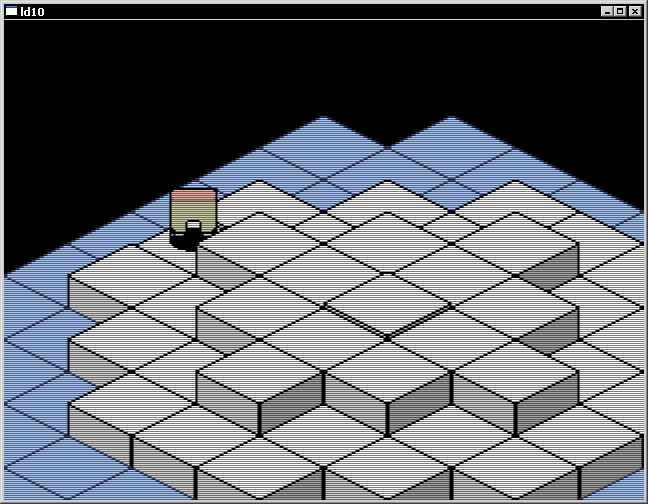
LD10 December 14–17, 2007

The Farmer

Splash

Theme Growth. I did get a review on this game, here it is:

Not just reliant on a funny intro song, The Farmer is a pretty good game coded by drZool for the Ludum Dare competition. Part Harvest Moon with some Mario-stomping element, you play the role of a farmer who has to achieve certain level objectives shown before the start of each stage. This would usually be a certain number of coins, seed, flowers or fertilizers. You start off with a few seeds that can be used to generate the four items mentioned, depending on when you decide to harvest them by pressing space. Some planning is required as the game will end if you run out of seeds. You will get more seeds if you pick the flowers as soon as the petals fall off. Exchange flowers picked when in full bloom for coins from the shack on the right. Decomposed flowers can be collected as fertilizers, while roaches can be eliminated by jumping on them. The rules may seem a little complicated at first but players should be able to grasp the concept after a few plays. Ingame

Ingame screenshot

Tags: farm, final, growth, pixel, pixels, shockwave

Raids

Infected game

A infected game. It didn’t get done but there is some odd graphics and strange swedish doctor sounds. Play the “game” online.

The player, shoot with a digicam on timer, yes, that is a floorball club I’m holding in my hand.

Tags: digicam, final, floorball, infection, shockwave, zombie, zombies

VoidGame

I was faily stumped for ideas in this one, ‘Build the level you play’ . The only ideas that I could come up with were Tower Defense style or maybe a netstorm clone. Several people encouraged me to do the netstorm thing, so I had a go. I used BlitzMax for it, This enabled me to make a nice ‘just the exe’ version that just works.

VoidGame

All up, I think I did quite well. I didn’t have time for a proper enemy, so I just added a tower defense style neverending wave of aliens. Instead of the Netstorm style resource collection, I made the ground itself produce energy. This made quite a nice playable element where you made pipes to make the energy flow to the right places. Unfortunately people had absoluetly no idea how to play the game. Unless you’ve played netstorm a bit, it seems there aren’t enough clues as to what the hell you should be doing.

Voidgame tutorial

After the Compo, I put together this shot to give people a clue as to what they should be doing

I didn’t make much in the way of post-compo changes to this game. I played with the engergy flow a bit just for fun, I think that’s about all.

Post-compo version is available here

Tags: Cannons, final, glowy things, netstorm, pipes., UFOs

Swarm

Swarm was my entry to LD8. The theme of was, well… “swarm”. I know, I know, I’m no good with coming up with names for my entries. Anyway, for this game, I coded an entire 3D engine (octree based) from scratch. So, I spent most of the 48 hours debugging octree code, and crammed in some gameplay towards the end. Since I never spend more time on gameplay – it still should be as fun to play as most of my games :)

Swarm

This is an in-development screenshot, showing some octree debugging going on.

Swarm

That’s how the game looks like. Shoot down all the pink, eyed balls to encounter the uber-cool-final-boss-with-superior-AI. (I got feedback suggesting that at least one person actually played long enough to encounter the boss – so I consider the gameplay aspect successful.)

Here’s a mirror of the original submission: Swarm

Tags: 3D, allegro, boss, eyes, final, flying balls, flying monsters, FPS, LD8 - Swarms, linux, monsters, octree, opengl, pink, shooter, swarm

The Destruction of the Viruses

The Destruction of the Viruses was a fairly ambitious (but not very innovative) game written for the Infection theme. The player had to clean out the insides of a computer by killing all the viruses that resided there. The viruses could clone themselves, so it wasn’t always that easy.

It played like a top-down shooter, with FPS controls, and used OpenGL to draw a level that could be rotated around the player.

tdotvshot1.png

There were many good intentions, and much love for the number 5 (there being 5 levels, 5 enemy types, and 5 weapon types), yet the game failed badly. The biggest mistake was a bug which made some parts of the game framerate dependent, leaving it extremely hard if you had a low framerate (it played as intended at about 180 FPS). It’s hard to say how it would have fared without the bug, but as it were, it placed about 23th.

You can get the compo version, or its source, if you want to, but I really must urge you not to! Better to get the ‘made working dist’ released a few days after the deadline. Both of them are for Windows and OpenGL.

I have an even better version around somewhere, that I haven’t packaged and released yet. I’ll do that soon, and then I’ll include it here.

Tags: 2D, allegro, C++, destruction, explosions, final, infection, opengl, railgun, rocket launcher, shooter, tiles, viruses, Windows

Crystal colony.

I tried thinking out of the box and failed miserably.

The theme was growth, I thought of the idea of crystal growth and pretty much made an incomprehensible game with crystals in it. Hardly anyone figured out how to play the sodding thing. The final insult was that I ran out of time so you could build yourself an army but had no-one to fight.

The bright side was I was quite pleased with the overall look and User interface. It’s a basic RTS engine with minimap and group selection, resource collection etc.

Some of the development was stalled due to me not knowing how to debug. I wrote the game In Blitz max, having downloaded the demo version on the thursday before the compo. I didn’t figure out how the debugger worked (or even that it had one) until sunday.

Crystal colony screenshot

Tags: bugs, Crystals, fail, final, growth, slugs, unfinished

Teeny Tiny Ninja

I was quite pleased with how this one worked out, The game only has three levels and I was quite worried that the last level might be impossible. As time was running out on the clock I was trying to figure out if it could be done, I finally got a single ninja home and went “that’s it! ship it!”.

playing post compo I actually managed to figure out how to get all of the ninja home on that level by using a few tricks.

Teeny Tiny Ninja

I also liked the look of Teeny Tiny Ninja. I got the stars idea from a previous Bluescrn entry. Adding a bunch of stars does indeed liven up the look of things. Also The ninja home came out surprisingly well for programmer art. I thought the sound worked well too, but the scores the game got suggested I was in the minority. when a ninja goes ‘Hut!’ every time he jumps it’s cool, but people found it less so when there were a couple of hundred Ninja doing it, serves themselves right for picking swarms as the theme I say.

The game used a homebrew physics engine made during the 48 hours. this worked quite nicely, Ninja were all implemented as tiny triangles

Ninja Triangles

See. There was no Line to object collision detection so it was possible for Ninja to get stuck on corners by impailing themselves on a point and having their triangle points go either side. There were alsdo a few other little quirks that caused th ninja to get stuck. The solution worked brilliantly. I checked to see if a ninja hadn’t moved for a while and if so just added a huge random vector to its movement. A lot of people took this to be an intentional behaviour because it looked very ninja like. sometimes a ninja would jump to a wall or point and stick there for a bit then jump away again.

Once again the controls were a bit unintuitive. But I thought the use of a mousewheel worked well.

Download the game

Tags: final, ninja

A Perfect Swarm

Ludum Dare 8 was my second ‘short term’ game programming contest, and my first solo. The theme was ‘swarms.’ I was bound and determined to do an RTS game this time, since my partners in team compos always want to do something actiony. I think I actually wanted robots or magnets or something like that.

I thought it would be nifty if instead of directly building units, you had to attract units with various buildings. So you start with a base and 1 swarm. There are resource buildings (Apple, Flower, and Metal) that you can hover over that will give you various resources. You also have a base. You can build either Apple or Nectar huts in your base. These increase your attraction rates for food or nectar. (It was originally going to be food and sex, if you read the code. I guess bees have sex with flowers or something.) Once bugs are attracted to your base, you can add them to existing swarms, or break them off into new swarms. You can also build Radar to increase your attraction range, or buildings to increase the power or speed of your bugs.

Initially this was going to be swarm vs. swarm warfare, but I ran out of time pretty quickly. (I’ll go into my mistakes below.) So instead the computer just sent a specified number of waves with a specified strength at you at regular periods, and you needed to have swarms built up and ready to fight when they came.

Obviously one of my largest problems was art. As you can tell from my screenshot, It’s ugly. Really really ugly. All the art in the game was ‘placeholder’ art that I was going to go back and fix. That never happened. Secondly, I panicked at about 30 hours. I barely had an engine, and the deadline was closing in. I actually ‘gave up.’ I came back to it, and finished up later. Thirdly I didn’t have a good plan. I know I wanted an RTS, but I didn’t have a good execution plan. I also bit off WAY more then I could chew back then.

My tips for beginners are:

  1. Make a plan – Seriously, take that first hour, and may out some code to get rid of the urge. THen take the next hour or two, and make a task list. What code does your idea need? Divide it up into tasks. As you go along, check things off that you’ve put in.
  2. Take breaks – This is always a newbie mistake too, but, make sure you take regular breaks. 48 hours, even with a couple of sleep periods, is plenty of time to get something done.
  3. Start Small – It’s much easier to add to a simple game then it is to try and cram in everything a more complex game needs.

A Perfect Swarm

Tags: final, pygame, python, RTS, swarm, ugly

Comments

20. Jul 2009 · 15:04 UTC
Keep working, great job, I love it!

Random Dungeon Exploration

Random Dungeon Exploration is the result of trying to push the Random theme as far as possible. It got random levels, random enemies, random quests (well, a little bit random!), random items, random player names, and random events. I guess it could have been even more random, but time was a limiting factor.

As for the actual gameplay, it’s fairly simple step based dungeon crawling. And a ‘town’ screen where you can shop and select dungeons. It felt pretty solid, but there were a lot of balancing issues that you’d notice once you reached some higher levels.

shot9.png

The game was well received, placing second in the ‘Fun’ and ‘Production’ categories, and also getting the ‘Best In Show’ UBER prize.

You can get the slightly improved post compo version, or the compo version. Both are for Windows and OpenGL.

Tags: 2D, allegro, Best In Show, C++, dungeons, exploration, final, firs, opengl, random, RPG, shopping, The One Ring, tiles, Windows, winner

LD7: Pathmania: Way of the Jelly

This was my entry for Ludum Dare #7, which was the first LD I entered. The theme (growth) eventually gave me the idea of growing a maze.

So, you create the maze as you walk around inside it. When the game begins, the maze is just a set of disconnected squares. Each of these squares can be linked with a set number of its neighbours (how many depends on the square, from none to four), and you create new links by walking from one square to another where there’s no previous link. Once a link is created it can be walked on as much as you want, but a link can’t be removed once created, so you have to be careful when creating your maze so you don’t get stuck.

Once I had that working the deadline was looming close, so I threw in some keys and locks and made the objective to clear all locks of each level, to make the thing resemble an actual game. In the end there was four levels, a random level generator, and also a level editor.

pathmania-ss7.jpg

I wrote in the original README that I’d continue to work on the game, something I haven’t done. I still like the general idea behind the game, but it has this tendency to degenerate into just staring at numbers, which isn’t very fun at all, and on top of that it’s easy to get stuck, having to restart the level if you don’t pay attention. Perhaps some of the extra elements I didn’t have time to put in the game for the compo — more tile types, powerups, bombs, enemies — would have made it better (more varied if nothing else), but I think the interface is the main problem. It should be more obvious what tiles can connect, how many exits are left, etc, so there’s less guesswork, no number tracing, just puzzle solving. Since the levels are so “dynamic” getting that to work would be tricky, though.

Download: [ Windows | Linux (x86) + source code ]

Tags: final, jellies, keys, linux, locks, maze, post-mortem, puzzle, screenshot, SDL, Windows

Vector Tail Game

Proof I have real trouble coming up with good game names.

This game was a quick one. A week before a LD we had a warmup, put in 12 hours during the weekend. The theme was vectors and a subtheme of chains.

I was quite pleased with how this worked out in a lot of ways. The rendering was with a little 2d OpenGL style setup where I implemented pushmatrix, popmatrix, scale,rotate,multmatrix,LoadIdentiy, setcolor and line. All of the glowy effects were done by a two layer drawing system, A blur buffer of high saturation drawing and a overlay of bright low saturation. The persistance came from averaging neighbouring pixels in the blur buffer and subtracting a bit. I did that part with a wee MMX routine.

TailVector

Most of all, the thing that pleased me about this game is how fun it is. It’s a bit hard but I think there’s potential for a great full game in this idea. I build a linux version and had it running on my arcade cabinet for ages, that was great fun.

I guess the only sad part about this on is that if I had have done this for a genuine LD48 I would have used the extra time to make something even better.

The final game isn’t entirely my own work though. I slapped a mod file onto the game for music. Livens it up quite a bit.

Download the game

Tags: final, glowy bits, Vectors

Elephants

It was a dull Saturday afternoon and I needed to make a game. I proposed the idea in #ludumdare and got DrPetter and trick on board with the idea. In “4 hours” we whipped together a game about an elephant that jumps on a rolled up squirrel catching falling giraffes while dodging spears thrown by the natives. It’s more fun than a barrel of pigeons!

elephants.png

You can get the game here. Be sure to check out the forums, there are some pretty sharp strategies people have worked out to get ridiculously high scores :)

Tags: 4-hours, elephants, final, giraffes, mini-game, natives, pygame, spears, squirrels

Elephants

It was a dull Saturday afternoon and I needed to make a game. I proposed the idea in #ludumdare and got DrPetter and trick on board with the idea. In “4 hours” we whipped together a game about an elephant that jumps on a rolled up squirrel catching falling giraffes while dodging spears thrown by the natives. It’s more fun than a barrel of pigeons!

elephants.png

You can get the game here. Be sure to check out the forums, there are some pretty sharp strategies people have worked out to get ridiculously high scores :)

Tags: 4-hours, elephants, final, giraffes, mini-game, natives, pygame, spears, squirrels

LD6 entry: Photon

Photon was my entry to LD6. The theme was “Light and darkness”. I still remember all the time I fiddled with shadow calculations. In my game, each light source does exact shadow calculations with all the level geometry – and in order to still have it all run with < 1% CPU, this was quite some work. Now, there’s nothing special about this except, I wanted to do things in the most simple way possible, this being an LD. And I had to admit utter defeat when I later saw bluescrn’s entry. Instead of spending half of the 48 hours on it like me, he went for a dead simple approach – with the only difference that his was not 100% accurate. Which would have made no visual difference in my game whatsoever. In fact his shadow method would have worked a lot better in my game in just about every respect :)

I still managed to do quite well. Here’s some screenshots from back then:

Photon

The title screen.

Photon

The goal of the game is to send all the photons coming from the lamp to the prism, but the problem is, you only can see the areas of the map which are lit up by the moving photons.

Photon

To control the photons, you can place mirrors – to light up more areas of a level, and once you have found the prism, send them all to it.

Seems the original submission is still up: original zip at original site

Tags: allegro, darkness, final, LD6 - Light & Darkness, light, linux, mirror, opengl, photons, prism, puzzle, shadow, sparkle

Comments

19. Apr 2008 · 23:44 UTC
In 2005 I released a fun little puzzle game called Ping Ball. It took me 9 months of spare time to write, and I did all the coding down to the hand tuned assembler code for the blitters, and even render the sprites myself with Povray. It was the first project where I used the sub- pixel sprite technique, that I recently replicated in Python. The resolution is only 640 480, but you would swear it was a lot higher. I thought it was a great game, I enjoyed working on it, and I loved playing it. So I assumed I…

Uplighter

Uplighter was my entry for the Light & Darkness theme. It was a puzzle game centered on lighting up levels to certain percent by, among other things, placing lights, breaking down walls, and removing light sinks.

It’s was my first entry to feature 3D, although all gameplay and lighting is really in 2D, and it was also my first entry to not use Allegro. Instead it used GLFW, which is more lightweight, and I really didn’t need all the extra stuff from Allegro.

09final.jpg

Uplighter is probably my best and most innovative LD entry so far—it placed first in ‘innovation’, second in ‘fun’, and also won the ‘Best In Show’ award.

You can get the compo version of Uplighter. It’s for Windows, but there’s a shell script (kindly provided by alar_k after the compo) that will fix stuff so it will compile for linux. You’ll need GLFW, GLFT, FMod and FreeType2.

Small notice: After the compo, it was reported to run very slowly on 3.0+ GHz machines. I’m still not sure what that was all about, but it has been reported that this can be fixed by compiling it in VS. If this is still much of a problem, I might get around to fix it myself.

Tags: 3D, Best In Show, C++, darkness, explosions, final, GLFW, innovative, light, linux, opengl, puzzle, shadows, tiles, Trendy Cellars, Windows, winner

The People

The People was written for the Growth theme, and in many ways it resembles my first two LD games—there’s the tiled world, and you can build things on it. Only in this case it looks more fancy due to some clever tile rendering. Like my two first LD games, it’s a puzzle game.

There’s seven levels of varying difficulty, with goals such as ‘reach a population of X’ or ‘get Y huts’, a sandbox mode, and a tutorial mode. While you build stuff, a simulation is going on where new people appear and so on. A good description of what you actually do is, as someone put it, playing a planetary engineer.

shot7final.jpg

My ‘post mortem’ for the game was pretty much the following:

So how did the game turn out? Good, and bad. My first idea was a kind of God game where you created land and such and people appeared. And there was supposed to be a kind of currency, that I called belief. So I coded the tile system and the simulation first, then I started to try to get it into a game. Well, it didn’t work, or at least it didn’t work without very much job, so I dropped it (the game idea, not the simulation and that). So I figured out another game: You have a limited supply of different kinds of land, and you have objectives to complete. Then there’s supposed to be interesting levels that are fun and challenging. I fixed up a tutorial mode, and a sandbox mode. These are pretty cool. Then there was the levels. I managed to come up with a few OK ones, but then it went downhill. So I ended with 7 levels, of which some are OK. Most are pretty easy, you just have to wait a while. I’m not very happy about them. But on the whole, the game’s pretty OK.

If you’re to believe the unofficial results from my own vote counter, The People did indeed turn out OK, and placed first in ‘fun’ and second in ‘innovation’ and ‘production’.

You can get the Windows compo version, or the Linux port version. They require OpenGL with multitexture support.

Tags: 2D, building, C++, final, fun, GLFW, growth, huts, linux, opengl, people, puzzle, simulation, tiles, Windows, winner

Diaspora

Conways game of live ‘verses’ mode :)

I think it got a bronze pelly for something.

Diaspora

Slightly updated version can be found here: http://ds.diaspora.googlepages.com/home

Tags: final

The Hat Swarm Attack on Dance Islands

The Hat Swarm Attack on Dance Islands is a game made within 14h for the LD8 Swarms compo. However, it was never really entered into the compo, because I felt it wasn’t quite enough, but also couldn’t figure out how to make something more of it. In the end, I abandoned it, and instead used it as a base for Ultra Fleet, which I did enter. This might not have been the best of decisions, but no matter.

You navigated your hat swarm around islands to destroy dancers that tried to defend the islands, while at the same time trying to avoid the deadly dances that was danced at you.

hatattackshot.jpg

The Hat Swarm Attack on Dance Islands prime features was an intro, an island generator (that I later used as a base for rather prettier islands), the famous Hoids algorithm that simulates hats in groups flocking behaviour (later adopted for the fleets in Ultra Fleet), stick figures, and a lot of dancing. Strangely, it was also my very first LD game (together with Ultra Fleet) that didn’t use tiles.

There’s no dedicated distribution for The Hat Swarm Attack on Dance Islands, but you can get it as the bonus in the Ultra Fleet compo version. It’s for Windows, but if you’re a bit clever, you can probably compile it for Linux. It requires OpenGL with 512×512 sized textures support.

Tags: 2D, arcade, boids, C++, dancing, GLFW, hats, humor, intro, islands, non-entry, opengl, random, silly, stick figures, swarms, Windows

Ultra Fleet

Ultra Fleet was my entry to the LD8 Swarms compo. For a bit of background information on it, please read about The Hat Swarm Attack on Dance Islands.

Set in space, you controlled a fleet of virus ships that could convert enemy ships. Fleets of enemy ships kept on attacking, and you needed to keep your fleet alive so you could go on fighting, gaining points while doing so.

work11-rc1.jpg

The game was, if anything, more pretty than fun, but it really was playable once you got into it. Although you probably got bored within an hour or so. Don’t know how it placed, but it received OK scoring, and also got praise such as ‘The game I’m supposed to be reviewing is more like a screensaver’, ‘I liked Hat Swarm better, though’, ‘Without a doubt, Hat Swarm is WAY better’, ‘I honestly would have given the hat swarm a higher score though.’ But seriously, some people (including me!) actually seemed to like it.

You can get the Ultra Fleet compo version. It requires OpenGL and is for Windows, but I’ve been able to compile it for Linux, although I have no idea where that port went, but it should be pretty easy if you want to try yourself.

Tags: 2D, arcade, boids, C++, final, fleets, GLFW, opengl, pretty, ships, shooter, space, swarms, trails, Windows