Arktrail: Brainslugs for everyone!
Enjoy this coding timelapse with a snippet of gameplay!
Hi all,
In case you’re looking to dive straight in to another jam, the second annual #SpeccyJam starts on 29th August 2014
Dev’s have 1 week (29th August – 5th September) to create a ZX Spectrum flavoured game.
It can be for any platform (Browser, HTML5, Flash, Mobile, iOS, Android, PC .. anything), and you can use any game dev tools to create it (doesn’t need to be programmed in machine code and load on a cassette tape or anything like that.)
Just as long as it looks / feels / plays like a ZX Spectrum game, then it is fine!
You must use only the ZX Spectrum colours and resolution, and you can use the “attribute clash” rules if you want to make it look more authentic (but not a strict rule).
For more details about rules and registration (by way of forum), check out http://www.speccyjam.com, and follow @SpeccyJam on twitter
Thanks for reading, and hope to see you there!
Cheers
Dave
Tags: 2D, game, game jam, jam, ld48, retro gaming, zx spectrum

I decided to start a Post Compo version of my entry, Orbital Expansion.
I hope, this improved version will be playable at the end of the week.
I started to change the UI, i want to add some content to the game, but before that, i needed to redo the UI in order to make the addition of new content possible.
So i guess, a new version of the game without new content (only a new UI) will be playable at first this week, and after that, I will add new content to the game.
If you want, you can try the Compo Version of Orbital Expansion !

I’ve compiled builds from my game at various points along the way to completion and thrown them together as a sort of interactive time lapse, I thought someone might find this interesting or be able to learn from it, so here it is!
https://www.dropbox.com/s/z2j8pko5aly53xu/ld30-lethal-timelapse.zip?dl=0
You can also find my submission here if you fancy playing the final thing:
http://www.ludumdare.com/compo/ludum-dare-30/?action=preview&uid=5178
Hey everyone you know what ? I’m making a post compo version of my game.
I wanted to rework (absolutely) the arts/ux of my game and after 2 days thinking about it, I think it’s done.

Also I’m on few features to add enjoyment and challenge in the game like combos and power ups.
If you don’t already played my game/rated it, go for it, now !  (it’s take you 30 seconds to play it)
And coming soon version downloadable from stores (but it was already working on mobiles and tablets).
Check out the post-compo version!
4 Ludum Dares down, many more to go! I managed to “finish” my “game” within the 48 hour window this time, and I didn’t stress out anywhere near as much as I have for previous events. I’ll take that as a sign of consistency. As always, I’ve learned so much over the course of this past weekend and I’ve had a great time to boot! Anyhow, shameless plug for my own game here to accompany the obligatory postmortem.
Timelapse
Tools and Software
What Went Right?
What Went Wrong?
Stuff I Enjoyed
Thoughts for Next Time
Again, if you’ve spared the time to read through all this then thank you very much! This is more for myself to crystalise any knowledge I’ve gained for surviving game jams, but it’d be even better if this ends up helping any of you folks out there. Now, get back to rating all those games!
-Felix
Tags: golf, LD30, Mortem, Post, postmortem
What I Used
What Was Good This Time
What Was Decidedly Not So Good
For Next Time
Well, that’s it. If you haven’t played Ghostnet yet, and you actually read this whole thing, you probably should! It’s not half bad. Stay spooky, friends.
Last weekend I created Hello World, a game where you guide messages. Check it out here http://www.ludumdare.com/compo/ludum-dare-30/?action=preview&uid=23945 !

“Hello World” Gameplay
As I mentioned before, my entry in the 48 hour comp was “Dreamshift“.

THINGS I LIKED:
THINGS THAT NEEDED IMPROVEMENT:
I’ve always felt that LD is supposed to be a learning experience after all, not just a showcase of talent, and I definitely learned a lot doing this. I hope everyone else has as well.
P.S. No, I don’t know what the hero of the game is supposed to be. A cat? A rabbit? I’m not an artist; I honestly just drew until something looked right.
Play and your vote in our first participation. It would be very good and important to receive us your feedback.
http://www.ludumdare.com/compo/ludum-dare-30/?action=preview&uid=40832

Given that Twitch is currently on fire, I’m streaming (mainly 48 hr Compo games) on Hitbox! http://hitbox.tv/marekkpie
LD30 was my first full Ludum Dare. I had entered two MLDs before, but not any actual compos. I am happy that I managed to complete my game, but it has some serious problems. (My game is called “A Rainbow”, by the way). First and foremost of these was that I didn’t set a standard tick rate, making the game run incredibly fast on fast computers. Also, the graphics sucked, and there was no audio. Still, I am pretty happy that I managed to create a game at all in 48 hours without a game engine. (Although, next time I’m probably going to use Unity).
The idea for my game was that several coloured worlds existed, and you could teleport between them. Also, you would be able to see outlines of objects in the other worlds, so you could jump off of an object in one world, teleport, and land on an object in another. This mostly carried over into the final game, although I wasn’t able to make the outlines appear, in the end I just made it so you could see everything the same in all worlds.
Originally, I was going to make a sprite-based game. Then, at the end of day one, I had to restart, since my rendering system wasn’t working. I ended up using Java’s built-in graphics, which are very underwhelming, but worked.
I also planned to have 10 levels, but then cut it down to five as a time saving measure. Later, I reduced this to three.
All in all, I am quite satisfied with the final game, despite its flaws, and I will definitely be back in December!
-Mons657
Tags: #LD48 #LD30, post-mortem, thoughts
This was my second Ludum Dare, and I very nearly gave up.
Before the theme was announced I knew that I wanted to do something with ‘proper’ game models. You know, going into Blender, making a character model, rigging it, making a run/walk cycle then exporting that into Three.JS and displaying it in the game. I also knew I wanted to play with some neato post-processing filters like Bokeh (depth of field) shaders and so forth too.
The problem was I didn’t have a clue how to do any of those things.
In my preparation for Ludum Dare I made some base code (published on Github) which gave me a basic rendering pipeline which gave me DOF, Bloom and Antialiasing passes so that with a bit of luck I just had to throw some geometry at it. I also had a play with bones in Blender and after a bit of fighting managed to get a sausage wobbling on my screen. I thought I had everything I needed.
So then the theme is announced and it’s the theme I was desperately hoping it wouldn’t be: Connected Worlds. Agh. Mind blank. Couldn’t think of a thing. So plan B then was just to jump into Blender and start making some random assets. I knew I was going to meet the theme by mixing very unlikely things. So I made a tripod…
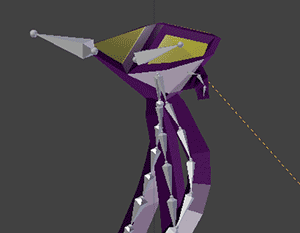
… and then I made Slug Lord…

.. and then I made a model of the author Jane Austen.

Jane and the tripod had a run cycle and Slug Lord was flapping his tentacles around. But all this? This took me an entire day. I had never modelled a humanoid before, never animated a run cycle, never dealt with Inverse Kinematics. It was incredibly frustrating.
On the second day I knew I needed to work on the actual game. So, naturally, I spent 4 hours writing code to generate text in WebGL and load all the assets (I wanted to make sure all the assets had loaded before starting the game because, by default, Three.JS is very happy to start rendering things immediately and let textures and models pop in as they’re loaded).
Finally, with all that done and 14 hours remaining I needed to start on the game. I knew I wanted Slug Lord in the middle of the scene, with Jane running circles around him. The original vague idea was some sort of single screen point and click adventure, where the player character had to escape from the clutches of slug lord… there was no chance of that though. Instead I considered some sort of Canabalt style endless runner/jumping thing.. so I started putting the scene together… and naturally spent another 4 hours tweaking the depth of field effect which, for some reason, was refusing to work properly.
I approached breaking point here and wanted to just give up. I didn’t want to abandon the thing that had caused me to waste so much time, but I was, in fact, wasting huge amounts of time on a pointless effect most people wouldn’t even notice, and I saw the deadline approaching fast.
And I still didn’t even have a game.
Agh.
Mercifully though I got the effect working in the end. Just. At which point I was back in Blender to make a very rough and quick background scene.

At this point I had about 5 hours remaining… and still no game. The platform/jumping game was out because I didn’t have enough time, so I added my tripod model into the scene and realised I could probably just make a simple twitch reflex chase game. You know, press the button at the right time and you go faster, press the wrong button at the wrong time you go slower and then the tripod can catch you.
Simple. Kinda funny. Easy to implement. Messages popped up as instructions from Jane telling you which mouse button to click and the mechanics of the chase were in and… mostly balanced.
Had enough time, in fact, to get a neato shader in for the background and add a bunch of random particles and lights… And it was sort of done. And I got this:

And lo, it was silly. The red and green and snow thing was supposed to connect the world of Christmas to the worlds of The Slug Lord and Jane Austen but I guessed that was a bit too subtle. My work was done anyway.
Now, someone in the comments for this mentioned it probably should have been a typing of the dead type game. And this was the biggest ‘doh’ moment ever for me. Of course. Jane Austen was a writer. It would have been perfect. And if I’d thought of that on day one I could have done that. The time I spent tweaking shaders or fighting with weird vertex twisting in Blender could have been spent on a typing game mechanic and importing a load of Austenesque phrases and words. And that would have been great.
So lessons learnt: Never use technology you’re not 100% familiar or comfortable with. Ludum Dare is best when you’re spending the time coding up interesting game mechanics, not shader effects or learning new platforms or entire skills. Also: More base code, especially if you’re using Three.JS which puts you at a massive disadvantage compared with Unity.
Finally, and I made this same mistake last time and failed to learn from it : Make a lo-fi game with simple boxes and if there’s time add models and shiny later. Game first, graphics second. This is Ludum Dare, not EA.
Considering my original objectives I think I got what I wanted out of this Ludum Dare though. Disappointed the game itself is basically the thinnest possible layer on top of what is basically a screensaver, but considering what I had to learn to build this it’s possible – just possible – I got more out of it than I realise. Maybe.
The game’s page is here and typical play sessions last about 30 seconds. Which, you know, is fair enough.
Tags: postmortem ld30
Indie’s & Game Jams make the best games. Im Larry Chupacabra and Im jumping on the band wagon to make showcase / review videos during the entire voting period. If you think I missed a really fun game while jumping through the list just let me know.
First up on the Docket:
Warp Corp:
http://goo.gl/zedflJ
NECLiD:
http://goo.gl/hHESBz
Sinister:
http://goo.gl/J2wjpS
Tags: LD 30 Showcase, neclid, Sinister, Warp Corp

Our jam entry “Corponnected Ltd.” is now in the wild, and first feedback has been very positive! To hear people saying they actually finished the game / played it for half an hour is incredibly heartwarming. Here’s a quick postmortem while memories are still fresh:
Before the Jam
This week-end was my fourth LD, and the second one with teammate Manu. This time we managed to make a 3rd person, Guillaume, join the team, so with our extended workforce we felt like the sky is the limit! With our little experience with previous jams we knew we had to avoid making a too complex game, so we planned to make something that could easily start small, and then be iterated over.
We chose in advance to make the game with Phaser.io (HTML5 engine), so we could practice with it a bit before the jam (before that, our engine of choice was CraftyJS, but while we love its API, some annoying issues made us want to try something else).
Jam progress
We were quite lucky in that it took maybe 5mn between the moment I discovered the theme, and when I figured out what I’d want to make. Our concept, a factory building simulation, is actually borrowed from a game idea that has been in my head for a while. I also liked that management games are usually nothing too complicated at a technical level (or so I thought), leaving more room to focus on game design and balance. We actually discussed so much about the game mechanics that we didn’t start coding until maybe 3 hours into the jam.
When getting started, we quickly realized things were more complicated than we thought (such as the workers AIs), so the “let’s make a small game and iterate” thing kinda falled through… Actually it’s much harder to work in small steps when you’re a team of 3: the most immediate way to split the work was instead to cut the game into subsystems and make each person responsible for a part, so the whole game is actually developed concurrently. In our case here’s how it was initially split:
– Wan: Factory building screen / Workers AIs
– Guillaume: World map screen / Level design
– Manu: Game state & contents modeling / Save system
This worked pretty well, but the side effect was that the first “working” version was barely ready for sunday evening. At that point most of the game was done though – it lacked a lot of polish (like a tutorial, an endgame, music, etc.), but the engine was up and running! There was a down side though. We had huge balance issues on top of the lack of polish & contents, so we were still really worried about one thing: will the game be actually fun?!
Monday was a work day so we only had an evening left to actually turn this first version into a fleshed-out game. We were really tired at this point, but every bit of work put into the game during this final rush made us increasingly excited, as we saw everything falling into place and the game mechanics starting to make sense, turning up the game into a surprisingly cohesive experience.
By the time the game was done (about 2 hours before the deadline) we were pretty satisfied with the entry, and decided to call it a day – though Manu still did some bugfixes after that! At this point he was the only one who actually played the game from start to finish, so even I wasn’t sure how playing the game actually felt. Even at this point, we were still worried about whether people would like the game: we barely had some external feedback during the jam, so we weren’t even sure whether the tutorial and the building descriptions were enough to make the game easy to pick up.
Fortunately the feedback was eventually positive, and the main complaint instead was that the game is a bit too easy – which makes sense, especially since we completely forgot to balance the feature (monthly taxes) meant to complicate things! But overall we’re really proud of our game – I even prefer it over the one that made 2nd place during LD24. We also really felt like the experience from the previous jams played a part in this session going well… I love it when a plan comes together.
Went right/Went wrong list
[+] No major issues met, we had a nice time overall
[+] Discovery of PhaserJS was pleasant, this thing just works. Docs are a bit weird to apprehend, but otherwise we really recommend it. Even integrating GLSL shaders (animated water) was flawless.
[+] Task management and distribution went well
[+] People liked our music, despite it being the most hastily and dreadfully patched thing I’ve ever made… (Can you spot the game from which I tried to mimic the soundtrack?)
[-] We should have taken our Monday off!
[-] Initial scope for contents was way too big – a lot of planned content (factory types, etc.) didn’t make the cut
[-] The UI was made within the engine, but we eventually realized that most parts could have been made much more easily in plain HTML…
[-] Still lacked some time for polish, the engine could have supported even more variety and challenge while making factories. Some features such as having terrains of different sizes, or really complex terrains weren’t really leveraged in the levels.
We had an unusal amount of ideas for this game, it would be nice if maybe we could turn it someday in a full-featured game… But y’know, that’s what we say after every jam!

Hello, everyone! I’m Shaquille Stoutamire (Defacid/Acid) and I had a lot of fun with Ludum Dare this year! I’m really excited that, even though I still had a lot going on, I managed to finish my entry! It’s not as fleshed out as I wanted it to be, but I submitted it in time… with a whole minute to spare!
WHAT I ACCOMPLISHED:
– Randomly generated worlds with terrain and plantlife variations
– Pretty decent gravity and rocket physics (there are definitely bugs, but it’s relatively solid)
– Basis to a leveling system
WHAT I FAILED AT:
– Fleshing out the level system to actually DO something
– Adding outposts and environmental interactions like gathering resources and using them to survive
– Spending too much time on the planet generation: I had already build a similar system before, funnily enough for a previous Ludum Dare, but I ran into an error didn’t want to look at it or use that code base – when I do a game jam, I like to work from scratch in the engine/IDE that I’m using. Next time, even if I’m not going to copy and paste, I’ll at least look. 😛
– Actually fleshing out the morality element. Right now, the player themselves has to ask the question of “Why am I killing these little guys?” when experience doesn’t change anything about the gameplay. But I wanted to actually add something of value to the mix like planets losing color saturation when you kill enemies, but you get something in return so you have to weigh whether or not it’s worth it to kill these defenseless little guys.
– Clearing my schedule for the event. It was unavoidable (school, watching my son, my car broke down haha) but it still definitely hurt my game. I lost AT LEAST 24 hours due to obligations and 8 to sleeping. So I ended up with about 12 or so game dev hours at the maximum. 
WHAT I’M DOING NOW:
I’m going to port my game to HTML5 within the next day so that more people will play it! But within the next 20 days, I’m going to play as many other compo entries as possible! I will make sure to play and rate every game of every person who rates and comments on my game.
Tags: 2D, compo, exploration, Explore, flying, game, planetoid, planets, post-mortem, postmortem, progress, shooter, space

Go get you some twin-stick arcade style shmup action!!!
Play as a rogue wanderer, with a mystical gun capable of absorbing lost souls for ammunition.
Stop the creatures from another realm from capturing enough souls to grow to their true forms!
So we found out a way to finish our game on time despite of all the problems we had (idea for the theme, programming, art) and this is it! I hope you spare some of your time to play our game!  Fire beats Earth, Earth beats Water, Water beats Fire. Have fun! Btw, this is our second game for Ludum Dare.
http://www.ludumdare.com/compo/ludum-dare-30/?action=preview&uid=41003
I’ve read in the past how bad Linux players have it due to no Unity in a browser for Linux, so I followed the instructions in a post and made you guys a Linux build (untested, sorry). It should be 32/64 bit together, per the instructions, and in .tar format.
Enjoy and please rate/comment

So, still working on my game*, and I just added a way to heal yourself (besides dying), can you guess what it is?

Dungeon Blaster updated for Taco Tuesday!!
(*: not modifying the Jam version or any funny business, just having fun with it, might upload it in a week or two with the caveat that it’s not the official #LD30 version…)
Tags: dungeon, dungeon crawler, tacos
It’s a fail but it was funny 😀

This game isn’t finished. It is “playable” but there is no end and monsters can’t be killed.
This must be the shitiest submission ever done but I had to. By respect for my girlfriend to let me participate despite our busy weeked and for the work done (graphics!).
At first I tried to simply focus myself on a classic WTF game but I quickly bored myself turning around with stereotypes. When suddenly I found The thing, a game, with only cliche ! 
And here comes “She”. The all mighty and lovely Viking warrior, with a huge breast and a magic bow that throws fireballs (and other things).
You must help her to protect her igloo in antarctica against bad kamikaze zombies aliens villains.
Why I failed ?
The project was too ambitious and with less than 10h of work, according to my actual skills, I could not hope for a better result.
I will do the next LD more seriously.
In fact I’m pretty happy to have experienced all of the pgtech workflow. It was a good test.
In an enhanced version I will add some laser beams and T-Rex. And maybe animations, sounds … and feedbacks and … dammit !
See you next LD 😉
Hi all,
First thanks to all that have tried my game and rated it.
As many have mentioned the flotiness of the controls, I thought I would share a video of me playing the game to show, what I think is a good play/run. In the video I get a time of 128.8 seconds which is 20 sec over the maximum difficulty which is reached at time 100 sec.
After the 100 seconds you are you own worst enemy, because of the wrapping around of space letting your bullets hit you in the back
Hope this shows that the game isn’t suppose to go on for more than a minute or two.
Hope you enjoy. 😀
Now, go make games 😉
http://www.ludumdare.com/compo/ludum-dare-30/?action=preview&uid=10263
GOAL : Reach the hill
MEAN : Kill enemies by weakening them with opposite rhythm to increase your “cable” length and increase your reach
COMMAND :
Left world :
————
wasd : movement
Left ctrl : action
Combat : 1,2,3 in rhythm
Right world :
————-
arrows : movement
Right ctrl : action
Combat : 6,7,8 in rhythm
Made with Unity 4.6beta

It was a long and tiring 72 hours but I really had fun making my entry. To those who want to see three days of game development condensed in a few minutes, then click on the image below:

Go here to play and rate my game!

Hey everyone ! Here is the post mortem of my game Linked Colours.
As always, you can click here to play and rate it.
WHAT WENT RIGHT
Idea and development
As last time, I had the idea pretty quickly and stick to it. Thankfully I didn’t encountered big design issues and if I doubted that I would be able to create many levels, random generation came to my rescue, so I didn’t even needed to create levels manually other than the two tutorials.
In addition to Daneel, the framework for CraftStudio I created and which is the base of all of my projects, I was able to borrow quite some code from other projects of mine, so that I could focus on gameplay instead of reinventing the wheel once again. Having so much code already ready is what made me enter the Jam and not the Compo as the previous times in the first place.
But having an extra day prove very useful as even with a simple idea and lots of ready-code I hadn’t much at the end of the second day in term of gameplay (but visuals where almost final).
 Visuals
Let’s say it with some pomposity: linked colours is the best-looking game I have ever created in my entire life, so far ! Look at this beauty ! I am not even an artist, or am I now !?
Well, not quite, but it’s what I am most happy about, the game looks really great, especially compared to my previous games (improvements, yeah !).
Random generation
At the end of the first day, I wanted to add a level editor so that anyone could have created levels. I have one almost working for another game but I ditched the idea even before beginning the second day, where I worked mostly on visuals. Instead I spend some time working on random generation, and it did go surprisingly well.
The generation is pretty simple : on a 5 by 5 grid, it picks a square, then picks a color, then finds another square nearby and sets a color the previous one can connect to. It repeats that until there is no more colorless squares on the grid. Then it picks the squares that are not connected to any one and change their color so that they can connect to a nearby square. Then it finds squares with 3 or more connections (3 is rare, 4 in really unlikely to happen, 5 or more never happens) and sets them as squares with a required number of connections.
And that’s it, and it produce pretty nice levels, with actual mixed difficulty. I just wished I had time to tweak it a little and have some variations in the grid.
Web Player
 Web players are very convenient, so I really wanted to produce a game that is playable that way. Unfortunately, CraftStudio‘s web player is sometimes a WIP and some things that works great in a desktop build just doesn’t in the web player, forcing me to find workaround when they exists. This was mostly what prevented me to release a web player build of Snale Driller, my entry for the last Ludum Dare.
But this time, I hadn’t had to add a single line of code to make it work in the web player ! It literally just worked… So, hooray !
Also, thanks to the web player, the game works great on Android (tested on a Motorola Moto G LTE running Android 4.4.4 and Chrome 36), even if the controls are tedious because the squares and links are tiny compared to my fingers.
WHAT WENT WRONG
Time
Once again I didn’t worked that much since I only spent 22 hours (9+7+6) on the game.
And even if the game definitely looked nice at the end of day 2 I really didn’t had any gameplay but the two tutorials. It took me the “whole third day” (6 hours…) have proper gameplay and fixes.
Also time-related I hated the shortcuts I had to take with the scenes and code in order to finish what I wanted in time. But I guess that’s expected in jams to have not-optimal code (and general organisation).
For the same reasons, the game lacks feedbacks. I wanted to add more “juice” but I just added some sounds almost at the last minute. The inputs could have been improved too, like allowing to link by clicking and dragging the mouse instead of clicking every times.
CONCLUSION
 Definitely more rights that wrongs this time, plus a successfully shipped game, nice looking and full of gameplay !
That’s a very nice addition to my portfolio, I am happy I was able to spend the time on this Ludum Dare !
See you next time !
Tags: craftstudio, jam, puzzle game
…I do too, so I made one
Here are my favorite LD games so far. They all deserve to be played, so go ahead!
Twist and Weave: A fun puzzle game where you have to connect your circle with other circles and they build a chain. The catch is that the circles cannot move through walls of their color. Tricky at times, but feels always fair.
Fragments: A puzzle game where you have to build paths in order to restore the memory of the protagonist. Has a great atmosphere that adds even more depth.
Yonumbo: Yonumbo is very minimalist, all you have to do is click on the little squares with numbers in them to add to the number or subtract. The game shows you which mathematical operation you do next and all squares have to be 0 when you used up all your actions. So simple, so much fun. A very rewarding experience.
The Lion’s Song: A point and click adventure where you play as a composer sitting in a house in the mountains trying to get inspiration when suddenly the telephone rings. The game features awesome graphics with a very unique style and it’s very well written, too.
Color Worlds: A PuzzleScript game where you have to combine colored blocks to get the color black. Sounds simple, but gets very difficult quick, as you can also split the blocks up again, as you can only push blocks through walls of another color.
A Sneeze a Day: Another PuzzleScript game where you literally sneeze the boxes to their destination. It’s both hilarious and clever.
Ordinary Weekdays of Tech Support of Parallel Worlds: A cool shooter game where you have to maintain a server and protect it from virus attacks. Awesome pixel art and music!
On the Edge of Earth: I think this was my favorite of all. You’re the only one on a space station and you have to operate several machines in order to calibrate a laser beam that can create life on dead planets. Very funny and atmospheric game.
Heart Star: The most polished game I played so far. You play two cute characters living in parallel worlds and you have to switch between them in order help them both to get to the exit. Awesome graphics, sound and controls!
So what were your favorite games? Which one should I play? Please comment!

Hello fellow LD’ers, looks like it’s time for a post mortem of my game, drink the Ink / drInk / drINK. ( They’re all good names )
I just want I didn’t want this theme, I think it’s pretty bland. IMO, Isolation or most of the themes in the last vote would have been far more exciting. But anyway, it was 2AM here when it was announced and I woke up in the middle of the night to check itAt first I thought about making some kind of planetary rythm game where you played a satellite that jumped from world to world if you pressed a button at the right time in the orbit. I even made a mockup:

It quickly dawned on me that this kind of aesthetic would be the single most overused one in all of Ludum Dare. So I scratched that. Instead, I took a less literal approach to the theme and went with connecting the worlds of visible and text. The initial vision was of having full 2D world that the player could control through the choices in the text world, but as per use, it was too ambitious. So I just opted to have this top-hatted scribe guy on the top half of the screen, just writing the story the player’s playing and interacting with him once in a while. ( I spend a ridiculous amount of time on animations for this)
Anyway, I went with the plan and drew this mockup:

as you can see, most of it ended up on the final game.
The tools I used:
– Gimp 2 for all the sprites,
– Audacity to record the music on my Cort X2 guitar,
– My white board to plan out the story and its branches,
– And Unity in 2D mode, of course.
 .
.
. uglyuglyuglyuglyugly
What went wrong:
. Unpolished pixel art was used because I started animating too soon.
. Too much time spent brainstorming / changing my mind on what the story would be, very little writing it.
. The whole text adventure architecture was half-assed and brute-forcish in approach. I could’ve done it much more elegantly, but time constraints and all… The user end is still fully functioning, with the exception of trying to put the ink away. What should take you back to the previous screen just restarts the text adventure. Oh well…
. A lot of my time was wasted on googling, not finding, and proceeding to despair for answers I’d find roughly 1 hour later. Several times.
. My unfamiliarity with unity didn’t help me be as productive as I wanted to. I spent way too much time figuring out how to use 2-dimensional arrays to store all my text and references between sections, as well as learning about ways to customize the Unity UI
. I devoted a lot of time to small details like the timing of all the Scribe’s animations and sound effect cues like the writing, or flipping the pages.

. It turned out fine :3
What went right:
. Even though the pixel art wasn’t the best it could’ve been, I’m very happy with all the little quirks and animations I managed to print on the Scribe, as well as the whole mood of the game;
. The music was surprisingly fast to finish ( although crappy );
. Best name(s) ever. (drInk)
. The story’s concept :
I really, really like this. Being trapped in a dungeon is classic game 101. Escaping the dungeon is classic game expectation 101, so I wanted to make it impossible to escape. Paired with the image of the Scribe inking away at the book of fate, sealing the player’s tighter with each page, I think it makes for a powerful experience. Which is exactly what I wanted, a game about determinism, the inevitability of one’s fate and breaking the illusion of hope and success. To make the player feel the obligation to succeed and at the same time powerless in such a way that they resort to killing themselves to escape. The game is too short to fully convey the intensity I was going for, so I’ll have to redo this, perhaps in 3D, with little text. But this Ludum Dare I stumbled upon an experience I’d very much like to make.
. I learned a lot about unity and the workflow in it, so I won’t have to waste this much times on these particular things ever again!
In short, I learned a ton about Unity and making games and myself. Succcessful Ludum Dare is successful.
So, I started off my first day full of ideas and energy, and started work on an amazing HD, high FPS, hundred-level super-platformer. By the end of the day, I had a little guy on wheels who jumped about in a physically realistic world.
By the next day I had realised I wasn’t going to finish, so I scrapped most of it and just decided to make a slightly retro infinite flying game.
😛
Check it out here: http://www.ludumdare.com/compo/ludum-dare-30/?action=preview&uid=39482
Hi all,
I’ve now rated 50 #LD48 games, and are having so much fun playing the games and seeing what you have all created
I definitely hope to be able to do LD31, LD32, and so on. Great experience, and rough.. You DO feel the pressure, even though the only one pressuring you, is… You. .
Most fun so far have been “Zanlings Match” by Franklins Ghost, only game that have made me laugh out loud. Great humor. 😀
Most moody and aesthetic pleasing graphics I’ve seen, was “juxtapose ” by zillix.
Have fun playing LD games
Now, go make games!
– Henning
Here, have a timelapse of my desktop computer (the laptop one didn’t record for some reason):
As always, I had a lot of fun this Ludum Dare
Although I initially liked the theme, it was kinda difficult to choose what I wanted to do with it. At first, I wanted to make a Lukasarts-style adventure about a girl who visits other worlds, but that stalled when I realized I didn’t know the right graphics tools for the job (Blender would have been it, adding it to my to-do list now). Next, I thought I would make a strategy game where you manage a space port – kind of like Sim City, but with a space port theme. By then it was Sunday, and I had begun playing around with a third game. This was/is Killbot’s Last Adventure. Because I wanted to actually deliver a (somewhat) finished game, that of course meant going for the Jam, again.
Killbot is a recurring character in most of my LD entries, and once again I wanted to tell a story in adventure mode.
The Good
Did I mention it was fun? Besides that, a game got completed. More or less. I’m pleased with the graphics, especially on the early screens, when time pressure wasn’t as high.
I am relatively pleased with my music this time. Part of it is due to the fact that I recently switched from GarageBand to Logic Pro, which was quite the upgrade. The soundtrack of the game, while not always entirely appropriate to the scene at hand, came from an inspired place
I made most of the tracks before I even started programming, and then listened to them as I coded the game.
The Not-So-Good
Almost no sleep, and almost no IRC or blog activity. During this LD I finally wanted to integrate with the community, but I found it too distracting. Bummer, I guess I’m remaining an outsider for a little while longer.
The game itself, well. It’s mostly a slide show, to be honest. I just didn’t have the time to put all the puzzles and animation elements in that I wanted. There was supposed to be an action mode where you could steer Killbot from above running through dungeons, killing things. But this, too, didn’t get finished and never became a part of the game.
Killbot’s final adventure is also too short, even from a story-telling perspective. The story could have been good, but sort of fails due to (the lack of) narrative timing. I wish I could have given Killbot a more worthy sendoff, but as endings go, I guess it’s not a bad one. Maybe I’m too critical 😉
Things to Do Differently
Next time, everything will be different! Next time, I’m going to challenge myself more by making a game that is outside of my comfort zone. No more half-hearted adventure and strategy games! I want to make a jump’n’run or something. Also, maybe pixel art, finally. Things I haven’t done before!
Also, not being a game developer by trade, I’ll have to seriously expand my tool knowledge. Just showing some images with CSS here and there isn’t going to cut it, and I know that.
Check it out: Killbot’s Last Adventure
Wow, what a weekend, I’ve played some great entries and I’m totally impressed by the level of quality I keep seeing in some of the games.
So, this was my first Ludum Dare, we made a game jam in Beijing, China and it was a blast to get my first taste of games design (I usually only make pretty things haha)
In the end we created a twitch platformer called Parallel Rift
The Idea – Connected worlds
So, for a while all of us sat around a table and blasted off a few ideas, the board was covered in interesting directions, then Sam mentioned TimeCop (the old Van Damme movie) and how when the same person came in to contact with their past self, they went boom boom!! I totally loved this idea, but the other guys went off to do their own things (all of them turned out really great) so there I was, sitting there with a great idea in my head, with no programmer… Luckily Andrew Li came to the rescue, and we started our jam!

Day 1: We started at around 12 O’clock
So, I explained the idea to Andrew, and layed down the basic gameplay for him. I then got Peter Long to help with character design while I concentrated on environment. Unfortunately, I didn’t know that for the jam you could use pre-made assets, so we created everything from scratch!
The backgrounds were actually made in full 3D, I then used a cell shader to get the mood I was going for, and rendered it out to be a static background. Then I added the dynamic 3D objects (the vortex / platforms / particles) to create the scene you see below
During this time Peter was sketching out the initial ideas for the character, and I gave him some examples of the style I was aiming for, then he moved on to the basic animations. All this time Andrew was getting the development side done

Day 2: Music and putting it all together
I wanted some trippy, catchy music to go with the visuals, so I opened up my audio software and got down the track in a few hours, unfortunately, now I constantly have it playing in my head (so I guess my job was done), I now hate it! More coding, polish on the art assets and finalizing all of the character work! We got some basic UI in and working and prepped for the next day of bug squashing and polish.

Day 3: Bugs / Polish / Bugs…
We had a few problems with collision of the shadow characters causing a game over (we were moving the characters instantly away in the x axis) we figured out that even though it was moving instantly, it could still hit the player character and cause an unexpected GAME OVER, this was a simple fix of translating in the -Z axis instead! A few more issues, balancing the level / speed / jump height and we were pretty much done!
What went wrong?
It was pretty smooth all together, as Andrew and I work together on a daily basis, but it would of been nice to add a little more depth to gameplay. Unfortunately time wasn’t on our side. We also wanted to implement a High-Score board.
What went right?
The platform mechanics worked very well pretty much from the start, there were a few issues with the wall jump but that was magically fixed by Andrew. Peter’s animations suited the mood perfectly (overly stylized poses and motions) and we were pretty happy with the final result!
What’s next?
We’ll definitely be doing more Ludum Dares in the future, it was a great experience for me (first time designing a game), we’d like to push Parallel Rift forward, I think it would make a great tablet experience with lots of polish and more levels of complexity
Most of all thanks to all of you for sharing your games, I’ve had a blast playing them, and it’s given me inspiration to continue doing game jams!
Enjoy the game HERE!

What does all of this mean? And how will ranking be formed in the end? I mean… based on what?
D = Default = R – C, except not quite that simple
R = Ratings = how many ratings this entry has received.
C = Coolness = how many entries this user has rated
L = Loser = someone who games the coolness ranking. It’s the honor system, people. Everyone might think you are cool, but in your heart of hearts, you will know that you are a loser.
The R and the C of course I understand but I don’t get the D and the L. And I don’t see how a winner can be chosen based on these numbers. Is it bad if you rate more games than the number that rate you? And does it matter if you rate just anyone or specificly the ones that rated you? Will there be only one mention or a list per category?.. My first time so I don’t know these things sorry.
Spaceway Transportation Incorporated is a transportation company devoted to transporting aliens safely and happily from planet to planet. But, as a Spaceway pilot, you must be aware of flying objects and enemy ships that don’t want you near their planets.
Play it here: http://www.ludumdare.com/compo/ludum-dare-30/?action=preview&uid=33942
Timelapse/gameplay video: https://www.youtube.com/watch?v=iSkU-nWH2B4
Spaceway Transportation has gotten some feedback already – saying it was too difficult. What’s wrong with super difficult games?!? I can understand the level generation system at times can glitch and spawn an almost impossible object, of course, but the game is supposed to be difficult! Anyways, to the post-mortem now.
Good:
I completed the game and *almost* everything I wanted to. I even had time to implement an unplanned endless mode. For writing a random interval-based level generation system in 48 hours, it turned out good (despite some impossible random things that happen once in a while).
The control system is great, and my OOP skills have grown very much. More importantly, it is FUN (to me, at the very least)!
Bad:
The theme. Really the only way for this game to fit the theme is if you play the Campaign mode and follow the story, so I wish I could have implemented the theme a bit more, but it still works.
GRAYSCALE – some people seem to like the grayscale graphics, but I don’t really like them. I couldn’t change them, though, because I settled on a grayscale software-rendering engine, written during the 48-hours. Either way, the graphics still look kind of neat (for my art skills, of course).
Better:
A lot could have been done better in this game. The theme could have been implemented a bit more, and I wish I had time to REALLY tweak the level generation system.
Final Note:
I finished a game, it is fun, difficult, and looks pretty good! Play it now!
Play it here: http://www.ludumdare.com/compo/ludum-dare-30/?action=preview&uid=33942
Timelapse/gameplay video: https://www.youtube.com/watch?v=iSkU-nWH2B4
We were pretty happy with the theme, and decided we would do a platformer game based on shadows and the imagination of a very small child. Everything else came about by exploring the basic idea of one player having two roles/worlds to interact with, in parallel.
The concept behind the game is that Zeno, a baby, sees real world objects as monsters he can fight. His imagination is reflected by shadows.
Play Dungeons ‘n’ Diapers
Tiled: our level editor of choice.
As you can see we got some of the mechanic down, but naturally our vision entailed a lot more than we could achieve. For instance, the shadows should attack the players shadow, but they pretty much just stand there. Also, we had a ton of ideas for puzzles, and some end of level bosses… Alas we may save them for a post dare version.
Moon walking:
During testing we found that certain key combinations caused the shadow to moon walk. Not necessarily a bug, just some missing logic in the control code. We decided to leave this in, it was kind of fun.
Earthquake:
This bug prevented you from progressing from level 1. The result can be seen in this video below:
Turns out I hadn’t cleared the data out when loading the new level, so there was an extra baby spawned just below at the old level’s start position. As the camera was set on the baby it was wildly oscillating between the two instances of the same object.
I’ve tried implementing this effect before using combinations of sine and cosine, but this is by far the best result and the simplest. I’ll be experimenting with it to see what sort of control/effects I can achieve with it.
In any case the whole thing was a massive learning experience for all of us, and as always it’s been great being part of a large collective of like minded people striving for a common goal. It’s almost like having 2500+ people over for the weekend (I don’t think there would be enough coffee).
LD30 was my 3rd jam only, my 2nd Ludum Dare, and my 1st one in solo. Just for the context, a bit of shameless self-promotion:

What went right


Sprites by Arachne
Music Space Machine A by Kevin MacLeod

Hey there babe, yeah you at the computer, you lookin’ fine tonight.
My names Harrison and with the help of two close friends we made Galilei, an ~arte~ game
Here is a full playthrough in action.
Anyway, I felt like I should talk about the somewhat downwards spiral that was Galilei and why it happened.
Initial Idea was too vague
Initially we wanted to make a space game as the artist really loves modelling sci-fi ships and etc, the theme fitted it perfectly but left little to the imagination.
We didn’t really think past that for a little while and went through a few ideas over the course of 24 hours before we settled on the final idea.
Most ideas were dumb
I really wanted to play around with lighting for this, I love minimalist art-styles and wanted to toy with shadows and all that junk, this lead to us starting off with an exploration game that would take place within an asteroid belt around an unknown planet, you would find audio logs and discover that previous ships had been trapped here after being sent through a wormhole.
that is fairly dumb and we spent too long on it, though some of the basic ideas stayed in but were changed artistically to fit, such as audio logs changing to gems and the reset function being based on a wormhole opening up and dragging you back (kind of i just went nuts making that to be honest)
I had no idea how to explain the art-style
I’m a programmer and designer, I was recently funded to start my own company.
I have a lot of knowledge about game design.
I suck at the art.
I’m bloody terrible at making art, I just can’t wrap my head around physically modelling/spriting/painting, I just don’t jive with that.
In my head I wanted a low poly art-style, that alone is very vague and explaining it to Nicholas was an immense task, eventually he figured out what a tired and slightly drunk me was trying to say and made magic.
Thanks Nick.
I ended up hating the art-style on the last day
Well, I do love it but I spent almost 18 hours coding new things and fixing old things once they handed me the final art assets, So I sat there looking at it for all that time and it got stale to me.
This didn’t really cause any problems I’m just not entirely happy with how it turned out due to how I had to cut quite a lot of things to make it look any good in time.
Now I need to talk about the good things
I’m surprised with what we made
I’m a very fast coder, I work fast and expect art assets to be done just as fast which is sometimes impossible
My initial code in prototypes is pretty bloody low, they work well but looking at them is ugly
I am incredibly impressed at what we made in the time period.
I know loads of people who study game design and all that junk who have made final projects for their classes that look and play worse than this, and they have passed, and while that might say something about the places they are studying at I prefer to say that we just did something good here, even if I’m disappointed that it’s not what we set out to make.
People adore the art
While I’m not the artist on this (Nick and Cameron made the art) it makes me incredibly warm and fuzzy inside to hear people compliment the art-style, I spent so long trying to explain it and it was made almost perfectly and people love it.
Some fairly important people have seen it now
I have had this problem where I like to prototype things, people love them and then I get bored of them.
I work on a project to learn a specific thing and then I drop it once I have learned what I set out to learn.
That means that a lot of what I make never sees the light of day and I’m never comfortable showing it to people who might want me on their project.
Seeing that Michael O’Connor (_PipeDreamer_) favourited a tweet I made about finishing Galilei made me happy, even if he’s just looking at whats happening in Ludum and saw that I finished.
If you see this Michael, you pressing a button made someone feel better about themselves.
Cameron also has some ties to Interceptor Entertainment, and according to him Frederik Schreiber enjoyed it, even if it’s not a “game” as much as it is a dumb ~arte~ piece.
Ending statement about LD30
I absolutely adore all of you, I attempted to do LD28 and had some serious problems with my house at the time and had to drop out.
This has been an amazing experience.
We are most likely going to continue working on Galilei as we all enjoyed the weekend even with the incredible lack of sleep.
We will be changing quite a bit up, most likely removing the spaceship aspect as it had its problems, and without a dedicated QA team we had no chance of ironing that out in 3 days.
Keep a lookout for it, It’l show up in your feeds again soon!
By the way, if you are still reading I love you.
Marry me.
Tags: Galilei, LD30, LD72, post-mortem

What wen right
Graphics
I’m not a pixel artist, so before the competiton started I was looking for someone to team up with. As I didn’t find one, I decided to do pixel art myself. And It wasn’t bad at all! I didn’t spend too much time on it, but I managed to finished it and make it look acceptable. Oh, and I probably should thank David Capello for making Aseprite, it was really helpful.

Theme
I liked the theme a lot and I spent just 10 minutes thinking about the type of game I wanted to do. I didn’t changed my mind at all so that’s cool.
Overall
I’ve been all year trying to make games, and I finished one in 48 hours! I think that’s the most amazing part of all and you should all be very proud of it. And play other people’s games and watch them play your is always awesome 😀
What went wrong
Coding
At first I tried to make good, clean and reusable code. But when I started running out of time, I stressed out and I did a lot of copy-paste, useless functions and hardcoded stuff that could have been implemented waaay better. But the game works and I’m not planning to touch that code anymore so… yeah.
Music
I didn’t even try but I would have liked to create something to cheer the game up. Maybe for the next time.
If you haven’t played my game yet, here is the entry page: http://www.ludumdare.com/compo/ludum-dare-30/?action=preview&uid=28965. Hit me on twitter and I will play yours!
One simply cannot create a game with placing/breaking blocks, time travelling, time paradoxes, crafting system and sandbox genre with an end goal. But I did. Kinda.
What the game’s about?
Planet rescuers is a sandbox-style game, where you play as a robot who was departed to an unknown planet with a time travelling machine. Your mission is to change future in order to get rid of strange creatures who will cause some problems.
Gameplay: You can break and place blocks in a 2D world. In the center of the map there’s a time machine which can send you to the future or to the past. The block that you placed in the past will stay when you’ll go back to the future. Metal will rust, trees will grow. Look at this comparison picture:

But if you break a block that was destroyed in the future, you’ll get a paradox. Paradoxes highly destabilize planet, so try not to create lots of them. Also, robot needs energy to move/jump/travel through time/craft/place blocks/mine blocks. Soon you will start running out of given energy. At this point you will need some generators. (currently, there are only 2 working generators: solar (place it with no blocks above) and heat (place it underground as deep as you can to get more energy).
After making this game I can say that the hardest part for me was GUI. This time I spent a lot of time on it, and it still looks awful. Also had no time for an sounds/music, so feel free to play your own music while playing my game 😀
http://www.ludumdare.com/compo/ludum-dare-30/?action=preview&uid=34143
Thanks for taking your time reading this post
My first Ludum Dare. Barely slept and I couldnt do the entire weekend. But I made the most of it and I am happy with the game I made.

Hi all.
Im not gonna waste your time by a long post all i wanna say is that It was my first game jam of all and we really worked hard and tried to make a fun game. This is a multiplayer game called fire & ice.
I guess it worth ‘s a try.Hope you like it.
I wrote a quick postmortem of my LD30 entry, Phase Shift, over at my blog.
tl;dr: Procedural graphics & levels FTW, Ableton rules, I should go easier on the caffeine in the future, and this is probably the last time I’ll use raw C++/D3D in a game jam. (Although I said that last time, too…)

I worked a lot harder on this Ludom Dare then the last one. Did it pay off? Well, I think it did… I mean, my game is kind of amusing, and longer than my last entry. But there are still some things I would like to have worked on more, or added.
The Good
I kept on schedule through this LD. Everything I did took as much time as I thought it would. Friday, I started the project. I came up the concept for my game, and once I got back from dinner with my family, I made a few sprites, and a background. I also started music. I finished the fight scene on the Saturday, and even made some extra sounds and graphics for Sunday. On Sunday, I finished the intro and handed in the game!
I came in luck with the music. I can’t make good music, no matter how hard I try. I tried fake music generator, but it wasn’t generating the type of music I needed. And I couldn’t make what I wanted on Otomata, (which is a really cool music device btw), so I went to Abundant Music. It generated a super slow song, that had potential. I sped the song up (a lot), on Audacity, and boom! Nice background music, (well I think it’s nice)!
I figured out how to check if the player is walking on ground in Unity2D, for the first time. I also made it so he has to jump over a gap, which was pretty good.
I learned the more about the differences between OnTriggerEnter2D, and OnCollisionEnter2d, which is great because I always seem to have trouble with collision detection in Unity2D, and not knowing the difference between the two, was probably was part of the reason!
Graphics were pretty good. I’m not very good at making them, but thanks to the powers of Gimp, they didn’t look to shabby!

Screenshot!
The Bad
Difficulty. The game was way to easy. For some reason Unity had this glitch where, some of the mirror beams would travel faster than I coded them to when I ran the game in the editor, (thank God it doesn’t happen in the build)! This made it harder for me to win when I was testing, so I thought the game was harder.
The intro was too long, and the game was to short. I should have made the intro faster, and more interactive, and the game longer, and harder. I find it sad that my game didn’t have a lot of gameplay, because that was what I was trying to focus on this competition!
I should have made it so you are able to skip the cutscenes. They really get annoying after a while.
Controls were a bit funky. You have to press the down arrow to go duck, and the down arrow to get up again. I used to have it so you press the up arrow to get up, and up arrow to jump once standing. But I found that made it harder to jump over the mirror beams , (especially with Unity making them super fast). So I made it so you can press the up arrow to jump when ducking, and the down arrow to stand when ducking. It’s kind of confusing to press the down arrow to get up though. It’s actually ironic in a way…
Animation wasn’t the greatest, but I do suck at graphics, so how good could it have been?
I had to make a lot of sprites. One for each deformation of Alex, in jump pose, duck pose, and stand pose. What I should have done was make four different versions of his head, each with a different deformation, and moved them whether he was jumping, ducking or standing. But oh well, what can you do?
In the scene where Alex’s mirror breaks, I should have made the text “My reflection.”, fade out faster. And I should have made the scene after fade in, because it all of a sudden just appears!
My Overall Feelings
Overall I think this was a pretty good LD. I learned some things, and found some cool new tools that I might use in the future. Though my game is short, and there wasn’t that much game play, it’s crazy, and funny, and I had fun making it!
Timelaspe
And finally if you want to play my game, you can find it here.
Tags: postmortem, timelapse
Hi there,
Here is my @Laguna_999 ‘s Postmortem Video for WorldGate WG-1
The game can now on the following sites:
http://runvs.io/Games/worldgate
http://gamejolt.com/games/strategy-sim/worldgate-wg-1/33341/
http://runvs.itch.io/worldgate
http://www.kongregate.com/games/runvsgamedev/worldgate-wg-1
And especially interesting for german gamedevs: http://pewn.de/game/?id=17736
Best,
Laguna


Infinity space!
Random funny monsters!
shop with 16 weapons!
Android version!
Upgrade weapons!
Ability to save progress!
Fun!)
So, Insomnia52 just finished and I was exhibiting Super Rude Bear Resurrection there. I love Insomnia, but I was a bit upset to find out it was the same time as Ludum Dare.
So whatever – I did both. My game wasn’t as good as usual but I refuse to break my spree.

Here was my setup. Luckily my friend Nate lent me a mouse.
I already knew I was going to do an JRPG going in, because this is the seventh Rude Bear, and there was no way RBVII wasn’t going to be a Final Fantasy parody.

I kinda needed to sketch everything up myself for this since I wasn’t with my housemate, and it would’ve been too much work for him, so I made the world really roughly.
I started out by doing the battle system, using puppets like the original Rude Bear, because there was no chance I’d get assets in time. My housemate later redrew these.
The whole battle is entirely realtime. This can be confusing, and hard to control, and I should’ve really implemented controller controls, but that would’ve been super slow to use for a start in comparison to getting good with the mouse, but also I only had one xbox controller there and it was plugged into SRBR.
Puppets are fun because they’re almost entirely trigonometry (which I really enjoy). I mean, everything in the game uses the magic formula:
Position += (finalpos-currentpos)*speed
And a bunch of trig. I just take a lot of anchors and use kludges.
I saved time on large attacks by just making one particle system and reskinning it for the various spells. A few of the attacks are bigger.

Initially everything was based on elements but I couldn’t think of symbols for element indication so I ended up just wiping that. Also you could originally heal yourself with your group attacks and stuff like that but it was getting too convoluted. In my friend Nate’s words, “Keep it simple, stupid”.
I started out with the world by sketching it (but I’ve lost the sketch unfortunately).
For the theme, I both wanted to make a bunch of worlds like a volcano, tower, desert, forest etc. and also connecting lots of worlds of games I enjoy. I started out by making Pallet Town:

As well as Crono’s house, Oak’s lab, a crypt etc.
I threw together two tracks from Earthbound and Oak’s lab, and adapted three old tracks I’d already charted by ear from Chrono Trigger, Pokémon and Super Mario RPG.
From home my housemate drew the art we used for puppets. Unfortunately I had no internet connection, so I could only grab art now and then either by tethering or going to the LAN hall (which I did a couple of times because some kids were being really loud at 4am on the campsite and I wasn’t getting any work done).

I slept around 4 hours every night. I was up till about 6 mosts nights just coding. We drank a lot every night so I was pretty alert (especially on the last night, we had an open bar).
We didn’t manage to get rooms this time so I had to camp. Extremely cramped in there with a laptop too but this is pretty much the setup I was working with.

Eventually I got the whole world done:

And just stuck colliders on everything. The movement’s a very simple rigidbody2D, and all menus are just activated with raycasting.
I was basically jamming everywhere, trains, bars – it took all my restraint not to get out my laptop during the pub quiz. I was worried people would think I was googling the answers or something.
Eventually I adapted a shader from Super Rude Bear Resurrection to make Earthbound looking battles.

It just loaded in the background of the previous area each time.
My friend SonnyBone and I were running an optional theme, “Marilyn Manson” too, and I promised to put the character Rad Boar with a Mohawk and sunglasses in too.
Things I would’ve liked to have implemented:
But given I was at Insomnia and showcasing my game at the same time, I couldn’t really. On the last night just before I went to bed I made a list of everything I needed to do at home, and streamed the last 6 hours (which was the implementation of the snakes, volcano monsters, pyramid monsters, cyberdemon and final boss).
I’m pretty happy with the amount of dialogue, 15 moves, an entire world and 14 monster types each with a different attack pattern.
Then I had some problems with my server, which was very stressful, but overall I’m pretty happy with it.
I’m sure I’ll learn of more problems as more comments appear.
But yeah, enjoy.
You can play it online in a browser here, download it for Windows here, and the LD48 page is here.
My twitter.
Originally posted on my dev blog.

Ludum Dare it’s my favorite game JAM, i love follow the progress of other game developers and play his games it’s the best part. I hope you like play our game too.
Star LORD is a classic action plataformer. You control Star LORD and your mission is neutralize SPACE LORD before he destroys the planet.
Hope you like it.
I’m sorry for delay.
See you in the next JAM <3
Play and give us your feedback! It’s important!
Here is a link to my time laps https://www.youtube.com/watch?v=LcHlRNjVuYw&index=1&list=PLp7zleVz6coT1VKWT5LZhfRVxKzlK9bGv&channel=UCntAP9M24nTIgSpZQWEbMfw enjoy
A quick update. Improves AI and framerate. There is also a simulation speed toggle for those interested.
Still no gameplay though. Should get more onto that now.

Also no gif this time. Will do one when there is more action between the factions.
It will be glorious! (for some sides of the conflict…)
Tags: new version, progress, update
The timelapse for the making of my game GalactiTrader can be seen below:

I decided to write a proper post-mortem on the development of ‘Reminisce,’ especially on the experience of using cgame (my rapid game development engine/tool) to make a game. For more information on the design philosophy behind and the implementation of cgame do check out the paper (slightly outdated — from May — also links to a poster) I wrote on it for independent work at university.

Editing the title screen in cgame’s in-game editor
When the competition actually began at around 7 pm I was out with some friends for dinner and was brainstorming game ideas. I thought maybe something modelled after Avatar, with a fire, water and earth realm, respectively with traps/enemies that utilize fire power (lava or flames), water power (flooding) and earth power (puzzles involving bushing blocks). Thus gameplay would have a different focus in each world, one on combat, one on speed and the third on puzzles. The idea was ambitious, but I wanted to start with a large concept and simplify it as I went, so that I wouldn’t have to grasp for ideas if I actually had the time later.
Eventually I dropped the combat (you don’t have weapons and just run away from monsters) and the water world entirely, and the game became mostly puzzle-based with later puzzles stretching across both hell and earth. To make it make sense story-wise I thought, “Ok, so you’re a dude going through his memories and they’re good and bad, hence the two worlds, and hence the title.”
cgame made coding really easy with the entity-system model and live-coding. To add a new element to the game, say a door, I drew the sprite in the atlas, added a new entity with a sprite system, set the sprite atlas rectangle, created a new door system in the code, added the entity to it and saved it as a prefab. All this could be done without ever exiting and restarting the game, seeing changes live — as soon as I added the open property to the door system in code it appeared as an editor property in-game.
Then to add doors in a level later I just hit ‘.’ in the editor (which means ‘create from prefab’) then type ‘doo’ (or even ‘do’ — it’s an autocomplete field) hit enter and I have a door! To tie it to a switch I just select a switch and hit the ‘set’ button in the door system inspector, because cgame figures out that it’s an entity-type property and allows me to select the switch visually.

Live-coding the door system (code on bottom right)
Ideally I would split the door logic into a generic door system which just exposes an open property and reacts accordingly, and a specialized door_switch system which would have a switch property and sets the door system open property based on the switch. Then you could have generic doors which may or may not be switch based — maybe have a door triggered by a scripted event instead of a switch, for example. But since this was a 48 hour compo and I was in a hurry I just put the switch property in the normal door system and went on to work on other things.

After adding the ‘switch’ property which can be set with point-and-click; also the new code
The prefab system also made it easy to construct objects in code. For example, the Lua statement that creates bullets in the quad-shooter enemy system is as simple as follows:
cg.add {
    prefab = prefab_dir .. '/hell-bullet-1.pfb',   -- the prefab is preset with the sprite etc.
    transform = { position = p + 0.7 * obj.dir },  -- position the bullet in front of us
    bullet = {
        creator = cg.Entity(obj.ent),              -- bullets like to remember their creators
        velocity = 8 * obj.dir,                    -- make the bullet go forward
    }
}
The cg.add function allows easy creation of entities in code, specifying systems and properties in Lua tables.
cgame’s built-in serialization capabilities made game save/load super easy. This is in fact how the portals worked — when you walked through a portal it would save the state of the exited world, then load it back when you came back, thus creating the illusion of time having paused when you left. I never had to write explicit save/load code for any of the gameplay entities, cgame handled it all automatically.
cgame’s sprite system uses an atlas image, so I drew all the sprites into one big atlas. I used Pyxel Edit for drawing. Staying true to its live-editing philosophy, cgame listens for changes to the atlas file and automatically reloads sprites in game. So you can draw/edit sprites in the atlas and they’ll just update in-game without you having to exit and restart. This was great especially for editing the quad shooter animation:

Drawing the quad-shooter animation in Pyxel Edit and watching it update in the game/editor live
I built the levels with cgame’s in-game level editor. This generally went pretty smoothly, except for two issues which I found to be pretty relevant from a practical level editing standpoint and would like to tackle before the next game project:

The editor’s duplication and box select functions allow quick level editing
The cgame editor interface takes a lot of inspiration from vim, emacs and Unity. It aims to be fully scriptable and is thus pretty easy to extend. For example, the physics system in cgame provides a visual polygon shape editor. This is simply written as an additional ‘mode’ for the editor (like modes in vim) and is not in the editor core at all. You could write your own such mode for systems you create — this could be useful for a camera track system for example to draw spline paths. The editor GUI itself is built with entities in the GUI system, so you could edit the editor GUI in the editor, or add editor buttons to physics if you really wanted to!
cgame has a sound system too, and the play_sound() utility function I wrote in the game code is as simple as follows:
function play_sound(file)
    cg.add {
        sound = {
            path = sound_dir .. '/' .. file,
            playing = true
        }
    }
end
So I just create an entity that’s in the sound system. You can see that I’m again using the cg.add function I talked about before. cgame doesn’t discriminate, anything can be done this way! And sound properties can be edited in the editor too — you can change sound gain, set loop state or seek around while it is playing in-game! The actual sounds in Reminisce were generated using cfxr, which is a Mac version of the popular sfxr tool.
In all, I learned a lot from this experience. The biggest thing I figured is that I was often really my own enemy more than cgame — just being tired, sleepy, stupid or lazy. cgame’s strengths played pretty well in a game jam scenario with all the live editing and coding. You’ll see many pauses in the timelapse, all places where I go, “Oh, wow, that worked out quicker than expected… Umm, what do I do now?” and ponder for a bit before moving on. I think it could work really well in the hands of an inspired, motivated and experienced developer, much like the ones churning out great games here at LD. This is why I hope to write some documentation on it soon and record video tutorials and such. I loved my first LD experience as a participant, and am looking forward to many more to come. Thanks for reading!
Time-lapse of the 48-hour creation of my entry for the 30th Ludum Dare, based on the theme “Connected Worlds”.
18h06m16s of total working time played back at x64 speed.
“Transforce” is a prototype game where forces transfer between levels.
Each level down, time passes at 1/10th the speed of the level above it.
Partially inspired by the movie Inception.
You can try it here: http://www.ludumdare.com/compo/ludum-…
Engine – LÖVE2D
Editor – Sublime Text
Graphics – GIMP
Audio – sfxr and Audacity
The awesome wallpapers I used for each day were provided by:
Day1 – http://twitter.com/7SoulDesign
Day2 – http://twitter.com/TwoScoopGames
Day3 – http://twitter.com/PixlWalkr
A Text-Adventure at Ludum Dare. That might be rare. But anyways we did it. If would like to play a text adventure go this way.


At this game you have a conversation with a player character and you can make him do something for you. It comes with hopefully funny dialogues and some hidden gimmicks.
This game connects 6 different games created at the same location. At certain points you should play one of these games to go on. Anyways, if you dont like to play them there are spoilers that gives you the passwords to go on.
Have fun
Tags: adventure, text, text adventure
Space Delver is waiting for you to play it!
We wish we could implement a combat & AI system but you know how long it takes for that kind of stuff.
Instead you can mine, sell, buy, upgrade, explore and so on.
We will be coming with a post jam game later on and maybe even with a full release one day.
Don’t forget to rate and comment.
Hope you all like

Hi guys.
I have a fast paced multiplayer game. There are too few people rating at a time to actually have two people playing at the same time.
I’m going to be playing the game online for the next hour. Please join the Reyn-Server. [ Woops I went to bed, you missed the game, you can still however host your own game, thanks for all the comments]
Unity web based. Here is the ->link<-
Please go ->here<- to rate

Thanks

Hi, I’m noc,
Making the bad guys was much more easy than hero, but I drawn a lot of sketches just to be sure it would be easy to animate in a 2D game.
If the character is easy to understand in a quick-made sketch, it’s sure it will be easy to animate
I use watercolors to see very quickly the concurrences between the different characters. The main difficulty was to have a color harmony between them and be sure that the player can recognize which enemy it’s keeping focused on the shrimp and the next star it has to reach.
more sketches soon, it’s time to play.
So, here I am after my first Ludum Dare. For the occasion, Zhyr & I teamed up to save some time and have some fun instead of coding alone. Here are a few humble comments about the whole process.
I have to say that we both down voted the theme “Connected Worlds” because we thought it was too accurate to be really permissive and emergent in term of concept and game design. But once it was announced, we forgot about our own taste and decided : “What the hell, let’s make a game with a theme we hate!”
It came after 45 min of throwing random ideas : Zhyr proposed to simply create connections between planets to make them rotate around each other without colliding. We decided very quickly that game’s rules should be very simple and not involving complicated physics rules. I think we stuck to that pretty well.
Some examples of fake formulas we didn’t need to use in our game :

So around two hours after theme release, we started coding… I will spare you some details and give you a short sum up :
Universe by Zhyr

All along those steps we managed short pauses composed of : 3 hours sleep, Coffee, Tea, Nutela, Brainstorming, Bagels, Zap de Spion (french zapping) and random food to fuel the brain machine.
The game is here, as we planned! Amazing! Ideally we would have added a few more features (like destructible meteor and more levels) but we are really proud and happy to have actually finished something in time.
We worked approximately a total of 100 hours. I personally broke my but on a wooden chair while getting my right hand atrophied by thousand of stressful clicks. Zhyr started singing weird Canadian songs during night coding, probably due to the twelves cups of coffee he had that day.
But overall, we are incredibly happy about participating to this jam. It was pure fun, even during insane working sessions and now sharing our works with you feels really great. We reviewed 60 games so far, posting large comments, trying to bring some thoughts into them and we also enjoy reading each of your reviews guys, so thanks!
Try out our game if you haven’t yet : PLAY GALACTIC DUMP

So, before you get all angry at the title, please. Hear me out. It was my birthday on the release of theme (It was released a 3am for me) So I couldn’t spend the day doing it, as I had family around and all that social stuff that I don’t like to engage upon. And well, I didn’t actually have a pc. Nope, I know. I was infact building one, for the rest of the time. It doesn’t take a whole or two too build a pc? No, it doesnt. You’re right, but considering I actually had problems with the hard drive. Which is well, important in a pc. By the time it was working, there seriously wasn’t any point in participating. So I thought, yeah. Lets do it now.
It’s unfair you say.
I can see why you’re saying that, had a few more days to think of something, develop it without us knowing. Yeah, I could off. But I didn’t. Luckily the website still has the theme, ’cause I only just found out what it is (and that was to post this) So no, I havent had extra time. And if you want proof it’ll be done in 48/72 hours, hop onto my twitch.tv/cmnatic to watch it live, and visit the timelapse afterwards.
Thanks guys,
CMNatic
(EDIT: these submitted games are looking groovy)

There was so much we wanted to accomplish… yet only so much could be done. Even though we have a little bit of experience in past Ludum Dare Jams, we again aimed for the skies and fell very short from what we wanted to accomplish. However! we are not dead yet. With the awesome momentum we’ve picked up over the past few days, we’ve decided to continue development and make this game a reality.
After getting in the core basic mechanics in, we can now move to adding a bit of flare to our graphics. Check out or progress and keep an eye on us as we will be releasing more updates in the “post-Jam” link.


While I sot out more of our game components, we’ll also get some of this awesome artwork incorporated as well.
Kumoi
I fixed one error in my game, so try it again.
My plan:
Connected Worlds:
Mixed genre – Few types of levels (which have different genre)
+ Mini Worlds – In levels to make character stronger, etc.; different genre
+ Connection – Story: in mission to connect Worlds in war
Final Match – End of the level; like Mini World but bigger
Level types:
|e|t|m| e-enemies t-traps m-Mini Worlds[1-the smallest; 4-the biggest]
|1|4|3|+ End platformer – Have platforms, you must reach END POINT
|3|2|1|Killing platformer – Have platforms, you must kill amount of enemies
|2|3|4|End shooter – More enemies than platformer, you must reach END POINT
|4|1|2|Killing shooter – More enemies than platformer, you must kill amount of enemies
Final match types:
Boss – one big enemy, and few small enemies; must kill big one
Final wave – many small enemies; must kill amount of enemies
Cleaning – rest of enemies that survive will be aginst you
+ Platformer:
Enemies types:
+ Jump-aware – you can jump on them and kill them
Jumpers – you can jump on them
Fallers – they can hurt you only if they jump on you
+ Normal – you can kill them only by shooting
Spikes – you can’t kill them
Comparing this game and previous LD game:
This game has story previous doesn’t.
This game has level chooser with 50 levels (+story) previous have only start button.
This game has one working level (other 49 are fake) previous have one infinite game loop.
This game has 5 types of enemies previous 4.
Two of this game enemy types have automatic shooting.
In this game you have one weapon (laser) in previous too (fishes).
In this game you are earning more laser entering the Mini Worlds in previous by eating fishes.
I put one dialog in this game, no dialog in previous.
In this game you can enter main menu from game in previous you can’t.
This game has sounds previous doesn’t.
This game has 32 used pictures previous only 10.
This game has 3 sound files, 2 tilemaps and 1 ttf file previous none of these.
This game has 907 code lines previous only 317 (blank and comment lines doesn’t count).
What went good:
– I finished game
-I create great game plan
-I created some really good art (for me)
-I created story
-I had main menu and so on before Ludum Dare started (I send link to my source code)
What went bad:
-Game was to slow in the end
-I created only one level
-Map is a bit of buggy
-Some transparency bugs
-Only one level type
-Only one Mini World type
-No Final Match
Tags: post-mortem
HELLO
I just uploaded a [POST COMPO] version. this version removes the increase of dificulty for the monsters as time progresses, and the people meet limit is 30 instead of 50, and you only need to do 20 at the beggining, and also some other minor fixes.

DO NOT RATE THIS ONE, THAT IS CHEATING
It is just meant to address the problems i didnt have time to fix in the compo version. And so people can enjoy the game even more!
THANK YOU!!

http://www.ludumdare.com/compo/ludum-dare-30/?action=preview&uid=24705
I ended up very happy with my first submission to Ludum Dare. It started from a simple idea: What if every step you took could come back to haunt you? What if, in the world of flicker, time is as malleable as clay?
I managed to get everything I wanted to in the game – I made sure to keep it simple.
Yet the main mechanic behind the game is one I want to explore a little more – its like a diamond half buried in the dirt. I feel like if I keep digging, I’ll be able to mine quite a bit out of this game.
So, I am going to continue development and hopefully do a full release in the next month or two!
Here is what I am planning to add:
– Bug fixes/ under the hood improvements to make adding new gameplay elements easier.
– More feedback when you accomplish something. The issue I found players were having was that it was hard to realize that when you enter a light, it actually damages the “big baddies”. So, to illustrate this better, I put a counter on each enemy that ticks down everytime you get a light, and I also am adding animations where the light “reaches out” and actually hits the enemies that can receive damage.
-Bosses and enemy types. I want the game to keep surprising you, so I have designed, and am planning to implement ten new enemy types. All the types of enemy are going to be very different, and eventually they will begin coming in different combinations. If you consider ONLY the combinations of two enemies, that is 100 different attack combinations. I am very excited for these guys, they are already looking pretty sweet.
-Balancing, balancing, balancing. Since I am adding so much new content, I want to make sure the game is balanced, and the player will get a chance to experience all the game has to offer. I have already begun work on this by cutting the enemy spawn rate in half so games have a chance to last longer. The best scores I hear from players were in the mid-30s, which is very short. I want the game to be something you can get lost in, just spend time in this world. If that is going to happen, it needs to progress in difficulty much slower.
-Graphical overhaul. I am already very happy with the art style, but I feel like it can be improved – I am going to completely re-do the graphics ONCE the game is content-complete.
-Music. The music drives this game – the music and sounds are essential, and what I worked hardest on. I am going to keep all the sound effects I made, because I liked them alot, but I am going to rerecord the song, and add different parts to it. The song was made in a simple audio editor, and was improvised in about an hour, from conception to completion. I am going to spend a bit more time on it, and add quite a few progressions for when different enemies come, etcetera. THEN the final piece of the puzzle: a little script that adds a tick to the game based on the BPM of the song. Then I can tick the enemies movements to the music, and the sounds they make will meld perfectly with the song. This is probably the feature I am most excited for: it will be a new territory that I am exploring so I hope it works out well.
All I can say is, the feedback I have been receiving is tremendous. Thanks for the support, and I hope you all play the full version once its released!
Until then,
Dan
Hello All!
Last weekend was my second Ludum Dare, and it was quite an experience again. Vibrastones, the game I made, divides the playspace in two. On one side you have a small box containing an abstract platforming level. Outside of that box, there are stones. If you click on on any platform or stone, it will emit a tone. You drag the stones over each other to make tones matching the platforms. This moves or scales the platforms to make the game playable. I basically interpreted “Connected Worlds” as connected play spaces. So how did it go?

What went right?
Concept: I had a hard time brainstorming this time around. Last time, I had about 10 ideas after 15 minutes. This time, it was over two hours to come up with two ideas. Those became one idea, and this was it. That being said, iterating on a single idea, instead of choosing from a list, benefitted the game. I think this is more interesting than something I would have just spat out without iteration.
Scope: I am apparently a good judge of my own skills. I have been using Unity for a while, but I don’t really do it all the time. So, I have to keep things pretty simple. That being said, I finished things almost exactly when I thought I would. I am pleased with the time management on that. Trello helped a ton on that end.
Sound: I am pretty happy with the tones I created. I based all of the synth arpeggiations on a Tristan chord, which created an interesting and ambiguous tone. The actual playbacks are a little bugged, but I’ll get to that in the next section.
Sleep: I decided to get to bed at 1 AM on saturday, and get a solid 6-7 hours. My work on Sunday was much more efficient as a result. I also made a lot less mistakes thanks to being well rested.
Visual polish: OK so it isn’t gorgeous, and I never did get to touching up the yellow stone. However, I am glad I took the time to polish up some of the assets, and create backgrounds, title screen, etc… It looks rushed (because it was), but I think it makes the game feel more complete.
Tool Selection: I used tools I have worked with before, and serve my purposes well. Unity, LSDJ ASEPRITE, GIMP, and Audacity are my go to tools. I threw iTween in as well. It is a good enough tweening library, but unfortunately I will be including it in my “what went wrong” section. I am glad I went with tools I could get up and running in quickly. I don’t really keep a library of unity scripts, but at this point I can get up and running pretty quickly. It really helped me not get bogged down, just getting the first prototype running.

What went wrong?
Sleep: OK I know I included this in the first part as well. On Friday, the theme was announced at 9PM for me. I worked until around 6 am, slept for about 3 hours, and got back to work. MISTAKE. I was slow, and prone to typos. I also had trouble finding those typos. The extra sleep would have netted me hours. Lesson learned.
Sound implementation: I am not going to get into the nuts and bolts of how the sounds are played, but it’s glitchy. It often just stops after one stone is removed from a stack, even if there are other stones in the stack. I needed to come up with a smarter playback system. I also heard some complaints about the volume level. I should have made an audio slider or something.
Level Design: I haven’t done a ton of level design, and I really should have spent more time on this. Of the 5 levels I made, at least the first two can be passed just by stacking all of the stones. I know how I can fix this, but it was just too late at the time.
Puzzle design: Trial and error works too well. If I had added even one more stone, it would have increased the possible combinations enough to make trial and error inefficient. Similarly, the game only supports pairs of stones. If it could also support combos of 3 or 4 stones, this would also increase the possibilities. At a point, I think this would stop players from using trial and error, and force them to actually listen to the tones.
Platformer controls: The way I am detecting if the platformer player character is grounded is a bit sloppy. So jumping can be a little weird, and sometimes you cannot jump when you should be able to. It was a last minute solution to keep the player from floating through the level.
Sloppy code: At some point like 30 hours in I just stopped paying attention my naming conventions. Please don’t look at my source. THE HORROR. If I want to continue work on this (and I do), I have a LOT of cleanup to do.
iTween: I basically did a “Hello World” with iTween prior to the compo, but had never used it before. MISTAKE. Ultimately, I couldn’t call the iTween events the way I wanted to, so I had to do 90% of the animations in the Unity animator. It isn’t a bad tool itself, I just really wanted to try out iTween. I am using the Shake Rotation tween, which works well enough for my purposes. This isn’t really a criticism of the tool, but I should have spent more time with it prior to LD.
Collision detection on stones: The stones are meant to have a bit of an aura, so they collide a bit before the sprites are touching. This is inconsistent at best, and makes the vibrations look really glitchy. I very much need to clean that up.
Conclusion
Overall I am happy with the results, and I will probably continue with development on the project. There is some level of novelty to the concept, and I think I can make some nasty little puzzles with it. This was, again, a great learning experience, especially in terms of finding my limitations. I will spend the next four months improving, and see you all for Ludum Dare 31. Oh, and please check out and rate my game! http://www.ludumdare.com/compo/ludum-dare-30/?action=preview&uid=34376 Thanks for reading!
Starpiercer now has standalone Win/Mac/Linux builds! Playing fullscreen in 1920x1080 is more recommended.
Play the game and vote for us if you enjoy it on our page.

Yours, Schrödinger Games.
First of all, I want to work on what was on the original plan and I didn’t have enough time to do:
– add Title Screen
– add Intro
– add The End: basically, a text that indicates the end of the game… a happy ending ^^
– add instructions: an arrow/something that indicates where to go.
– add music
– add more sounds
– add more sprites (car, dog, flowers…)
– improve collisions
– fix bugs
Besides, I’m considering to work on new ideas, some of them based on the feedbacks:
– make the bee bigger
– change some details on the final dialog to be more natural/friendly and less awkward 😛
– add a Time Trial Versus Mode (with new characters)
Well, I think that’s it… for now 😀
I’ve decided to record gameplay video from my augmented reality game and LD#30 entry 😉 Yes, I know I look silly playing
A machine from another time has entered your possession.
You activate it, but it demands ability-enhancing technology that hasn’t been invented yet.
Are your reflexes and multi-tasking up to unlocking the secrets within? Try United Nanolytics Knowledge Vault //

United Nanolytics Knowledge Vault

Team Fumiko here – we just wanted to let you all know that we were happy to take part in this ludum dare. We are a loose team of about 4 people. Two programmer, an artist and a levelbuilder – while the other three were already working together on a game I (artist) kinda just dropped in.
This was the first GameJam I did 3D for and even though I’d probably would have felt more safe in a 2D environment I’m glad I took the chance to test out my workflow.
At first we didn’t really like the theme and where about to make something like a spacetrader or infinity runner. Ironically I saw many games like that – so we kinda dodged a bullet when our lead-programmer and master of design came up with a new concept on a hunch.
Let’s make a dungeon crawler in which you compete for the loot. This was our new base idea. Our leveldesigner turned rad and built a level in blender which by no means was fitting for a dungeoncrawler. However the obstacleparcouring plattformer-madness that was this level gave an enitrely new flair to the concept. We went with a digital design theme and created our connected world.
While programming made big steps on the first day, I started a way too detailed character for my skills as an 3D-Artist – since I never really did hardsurfacemodelling it took me even more time and at the end of the day I had nothing else to show but one character (which I got padded on the back for though! So yay! ). Coremechanics were programmed only with cubes (dem bouncy cubes, man…) – however everything seemed to get along well.

The second day I started to get productive and meshed out most of the enemies, chests and coins in just a few hours. Sadly some of the team had to take time off for personal matters and we had some trouble because some found nothing to further contribute to the project while our two programmers shouldered all the pressure. This was before we knew that there was a Jam/Relaxed type of entry – so we thought we were on our last day already and because we did everything from scratch and most of us couldn’t resist trying out new stuff – quite some things were buggy. On the later evening programming became the ol’ tryanderror procedure – which as many of you will know does NOT make anyone happy. We fell behind schedule (not that we had one – but we regulary recapped what was done and what HAD to be done) so that we couldn’t really relaxed when we got the information about the knew deadline. (I’m kinda at fault because I asked our programmer to help out with animations – stripping him of time for his other work)
The last day was tough. Moral hit rock bottom – however we forced all the manpower we had available into this – as all art was done for the game and even additional stuff like handdrawn bumpmaps (because yaay! /o/ ) I downloaded Unity and got told how to help out with filling the level with entities and later on assigning every triggerable thing with a unique ID – which are a staggering amount of about 3oo units.

In the end everything depended on our leadprogrammer. All the features existed but had yet to be implemented into each other. He got it all working just minuts before the final deadline and the beginning of the extra submission hour. Done. He wasn’t happy. I tried to cheer him up – but his mood was shitty. He gave it his all and we both knew some things were still bugging out.
However after a day of him being grumpy he surprised everyone by having fixed the onlinescript for the game today and we’re happy to announce that our game is… pretty darn fun.
It is an online plattformer with emphasis on collecting coins during a ten minute match with an solid drop in drop out mechanic. To experience our vision of the game come join us when we play in the server – or invite some friends to try it out. We compiled a stable web-build which makes dropping in pretty fast and fun. Collect coins, find the fastest routes to chest and slay your way to being the player with the most coins. Join me at 5 – 6 PM GMT+2 when I try to beat my girlfriend in the game I worked on. You’d be very welcome to check out our game during that time to experience the multiplayer (or any other time for that matter)
tl;dr: try our game – it’s great!
+ don’t give artist accountrights to presentationplattforms – we’re way too much attentionhuggerly (totally a word) to be left without proper supervision.
Hi everyone the game I created for this LD is ‘When Worlds Collide‘
You can play, rate & brutally criticize it here!
Direct unity web player link here!

No this is not real space, it’s honestly a gameplay screenshot. Believe it son.
Mechanics :
– Randomly generated solar systems, planets, moons etc.
– Hover your mouse over planets to see planet name, planet population, and planet wealth
– Grapple multiple planets to haul them around the solar system
– Solar system radar displaying location of planets and the sun
– Player health
– Destructible planets and moons
– Dogfight with enemy fighters (pretty tough; got it in last minute)
Keys :
– ‘Spacebar‘ = Grapple planets
– ‘F’ = Fullscreen
– ‘Enter/Return’ = shoot
– ‘R’ = Create new solar system
– ‘WASD’ = Move up, left, down, right
– ‘Left Click’ = Hide controls
– ‘Mouse Hover’ = View planet information

This one is actually a picture of real space.
Extra :
The game is a little rough, but I feel pretty confident with how much content I got into it. There isn’t a definitive goal but it’s still an interesting free roam concept
It’d be awesome if you guys & gals would check it out and tell me what you think and give it a rate. And again, criticism is encouraged. Have a good one!
– Follow Me : @OfficialDingbat
Tags: 2D, 2d unity, 30Jam, connected worlds, final, gamedev. indiedev, jam, LD30, nips, OfficialDingbat, post-mortem, screenshot, unity, unity3d, update, webplayer
You can play and rate my game here

Back in LD#26 , I made a crappy puzzle game that was neither finished nor fun. In LD#27, I finally made a finished game called “10 second roguelike”. Although it only ranked #450, I received a lot of comments that were both helpful and inspiring. It was nice to hear others enjoyed your game especially when you are not a professional game developer. It was also really satisfying to see other people played my game. Therefore, I decided to join this Ludum Dare again to have some fun and yea it was definitely a hell lot of fun.
I decided that I would make a strategy or tycoon game this time around since I’ve never made one and I love strategy games. I was hoping the theme would be Alchemy or Fortress but it turns out Connected Worlds is a also great theme for making a strategy game (as you can see from so many entries being a tycoon game). My game was inspired by a super old KOEI game call Aerobiz Supersonic (yes, I love old KOEI games as you can see from my attempted to remake Uncharted Horizon 2).
Let’s now talk about what went well and what went wrong in this LD.

=== Things that went well ===
– Using an iterative approach was good because it turns out I have to throw away A LOT of the original design due to time limit
– Try out new things. I used Java + Libgdx which I was familiar with but I had never made a tycoon game nor that I know how to use scene2D to create GUI and I learned a lot.
– Play testing is important. I finished early as a jam entry because I was aiming to get into the compo, but it turned out to be good because the first comment pointed out I had some game crushing bugs. It also let me have time to play test it myself which enables me finding out my original version was way too simple.
– Music is important. It made my game feel much better after I added background music.
– Getting into flow. At some point I lost track of time and it felt great to keep on coding. I was amazed by how much I had done when I finished. I also need to thank my girlfriend for her support
– Separating the data with the game logic simplified my play testing because I only need to run the game again to see the changes I made.
=== Things that did not went well ===
– Time Management. I was aiming to get into the compo but I ran out of time to replace the place holder arts I found on the Internet.
– Poor Tutorial. I thought it should be easy for people to learn the game because I included in-game help info. It turned out I did a poor job and everyone complained about the game having a really steep learning curve at the start.
– No test run before start. Libgdx changed a bit since last time I used it and the documentation wasn’t kept up to date. I spent quite some time fiddling with the code to get some of the GUI element right.
– Forgot to buy groceries before the compo. I ran out of food to cook during the day and I had to go out and buy stuff which made me lose an hour of coding.
– Need more play testing when making a strategy game. I still feel my game is too easy.
Overall, I had a great time last weekend and I will definitely come back for the next ludum dare!
So, I rolled out my LD 30 entry, and there was quite some buzz about it, judging from the number of rankings placed as well as the coolness rating. And to be honest, I would have expanded everything in this visual novel — especially when I read the comments section and taking the criticisms to heart. As a solo participant, I knew very well the brunt of writing the full story line beforehand, coding the entire thing in Ren’Py, making the backgrounds and UI, and reading the entire thing over and over again to catch bugs and grammatical errors — all in three days.
Hopefully, within this year, I will give e|merge the polish it so deserves. Here are some things to be done.
1. Expansion of the story is first priority. 1,800 words is not enough to convey the melodrama I wanted to impart, combined with the theme. Without handing out spoilers, I will definitely iron out some kinks and plot holes for maximum clarification.
2. Rework the UI. One comment stated that the text did not make full use of the game (or quite not the game)’s 1366 x 768 resolution. Fortunately, Ren’Py’s NVL mode allows room for fully-customized NVL windows, as demonstrated in a recent favorite visual novel of mine, Sepia Tears.
3. Some hints of interaction would be nice. Name inputs? Choices? Anything interactive can apply — as long as it does not mess with the essence of the story.
So there. Expect a new and improved e|merge some time this year. Excuse me while I’m still recovering from flu.
I just finished the post-compo version of my LD game, Greener Grass!

The original version of the game was too hard, which is a good thing. The only problem was that I was throwing all of the mechanics at the player at once, creating five identical levels that were really fun but had no difficulty curve. To fix that, I’ve adjusted the spawn rates for each level in the post-compo version, increasing the difficulty for each level so that level 4 has the same difficulty as the original version. Also, it was kind of dumb that missing one jump could kill you and send you back five levels, forcing you to go through the whole thing all over again, so I’ve instituted a three-lives system.
Just in case those decisions are too humanitarian, though, I’ve added a new hazard in levels 5 and 6: fireballs.

This was a bug. The actual post-compo version will have at least 10% less fireballs.
You can download the post-compo version from my entry’s page. And feel free to play and rate the original first! 😉
Hello everyone, the game I helped make for Ludum Dare 30 is Spirit Shift – a multidimensional infinite runner. Programming by myself (Connor Halford) and Rachel Crawford, art by Cameron Moore and Tobias Cook. We’re all currently students at Abertay University in Dundee, Scotland and this is the first project any of us have worked on together. This is my first jam and everyone else’s second.
Development went fairly smoothly, though the view shifting and camera work took a long time to get right. I think we’re all pretty happy with the result. I’ll likely be posting more detailed breakdowns later, but for now enjoy this gameplay footage and of course have a go at the game yourself!
I was watching AtomicVikings (metaldemon) llivestream a bunch of live plays of Ludum Dare games today. Now I want to livestream, but I haven’t figured out how yet. However, I will do the next best thing. I will live chat with you as I play the game. ( Well, maybe it’s not the next best thing, but hay, it’s something. lol) Anyway, find me here — https://chatbox.com/#/p=37IWBvYRvRI=A-2-WnDtHXdIa4ifldlOxPn3WHY= — at 5:00 am UTC (2 hours from now), or so. I’ll be there for a couple of hours tonight. If it goes well, I’ll do more tomorrow, too.
(Also, perhaps someone could talk me through setting up a livestream, maybe??)
So I survived my first Ludum Dare. I got my game finished in 48 hours and dropped unconscious immediately after…lol. Actually this was a fantastic experience but I’ll get back to that. In the end I developed a dimension hopping platformer called PRISM.

Tools
I feel like I did a pretty decent job predicting the scope of the work I needed to do. I was watching the #LD48 tweets before the jam and there was one that really stuck with me from @beeglebug:
1. Think of an idea
2. Think of a smaller one
3. Reduce the scope
4. Reduce it some more
5. Finish it!
Anyway, totally did the trick for me. I shotgunned a bunch of ideas and picked one. Then I came up with as many concepts for that idea as I could. I picked from those lists the things I thought we possible for me to do in that time frame and ran with it.
SpriteSomethingI hadn’t even planned on using this, I intended to do most of my sprite work in Pixen. As it turned out, I spent a lot more time than I wanted to out of the house and I ended up doing the majority of my sprites from my iphone/ipad.
The musicIt worked out better than I thought it would. I wrote it rather quickly and was worried it would be more of an annoying distraction than add to the game. In the end I was pleased with how it turned out so I left it in.
What Went WrongBugs, like the player rendering before the tilemap, made him appear behind the scenery rather than infront in certain places, and my collision detection and controls could have been tighter. Definitely needed more play testing.
The yellow level was too easy. I originally wanted to make the teleport work as long as you were unobstructed, and fire off like a beam. If the beam hit something you’d materialize early. In the end I didn’t have time so I made it so you could teleport directly to the mouse pointer.
The green level, was suppose to have zombies which you’d be able to shoot with a new ability in that world. Again, low on time I opted to put spikes as the moving element for that level. I left the zombie sprite in the assets directory anyway…didn’t have the heart to take him out…sniff.

Also, I wish I did a timelapse, seeing everyone elses looks so cool. I kinda wish I had done one too, it’s neat watching a game take shape out of nothing.
I absolutely loved this experience. It was exciting and tense, and I had a great sense of accomplishment by the end of it. Hearing the feedback and playing other peoples games has been really great. I learned a lot from developing my game, but I think I probably learned even more playing games by the other developers. Picked up a bunch to new tools and techniques and can’t wait to try them out. It’s a great community and was fun to be a part of it, hopefully this will be the first of many ludum dares.
Got some great feedback so far, and have implemented a bunch of changes. Some of them aren’t 100% tuned yet, but it’s getting there. Thanks to everyone who has played and given feedback so far!
http://www.ludumdare.com/compo/ludum-dare-30/?action=preview&uid=7424
(original for ratings, and post-compo version linked for future enjoyment :))
Well, that was fun.

I’ve never made a game like this before, or, I’d never really finished one, so getting the chance to do it was great. I felt very motivated this time around. However, I must admit that the game’s not in the ideally finished state for me. Where the game only has 3 levels, I was hoping for 5, and I never got to include anything like keys and locks, or even a possible time limit on the levels. (Which would have made the stun from falling relevant.) So, because of this, I have to do some introspection.
What went wrong?
Time: 3 hours is not as long as you think. When I found myself thinking I had 9 hours left and I’d be fine, I got a little nagging feeling that it would pass by very quickly without me getting anything done. My intuition was correct, and I was only able to just finish. Act like all time is crunch time, and don’t spend so much time in the IRC .
Level design: Oh goodness. I decided to design the levels using the Tiled software, and I was very satisfied, but when I exported a file, I realized that I wasn’t sure about parsing the files. So, what I did was export to JSON, and just cut out anything I didn’t need, leaving the comma-separated-values that were easy to parse. Later, I wanted to add objects aside from the player that move independent of the tile grid, so I had to make up a format for that, and append it to the level file. So, every time I was making a change to a level, I had to export it, open up the file, strip the junk, and add the object data. This isn’t efficient, and level design depends on rapid iteration. Next time find a library or something that can parse it.
Poor code design: Global state everywhere, duplicated code, and like one comment that says “//Player Status. OOPify later” followed by a list of previously mentioned holders of global state. The result of all this? Extremely unreadably, buggy code. Consider actually OOPifying from the start.
What went right?
Time: As much as I felt like I wasted some of my time, when it was approaching the deadline, I was on fire. I figured I had a problem and like magic the solution was already being added to the code. I don’t think I’ve ever felt the feeling of just making so much progress like that. I felt like I finally knew what to cut out and what to keep in.
Motivation: Whenever I felt like a problem actually was getting to me, I decided to get up, and go for a walk. I’m not sure if this ended up saving time, but I felt like pulling my hair out less.
Not reinventing the wheel: I knew I’d have trouble reimplementing a tilemap class, so I took the one I put up on GitHub some months before. That was a huge timesaver.
Previous artistic experience: When I was younger, I never could make games, but I always was fascinated with the look of games. As a result, I spent a lot of time in Paint.NET, just making textures that’d never be used. That was really handy.
Knowing your tools: I’ve been using SFML for a while now, and I understand the ins and outs, and leading up to the competition, I made sure I knew how to use Tiled. (Just not its formats. :P)
Poor code design: In the end, I realize that there’s actually no time for sensible design in the game’s code. Though the code I produced isn’t that maintainable as a whole, it still works, and that’s what matters. This jam has taught me what it means to make a game and not something like an engine.
Conclusion
I had a lot of fun for my first Ludum Dare. Though it was stressful, it was also very exciting, and knowing now my weaknesses and strengths, I feel like I’m more prepared for next time. It was a good time.
After submitting my game with nobody other than myself testing it was apparent that the difficulty was a bit much. So I decided to do a little bit of fine tuning for those that want a less frustrating time. You can play this updated version here: http://mactinitegames.com/ludum-dare-30-interplanetary/
And if you could, play and rate my game here: http://www.ludumdare.com/compo/ludum-dare-30/?action=preview&uid=26320
Please rate my game based on the compo version and not the new one I posted on my site. Thank you!
Tags: update
Had a lot of fun this Ludum Dare; theme was great, and the game idea came pretty immediately.

If you haven’t played, well, why not?
Tools:
Convergence is a (very) short multi-dimensional puzzle/story game, where you switch between dimensions to reveal paths/hide obstacles. It drew some inspiration from the early levels of Half-Life 1, where the aliens were invading through rifts in space. The difference being that you were being torn between nearly-parallel dimensions, instead of being a bad-ass scientist.
It was originally intended to be a mechanic you could activate at will, but many puzzles became problematic due to the fact that I wanted to avoid jumping puzzles (they aren’t good in first person!). This led to most puzzles being completable in seconds.
So, like every Ludum Dare, the mechanics took a big ol’ midway change, and now the dimensions are changed by activating a pedestal. This prevents a lot of the problems, because the pedestal is only interactable in it’s designated dimension, much like the puzzle elements. Unfortunately, since all the levels were designed around the original idea (and didn’t work with the new method), I had to scrap everything, and with barely any time left, I only had time to make 1 ‘puzzle’. But, the mechanics work in a pretty simple way now, so it’d be easy to make levels after more design work.
This was the first game I’ve made with dialogue. It wasn’t very good. I recorded it in the final couple of hours, after I had been awake for 27+ hours at that point. I recorded with Audacity, adjusted the pitch, treble & bass, as well as amplified then reduced to add distortion (albeit only a little). Then some reverb was added, and even more was added inside of Unity with an Audio Zone.
Audio was triggered by invisible trigger zones, which doubled as ‘event’ zones, too (like the first time the dimensions switch).
I’m not a fan of unnecessary HUD elements and tutorials, so I tried to incorporate them naturally into the game. The controls are written on a sign on a wall in the beginning, in the style of a safety advisory board, and the voice-over lets you know you can open doors. Rather than having an indicator telling you what dimension you are in, you can pretty easily tell, since the walls will change colors. Looks much better than an icon 😉
The levels were made with a Unity asset called Prototype (a cheaper, but reduced version of ProBuilder), which allows you to take a primitive (like a cube), and extrude faces, rotate them, etc., to create neat-o geometry. This is a vital tool for me, because I don’t know how to model with ‘standard’ software, like Blender, or 3DS Max. I built 3 rooms, a tunnel, and a crosspath, and simply reused them to create the levels. I also created the cryo-pods with the same tool.
Because I was taking part in the Dare, and the source needed to be provided (and because I also like to include the builds), I exported all the models made with Prototype into OBJ files, then reimported them. Unfortunately, they weren’t named properly, so it’s impossible to tell which model name is what, without checking it manually (sorry to anyone who looks at the source!)
The human models were created with a free program called MakeHuman, which does exactly what you’d think it does. They’re even rigged, but I’m about as good at animating as I am modelling, so they just float there… In stasis…
The textures were all made in Paint.NET, with the black tiles simply being an inverted duplicate of the white tiles. The Purger used the black tiles for his emmittence effect, and his wings(?) were made from a different texture. That effect was actually completely accidental, but I liked it a lot so I altered his design to incorporate it more.
The worlds were switched pretty simply – I had a public bool called ‘currentWorld’, and the idea was that ‘true’ meant you were in the normal world, and ‘false’ was the ‘other’ world. The texture of the walls were changed based on this bool. A separate script was attached to each mesh renderer that was world-dependent, and changed the alpha value of its material based on the world. If it was a true world object, and the currentWorld was false, the alpha would be lowered. If not, it would be completely visible. This made it super-easy to set up which objects should be visible when.
It also made it super easy to determine which sounds to play, since all the sounds were added to the same GameObject.
Overall, I’m happy with this game. It’s much shorter than I’d like, and it’s not at the quality I’d like, but everything was present – audio, textures, dialogue, gameplay, etc.
I’d like to use the boss in something else later on, since he’s my favourite part of this whole thing!
Looking forward to the next Ludum Dare!

The Lion’s Song is a short-story format Point & Click Adventure made in Adventure Game Studio. It shows a perspective of the early 1910’s just before the war.
You play as Wilma, a composer who moved to the Austrian Alps to find inspiration there. But a storm lurking over the valley prevents her from going out. And so the only contact to the outside world is a new-fashioned device – the telephone (for emergencies only ;)).
What is absolutely amazing to me is that Kill Screen Mag has already written a short article regarding The Lion’s Song.
Also videogamenostalgia.com wrote a short post about the game.
I sincerely hope that some of you will like it. There are many comments saying that people liked it already and I’m hoping for more. I’d also appreciate feedback and ratings. Thank you for your time!


Well, that took way longer than i thought it would to upload, but here it is, my timelapse!
https://www.youtube.com/watch?v=Ifvk_MK5Hhs
WOWZ, I made a timelapse…..
10 hours (give or take) making this game. WOO!
If you’re stuck on a specific level or just want to see what Shattered Worlds is about, we’ve put together a trailer and playthrough video that will help:

Has your interest been piqued? Then check out Shattered Worlds, a puzzle platformer with a twist. All feedback is much appreciated.
You could only carve and inventory was hidden, it is the case no longer.
http://www.ludumdare.com/compo/ludum-dare-30/?action=preview&uid=37031

At the beginning of the day, the team had advanced work at home so we had a lot of ideas and we debate and share them.Once it was quite established, we returned to work in an individual way. Silverio, with Estanislao, fulfilled a merge to unify changes. Estanislao corrected mistakes of the code and added the sound controller. The illustrator, Francisco, began to realize all the drawings to computer with the graphical tablet; and Carlota dealt with the whole part of communication and continued with the diary of Binnacle.


Warmageddon is a simple RTS with two camps: God or the Devil; the way the game was made I expected most of the victory to be on the Devil side (if you are to try the game alone, you are going to play the devil). To get a bit of data back, I implemented some basic google analytics and the results are surprising me :
Yup, God is winning one third of a time, even though he is much less played! That means that there is more people playing it 2 players than I hoped, and I wish to thank you all for that!
Now, why not try it and rate it?

Images that moves!

This was my first Ludum Dare after having watched many from the last two years from the sidelines. I finally felt like I had a solid weekend to concentrate on my entry, so it was go time. I am mostly happy with what I finished with, but I thought I’d write up a post-mortem to detail everything and, of course, get some more exposure for my game.
Language:I love JavaScript and am glad I went with HTML5 and JavaScript for my entry. Honestly, I don’t know what else I would have used anyway. I have a little bit of Unity experience, but not with their 2D stuff and I didn’t want to spend time learning that.
Libraries (Processing.js): I have a lot/hate relationship with processing.js. I was introduced to it on Khan Academy in their CS area and liked the wrapper around the Canvas API that makes it easier to work with. Begin able to quick draw rectangles, text, etc makes prototyping any type of grid-based game a breeze. However, processing.js has some limitations and I ran into issues with needing to clip the single image I had for tiles to paint a single tile. I ended up using raw canvas commands to do that, which is frustrating. That said, if you haven’t messed around with processing.js, I’d recommend heading over to Khan Academy and running through their tutorials. It’s pretty decent.
Sound (jfxr): I have loved playing with bfxr over the years and jfxr is, in my mind, even better. I only wish it exported directly to mp3 or ogg. I also wish I would have listened my audio on regular speakers. I used my headphones the entire time and didn’t realize how low the sound really is in the frequency range. Played on crappy laptop speakers, they sound pretty harsh. I also wish I would have had time for music. I think music adds a lot to games.
Graphics: I’m glad I spent a little bit of time on these. I could’ve just done something using processing.js and shapes, but spending the extra time on actual sprites is much better. They’re not going to win any awards, but they’ve renewed an interest in pixel art I used to have and never explored. That alone makes it worth doing them.
Programming: I’m mostly happy with my code and structure. I could expanded on the OOP some more with a tile class, but because none of the tiles really varied from each other too much I didn’t find it necessary. I’m sure I’m polluting the global namespace too much as well, but I can live with it for what it is. The main challenge I had was collision detection. It wasn’t until the end that I looked up how to do proper box/box collision, but I should’ve done that from the start. Instead I just measured left/right and up/down from the player’s center point, but only in one direction at a time. So, you can be high enough over a tile so that your pivot point doesn’t touch it and it’ll let you move left/right into the tile even though you’re x value is inside it. Ah well, what are you going to do? I suppose in the end this comes down to doing research early on and getting the core mechanics working properly before you start fleshing out the bells and whistles.
Time: This really bit me in the butt. I had set aside the weekend for the comp, but life happens and I didn’t get to focus on the comp as much as I had planned. I pretty much worked until Saturday morning around 7am EST and didn’t get to jump back on until 12AM EST Sunday morning. I ended up spending the whole day Saturday with friends and family, which is great of course, but I should have managed that time a little better. In the end, if I had another 3 or 4 hours I would’ve been able to get in 5 more levels which is what I really wanted. Instead, I wound up with 5, 3 of which are tutorial levels so the game is very, very short.
Summary: All in all, I had a great experience and I am looking forward to the next Ludum Dare. In addition, I’ve been continuing to work on the game after the competition. Below are before/after pictures of a single level. Here is hoping I can keep this momentum going turn this into a full game.


after two team entries (LD28 and LD29 with LeafThief whose great game from LD30 can be found here: http://www.ludumdare.com/compo/ludum-dare-30/?action=preview&uid=3923) it was time for a solo entry this time.
my goal was to focus on artwork as much as possible. coming from the programming/game design corner of the business, i knew that i had those two areas covered and it was time to improve my drawing skills. usually i use simple 2d/3d objects for my prototypes but this time i wanted to improve on the visual end of the game.
after i got the initial game design done and prototyped (see gif below) i started up pro motion and watched/read a couple of pixel art tutorials.

i decided on a style with not too many pixels/character because i thought that this might minimize the margin for error 😉
at first i created the two main characters (see image below) and afterwards i worked on the smaller army characters.

I did a livestream of this process at http://www.twitch.tv/ddrei/c/4993048 – the video shows that i am not really fast but i am quite happy with the result.
here are the smaller characters:

what went well (in my opinion)
what did not work so well
all in all i am very pleased with the result and to quite some motivation out of it. i hope you enjoy the game at least a tiny bit!
you can check it out at http://www.ludumdare.com/compo/ludum-dare-30/?action=preview&uid=23131
please let me know what you did like and also what you did not like in the comments. see you next time! <3
if you are interested in my other game develop activities you can follow me on twitter: @iossif
People seem to love the music for our game. So due to many requests, we have uploaded the song to YouTube.
Keep in mind that if you haven’t played the game, you should play it before you listen to the music
then,
Rock on
Here’s a bit of a look at how the graphics for The Ghosts You Left Me progressed.
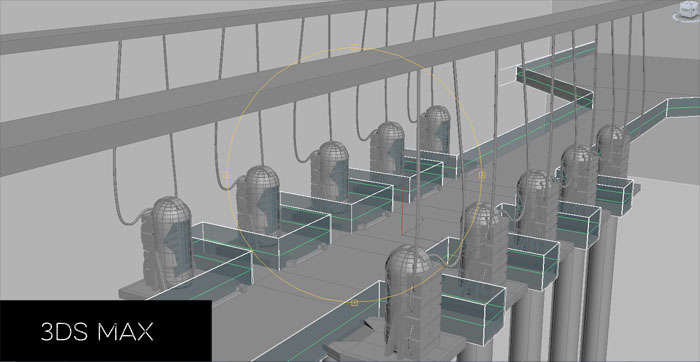
1. I first worked on the cryo pod, as this was the main point of interest for both the room and overall storyline mechanic. First I gathered some reference images of various cryo pods, abandoned rooms and sci fi rooms. The cryo pods ranged in shape from very rectangular, “industrial” looking ones, to curved and slick sci-fi ones. I settled on a look between the two, with a cylindrical shape as the base and form added around it with hoses and random-shapes-that-would-theoretically-do-fancy-medical-stuff. It took a good while to come up with the initial door shape in 3ds Max, I basically started all over twice after not liking what I came up with. Finally it started to take shape, and I played around with some bits of infrastructure around it – namely, the walkway. After a little bit of playing around I decided I liked the thought of the entire walkway floating in a large, tall room. I duplicated numerous cryo pods around and thought it made the room look much more interesting, rather than having just one. The room started to take shape just from trial and error and after about three hours or so I ended up with the mesh ready to import into Unity.

2. Now the mesh… into Unity… fairly straightforward. Here’s how it looked on initial import with nothing changed. Some incorrectly flipped normals here zzz!

3. I then went and added materials to all the objects. Seeing as I was limited on time, none of my models were going to be unwrapped, and I instead used simple diffuse/specular materials and relied on the lighting and particle effects to make them look nice. In the end these simple materials were actually enough to give the atmosphere that I wanted. Textures would ONLY have worked if they were done well, and in the time frame available that’s not really possible for me at my current levels; I think sub-par or standard textures would have actually detracted from the overall aesthetic. Either do it simply, or do it well – is my usual motto.

4. I then briefly played around with some lighting – this is just using a standard directional light. The light coming in from the ceiling windows looked quite nice. It started to look quite dark (P.S. On the Ludum Dare blog it’ll look wayyy darker due to the white background around it… but full screen it’s not as bad)… but I thought this felt more natural somehow. It was an abandoned, empty room essentially. You had to feel alone, and it felt more realistic to have a minimal light source. At this stage it was starting to come together however it didn’t feel quite right yet, until…

5. I started baking the lightmaps. This made the scene a lot more natural, in my opinion, as the previous lighting had all kinds of specular reflections which wouldn’t be there in real lighting. Now I’m actually quite a noob at this and it took a good few attempts at baking (slow zzz) until I got something I was okay with. Unfortunately I still don’t know how to get the lightmaps to be higher quality, as there is a lot of banding and low resolution artifacts in the final lightmapped scene which is quite noticeable. Still got a lot to learn. Anyway, the effect of the overall final scene was a combination of this lightmapping process in addition to some particle systems I added to give the room some dynamism and a bit more mood, instead of being completely static.
With regards to performance, this scene was actually not as bad as I thought it would end up (based on the naked eye, I did not run profiler or FPS tests) and webplayer compression did such a treat on the large lightmap sizes; however in a real deployment where I have more time I would definitely try to optimise things like the particle systems and the lightmap resolutions. The meshes themselves weren’t too bad with their poly counts and the room is quite minimal, but the objects could probably still be joined and batched.
Et voilà! There’s one I prepared earlier!
Hopefully this was interesting to some of you. I will be posting up more postmortems on the other aspects of development in the coming days.
– Camille
Tags: postmortem
This was the first time I used my new html5 toolkit I developed in the previous months. I was a little nervous about that, as I finished some important parts just hours before the start of LD.
After trying several ideas on paper, I stuck with a “connected cannons” concept, which is something I like to explore further. After about 8 hours of experimenting with different variations I had a finished looking game, and submitted it. I was pleasantly surprised to get multiple comments almost immediately, and the positive comments encouraged me to go on.
By the end of the day I had the game features pretty much down, but had this niggly feeling that I hadn’t tapped the full creative potential of my LD weekend. I kept thinking about other games that I wanted to make. Since my game was chaotic and trippy anyway, I thought about adding subgames at random points in the gameplay, with a contrasting style: neon (modern) in the main game, coarse pixels (retro) in the subgames. The subgames were going to be about my personal fixation with shooters. The idea is that the player can go into a subgame to save his/her ass when shields are low.
I quickly created some “programmer drawn” concept pixel art, which looked more satisfying than usual because I had decided to use only 6×6 pixels (8×8 with outline).

2/3 into the weekend, my game was about finished, with different types of cannon mirroring, 4 enemy types with variations, and 30 difficulty levels, and I had the feeling that putting more work in it would hit the “law of diminishing returns”. Time for subgames! I created a Frogger clone and the code for warping back and forth. I still had two hours left, so I created a Pacman clone as well.
The good!
The bad!
The game looks something like this:

And… the subgames go something like this:

So, this time I worked with my friend from Nice Penguins and my game will be on another acount.

You can find out here on the account of the Nice Penguins :http://www.ludumdare.com/compo/ludum-dare-30/?action=preview&uid=28578
This is my crew for making videogames : http://nicepenguins.tumblr.com/
Hope you’ll enjoy it 😉
This is our game for LD30, I could not update the game’s description until now, but here I want to share the link to it..
It is a puzzle/adventure plattformer, we had a lot of ideas but not enough time.. although we are not unhappy with it :)!
After LD30 we want to stick with the development.
And now: Try to escape from those aliens by solving the puzzles !
http://www.ludumdare.com/compo/ludum-dare-30/?action=preview&uid=33928
This was my second LD, so I took it with a more relaxed mindset than the previous one. I aimed for the 48h challenge but if I didn’t have something playable I could always enter the jam. Eventually I’d submit Elyseus for the 48h compo 😀

Tools used:
This was my first Ludum Dare using Unity.
For the graphics I used Photoshop as always.
For the music I used Music Creator 6 and my trusty midi keyboard.
Sfxr and Audacity for the sound effects, with some recordings of my own.

What went right:
Music and sound are hard to get right in so little time. In my last Ludum dare I didn’t even had time to make music. So for this one I gave it more priority.
The first morning I dedicated it to make some music to set the general mood for the game. I originally intended to make another variation for the underworld music, but left it as an optional goal which sadly I didn’t met. But overall I think the music fitted just well enough.
I also wanted to make some satisfying combat sounds. The sounds for the main enemies’ bones exploding deaths were made from a combination of Sfxr explosion sounds and a recording of some dirty cheap dice rolling 😛
The “clink” sound for the shield mechanic, which at first wasn’t even planned to exist but I had to implement it because the combat was so frustrating, was made by hitting my coffee maker with a pen!
Also, the world change effect worked surprisingly good, although it’s a bit incomplete. I wanted to fade the enemies from both worlds to be able to see what was coming, but only got it halfway and the appearing enemies just pop around when you are already in that world, so sometimes it’s a bit unfair.
What went wrong:
The main idea behind Elyseus was a lot bigger in my head, and big is always bad for a jam. For instance I originally planned to have a more simple combat to be able to make it quickly so I could make more features. Features which initially included online play invading other people’s games Dark Souls style… But that was way too much. So I focused on making sure what I did was at least fun to play.
The base objective of the game eventually ended as a cyclical infinite battle with the only possible ending being death. I wanted to make a more positive ending, but didn’t have enough time or any good and clear idea for it.
The other critical point was that to make the cyclical aspect, you could fight against another hero and without online implemented, I had to make an A.I. and A.I. is difficult to make. I spent the majority of the last day trying to make that work, even as shitty an A.I. it ended up being…
Conclusion:
It’s always a learning experience. At the end of it I had a playable game. In my opinion not enough fine tuned as I wanted but playable nontheless. I hope you have fun playing it! I want to know what you think!
Here’s the link to it: http://www.ludumdare.com/compo/ludum-dare-30/?action=preview&uid=36237
Tags: compo, postmortem, unity3d
Hey, I would like to take the opportunity to talk a little bit more about our game Uninhabitable..
A lot of people want to know more about the story line, And to be honest we are working on it 😛 We are figuring out little details about the lore..
But i will tell you a bit of the background story : Humanity is ruining earth and earth is in its dying days. So some governments decided to do an exploratory
expedition. Couple of years later, Earth got word from the exploratory team that they have found an earth like planet. Even though it is not 100% like earth.
Some of the resources can be used to “Revive” earth.. So they governments decided to build a Warp Portal, that can be used to ease the travel time between the two worlds.
While the portals where being build earth lost communication with the exploratory team. But that did not really matter to the governments, Because all that they needed to do is finish the portal
and they would have access to the new world. But they did not realize that the other planet was inhabited by an hostile alien race. Thus making the planet uninhabitable to us as humans.
So that is the back story. And i am glad we did the game for ludum dare.
The Future of the game:
We decided that this is something that we would like to work on. So we decided that we will be making this game into a multiplayer survival game.. With PVE in mind.
So for example, At night the gravity would change on this planet and get much lower. Thus allowing you to “Farm Items” but at night is also when the “Aliens” come out to play.
Thus you would need to work in a group to fight them off.
That is just some of the things we had in mind… And i assure you that we will make this game into one epic experience for our players.

Here is a map one might find useful for now

Please try our game Here
Hey, guys!
I’ll be livestreaming some Ludum Dare games in about 30min. You can send in your game here, and I’ll get to it as soon as possible I’ll start off with a couple that I already played and liked, and when the submissions are in, I’ll get to yours.
Don’t be a stranger, join me on Twitch!
That was a suprise! Nature Trial got a mention on Joystiq!
We were already pleased with how the game turned out, but it’s quite exciting and affirming to receive attention from the gaming press!
Ludum Dare 30 was our first time participating in the main dare, although we did take part in mini LD #53 as a warm up for our first proper dare. Despite taking part in the Jam we opted to limit ourselves to 48 hours anyway out of preference (and to allow ourselves the bank holiday Monday to relax).
So how did it go?

Things went much more smoothly this time (compared to the mini LD back in July) for two reasons:
As a result, we’ve ended up with a game which feels quite complete. We had the time to implement all our mechanics, multiple levels, splash, ending and game over screens, and aside from an issue with the controls, we managed to achieve a good level of polish.


We’re very pleased at what we managed to produce in 48 hours and with the feedback we’ve received so far, so we plan to expand the game further, the first items on the schedule will be the chopped content listed above, then we attempt some of the following:
This has been a really positive experience for us, the community is very supportive and we’ve received a bunch of helpful critique and plenty of kind words already. If you haven’t played Nature Trial yet, please do and give us some feedback!
Overall I’d say that the process of failing at mini LD #53 and examining how others managed to succeed taught us a lot and really helped us to improve.
Ludum Dare is the perfect environment to fail in, as there’s so much support to help you grow stronger. Thanks girls and boys!

As the title says, this was my first LD, and I’m proud to say that I actually “finished” a game.
I was streaming for almost 30 hours, here’s a 5 minute timelapse video of the weekend:
The game I created, HexConquest, is a turn based strategy game, made with Unity.
Here it is
When I woke up on saturday, the competition was already 7 hours in, and I tried to come up with an idea as fast as possible. The first idea was a strange tower defense game, but I tossed it pretty fast. I could reuse the tile generation code I created for the tower defense game for my second project. The second idea was to create a playing field controlled by different fractions, and the player should use his units to conquest the enemies’ zone to connect his main world to others. As you see in the list below, I didn’t get to actually implement the “zone”-thingy, that’s why the theme may not appear obvious…
I didn’t make a plan (one of the things I want to do different next time), so it was pretty chaotic. I spent a lot of time with the pathfinding, so I had to do the A.I. (a topic on which I don’t have any experience with at all) and game objective in a rush and couldn’t even start creating sound/music anymore.
Saturday:
Sunday:
The game has some serious usability problems, few bugs and calls for an overhaul. Until the next LD, I will spend time to improve everything and implement all the features I wanted in the beginning.
As I’m only a hobbyist developer, I learned more over a single weekend than I learned in all the months I was using Unity before, most likely because I never finished a game and never had to deal with every subject of development.
This was the first, but definitely not the last LD for me!
PS: Thanks for all the feedback on my game, it helps a lot.
Tags: LD30, ld48, postmortem, retrospective, timelapse
The beginning of the second day we met the whole team to obtain ideas about the project, which theme was Connected Worlds. After that we made a brainstorming and we get two possible ideas.
The first one we called it “Ships”, about a ship that was travelling through planets joining antennas, by what Connected Worlds was achieved. During the trip the character would find such enemies as asteroids, enemy ships or spatial garbage. The aim of the game was the conquest of planets.
The second idea was called “Connected Worlds”, about a climber that was climbing the different letters that form the word “W-O-R-L-D-S” up to achieving Connected Worlds. Finally, we decide to do a mix of both games, so that there was staying the better of every idea. The result was a game for web platform that treats of an astronaut that he was travelling connecting the antennas of diverse worlds, which were the letters of the word “WORLDS”.
Once everything was established, every component of the team worked in an individual way. Fran, the illustrator, realized several sketches in paper of the drawing of the astronaut for his later choice; Estanislao realized the design of the structure of the video game and the creation of the repository git of the project; Israel realized the sound search; Silverio created the first prototype and created the controls; and, finally, Carlota fulfilled the tester of the first prototype and she is the manager of the Diary of Binnacle.
t the beginning of the second day we met the whole team to obtain ideas about the project, which theme was Connected Worlds. After that we made a brainstorming and we get two possible ideas.
The first one we called it “Ships”, about a ship that was travelling through planets joining antennas, by what Connected Worlds was achieved. During the trip the character would find such enemies as asteroids, enemy ships or spatial garbage. The aim of the game was the conquest of planets.
The second idea was called “Connected Worlds”, about a climber that was climbing the different letters that form the word “W-O-R-L-D-S” up to achieving Connected Worlds. Finally, we decide to do a mix of both games, so that there was staying the better of every idea. The result was a game for web platform that treats of an astronaut that he was travelling connecting the antennas of diverse worlds, which were the letters of the word “WORLDS”.
Once everything was established, every component of the team worked in an individual way. Fran, the illustrator, realized several sketches in paper of the drawing of the astronaut for his later choice; Estanislao realized the design of the structure of the video game and the creation of the repository git of the project; Israel realized the sound search; Silverio created the first prototype and created the controls; and, finally, Carlota fulfilled the tester of the first prototype and she is the manager of the Diary of Binnacle.


