Turing Compete by Kaisean Games

Description
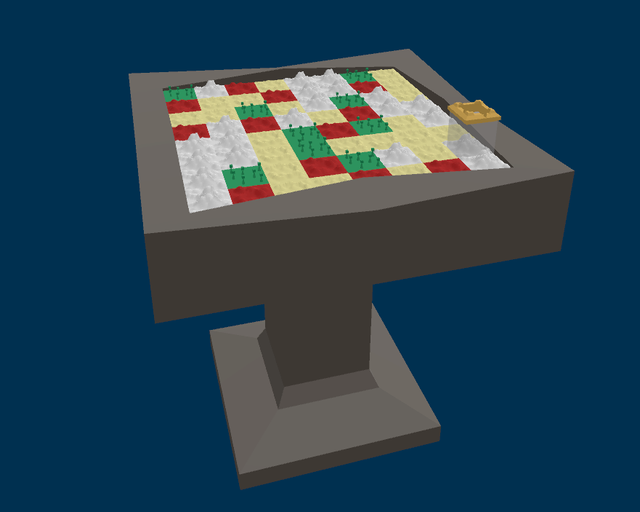
In this game, you need to program a 2D Turing machine to manipulate the terrain. Depending on what you get after 1000 cycles, you would score points.
HINT: If you are too lazy to create a turing machine that actually does something, try generating some random transition rules (Shift-click).
Important
Unfortunatelly, I failed to finish the scoring part in time, so currently, it's only a creative mode and there's no COMPETE in Turing Complete.
Links

Ratings
| Overall | 670th | 2.8⭐ | 27🧑⚖️ |
| Fun | 699th | 2.4⭐ | 27🧑⚖️ |
| Innovation | 55th | 3.92⭐ | 27🧑⚖️ |
| Theme | 645th | 2.76⭐ | 27🧑⚖️ |
| Graphics | 552th | 2.96⭐ | 27🧑⚖️ |
| Given | 39🗳️ | 45🗨️ |
Really nice clean visuals btw!
Not my kind of game, I must say, but I found it enjoyable and I had fun trying to make something that works (and I even made one, hah!). As far as I know, this kind of games have a lot of potential and there are some games like this on Steam, so you could improve and expand this, I'm sure a lot of people can find this interesting.
Seeing the screenshots and stuff, I can tell that this is potentially a really cool terrain generator, and I'm sure it feels awesome once you get everything working right. But I couldn't really get past step one and I kind of had to give up...Perhaps reworking your tutorial to something that's not just front-loaded text on the title screen before you even see the game board and what you can interact with would go a long way. Something that sort of guides the player more.
Another option would be to "simplify" what the player is working with. I can understand why you might not want to do this, as the concept of generating a unique terrain with a simple TM sounds (and IS) pretty bad-ass (I still think it's an awesome idea), but folks who maybe have no idea what a Turing Machine are doomed to be lost and confused as to how to operate you game, because there are too many things for them to tinker with, and the rewards for randomly fiddling with it are few and far between.
I'm curious to see what you plan to do next if you decide to continue working on this. :) Best of luck, it really is a cool idea!
Might I suggest using icons instead of letters in the list of instructions - one of the things I had to figure out is which letter meant which thing in the instruction - is it a state? a direction, a terrain type?
Some polish and some goals and this can definitely be a game that would get me interested.
Good job!
Maybe a mini tutorial would have been so much more demonstrating because since i'm not an english-speaker, the "instruction" part got me reading again for too long and still don't understand.
It lacked too of sound effects in my opinion. Not music really, but just feedbacks would have been great !
Anyway i just found the idea great, good job !
To my understanding the program:
```
(*|*) -> (A|=|=)
(A|GCHMD) -> (A|S|E)
(A|S) -> (=|=|S)
```
shall cover the terrain with water, but actually it does nothing not even counting cycles :s
Thank you sincerely for your interest. :)
I'm not really sure why the orange generating contraption stops moving once you set in new conditions, even with the speed set to something that is, say, medium. If I save my changes and it stops moving, I have to click the speed button rapidly to go back the desired speed. Well, I did think the fastest speed was very funny, especially when the generator is only terraforming in a very small area and the squares just go flying off the board. XD
It's an interesting game, though it would be in need of an in-game tutorial for casual players, especially if there is going to be a competitive mode.
I'm no CS grad, so I was a little scared at first but I managed to get to the point of clearing the board with all water.
This may defeat the whole point of the Turing Complete thing, but I feel like in order to do anything more complex in 2D, you need to at least be able to reset and check a cycle counter. That way we could do rudimentary positional checks. But then I guess a *counter* isn't a *state*, so it doesn't enter into it being a state machine?
For instance, I wanted to try and do a checkerboard pattern, but because the board positions wrap around, I couldn't figure out how I would move up instead of across once I had completed a row. Maybe another option would be to not wrap around, and have a check to see if you *could* move in a direction. But again, that wouldn't be a state so I dunno.
Lots to think about, which is great for an LD entry!